Collaborative Multi-Agent Framework as an Enhancing Structure for AI-Generated Medical Assessment Questions
-
By
-
Zhehan Jiang
-
September 14, 2026
Collaborative Multi-Agent Framework for AI-Generated Medical Assessment Questions
Overview
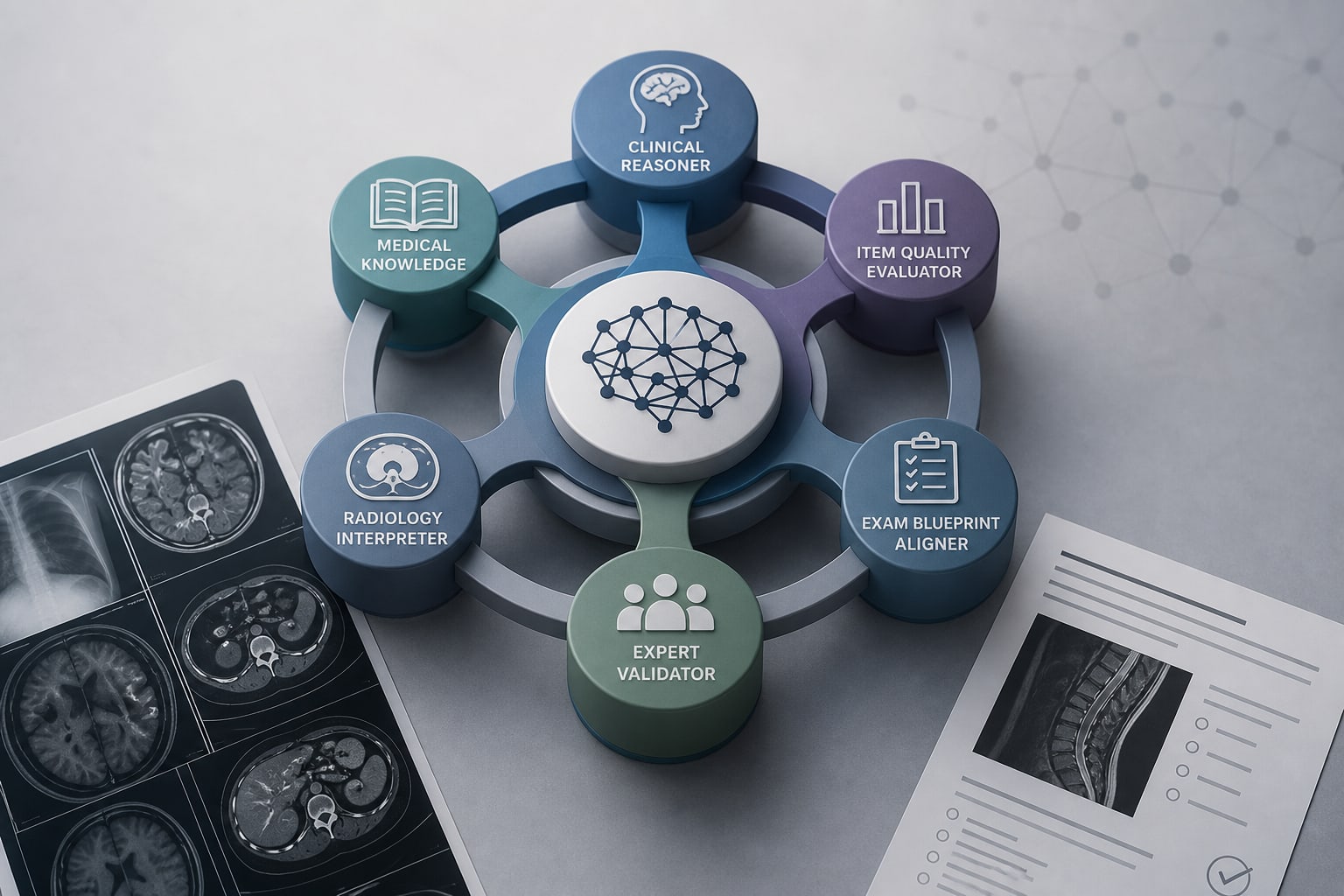
This study presents the Multi-Agent Item Development (MAID) framework, which enhances the generation of medical assessment questions by employing specialized AI agents in a collaborative workflow.
Background
The integration of AI in medical education, particularly in generating examination questions, is gaining traction. Previous studies have shown that single-model AI systems struggle with complex clinical reasoning tasks.
Data Highlights
No numerical or trial data was provided in the source material.
Key Findings
- The MAID framework utilizes multiple specialized AI agents to enhance the quality of medical assessment questions.
- Each agent in the framework has defined roles, including an Author Agent, Reviewer Agents, and an Editor Agent, mirroring human collaborative workflows.
- Reviewer Agents assess various aspects of the generated items, including factual accuracy, clinical plausibility, and item-writing quality.
- The framework allows for iterative revisions based on independent reviews, addressing identified weaknesses in AI-generated items.
- MAID aims to overcome the limitations of single-model AI systems, particularly in producing higher-order reasoning questions.
Clinical Implications
The MAID framework aims to ensure that generated assessment items meet established quality standards.
Conclusion
The development of the MAID framework represents a significant step towards enhancing the quality of AI-generated medical assessment questions through structured collaboration among specialized agents.
Related Resources & Content
- Qian et al., npj Digital Medicine, 2026 -- Performance of DeepSeek in the generation of in-training examination questions in radiology resident education
- Multi-Agent collaboration as a complementary architecture for AI-generated medical examination items, npj Digital Medicine, 2026
- npj Digital Medicine — Benchmarking large language model-based agent systems for clinical decision tasks
- Journal of Medical Internet Research (JMIR) — Enhancing Physician Resilience to Generative AI: Multilevel Framework for Shared Authority, Verification, and Skill Preservation
- JMIR Medical Informatics — A Multiassessment and Multiprofessional Agents Approach for Medical Chatbot Risk Estimation: Development and Evaluation Study
- npj Digital Medicine — A New Benchmark for Assessing Safety and Efficacy of Medical Large Language Models in Clinical Settings
- ACR Approves First Practice Parameter for Imaging Artificial Intelligence
- AI Policy Development Checklist
- Teaching AI for Radiology Applications: A Multisociety-Recommended Syllabus from the AAPM, ACR, RSNA, and SIIM | Radiology: Artificial Intelligence
- Important Updates to USMLE Policies and Procedures Regarding Irregular Behavior | USMLE
- A Primer for Using Generative Artificial Intelligence in Medical Education - NBME
- Can large language models generate exam questions comparable to humans? A systematic review and meta-analysis study in medical education - PubMed
- Performance of DeepSeek in the generation of in-training examination questions in radiology resident education | npj Digital Medicine
- Performance of DeepSeek in the generation of in-training examination questions in radiology resident education - PMC
- Frontiers | Assessing multiple-choice question quality in internal medicine: a comparative analysis of three large language models against expert consensus
- Multi-Agent collaboration as a complementary architecture for AI-generated medical examination items | npj Digital Medicine
- Collaborative intelligence in AI: Evaluating the performance of a council of AIs on the USMLE - PMC
- Supporting Radiology Resident Education and Clinical Decision-Making With Large Language Models: Comparative Study of Reasoning Models DeepSeek-R1 and ChatGPT-o1 - PMC
Based on findings from:
Multi-Agent collaboration as a complementary architecture for AI-generated medical examination items
Zhehan Jiang. Npj Digital Medicine, 2026.
https://www.nature.com/articles/s41746-026-03187-z
This content is an AI-generated, fully rewritten summary based on a published scholarly article. It does not reproduce the original text and is not a substitute for the original publication. Readers are encouraged to consult the source for full context, data, and methodology.