Clinical Report: An Automated Clinical Platform for the Production of CAR-γδ T Cells
Overview
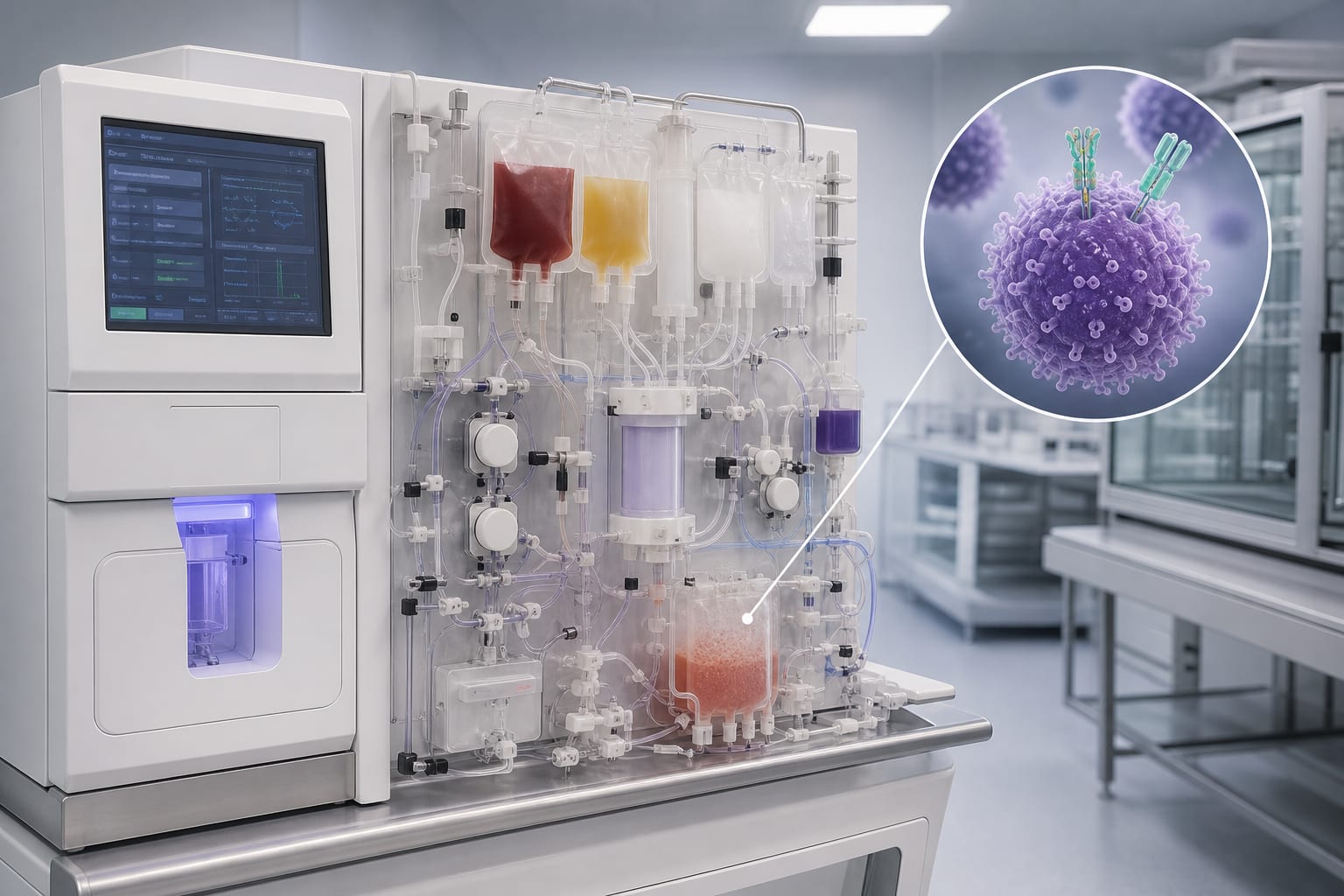
This study presents an automated platform for the efficient production of CAR-γδ T cells, achieving significant expansion and transduction efficiency. The findings highlight the potential of this technology for large-scale manufacturing of γδ T cells for immunotherapy applications.
Background
Gamma delta (γδ) T cells are emerging as a promising alternative for adoptive immunotherapy due to their unique ability to recognize tumor cells without the need for MHC molecules. Their low risk of graft-versus-host disease and potential for off-the-shelf therapies make them an attractive option in cancer treatment. Effective methods for their activation and expansion are crucial for clinical applications.
Data Highlights
Parameter
Value
αβ T cell depletion
4.59-log
B cell depletion
3.97-log
Vγ9Vδ2 T cell increase
374-fold
Final cell count
6.64 x 10⁹ (4.76×10⁹ – 8.98×10⁹)
Transduction efficiency
57.4%
Average γδ T cell composition
89.83%
Residual αβ T cells
0.012%
Vector copy number
1.4
Key Findings
The automated platform achieved a 374-fold increase in Vγ9Vδ2 T cells.
Mean transduction efficiency of CAR-γδ T cells was 57.4% using a GMP-grade lentiviral vector.
Final product composition included 89.83% γδ T cells and minimal residual αβ T cells.
Functional assays confirmed robust anti-tumor activity against leukemic cell lines.
The platform ensures compliance with GMP standards for reproducibility in cell manufacturing.
Clinical Implications
The automated production of CAR-γδ T cells may facilitate the development of off-the-shelf immunotherapies, potentially improving access to effective cancer treatments. Clinicians should consider the implications of this technology for enhancing patient outcomes in adoptive cell therapy.
Conclusion
The study demonstrates the feasibility of large-scale manufacturing of CAR-γδ T cells using an automated platform, paving the way for future clinical applications in immunotherapy.
by Jan Kuska, Julia Kostyra, Lorraine Pinot, Evgeny Egorov, Nojan Jelveh, Lilian A. Martinez Carrera, Congcong Zhang, Svetlana Khorkova, Mario Assenmacher, Rimas Orentas, Sabine Mueller, José Villacorta Hidalgo