Caffeine use disorder and analgesic dependence in medication-overuse headache: insights into an underrecognized relationship - Report - MDSpire

Caffeine use disorder and analgesic dependence in medication-overuse headache: insights into an underrecognized relationship

  • By

  • Rehab Magdy

  • Amr Hassan

  • Mona Hussein

  • Alaa Elmazny

  • Osama Yacoub

  • Mohamed Abdelghaffar

  • Nourhan Abdelmohsen Taha

  • Ahmed Essmat

  • May M. Fayez

  • Nahla Merghany

  • Anas Elgenidi

  • Ahmed Dahshan

  • July 13, 2026

Share

Clinical Report: Exploring the Connection Between Caffeine Use Disorder and Analgesic Dependence

Overview

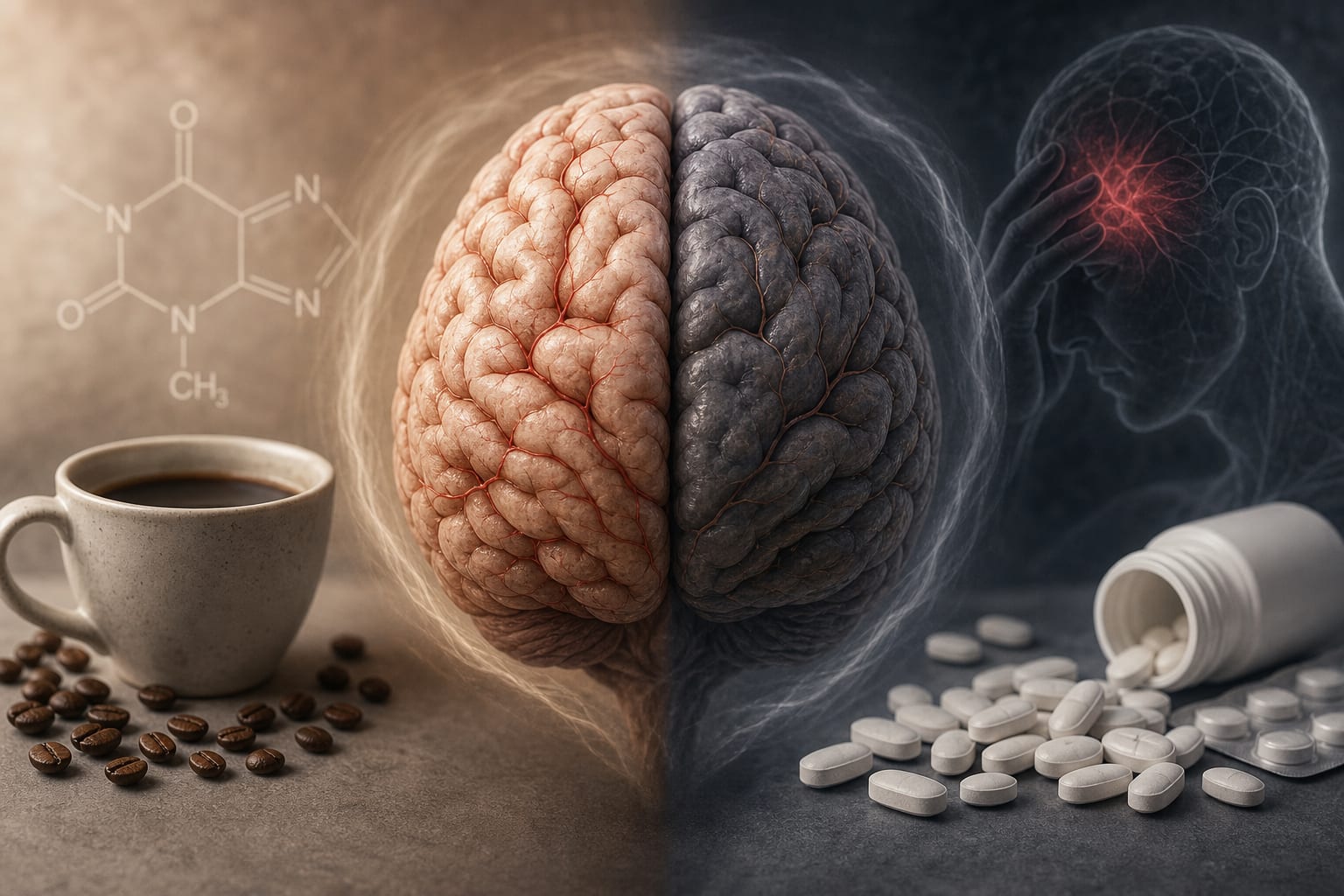
This study investigates the relationship between caffeine use disorder and analgesic dependence in patients with medication-overuse headache (MOH). Findings indicate that MOH patients exhibit higher caffeine consumption and greater psychological distress compared to non-MOH patients.

Background

Caffeine has a complex role in headache disorders, acting both as an analgesic and a potential contributor to headache chronification. Understanding its relationship with medication-overuse headache (MOH) is crucial, as MOH is a common condition that can significantly impact patients' quality of life.

Data Highlights

MeasureMOH PatientsNon-MOH Patients
Monthly Headache Days (MHD)HigherLower
Acute Medication Days (AMD)HigherLower
Caffeine Use Disorder Questionnaire (CUDQ) ScoreMedian 10Median 7
Heavy Caffeine Consumption23.8%9.3%

Key Findings

  • 33.2% of patients met ICHD-3 criteria for MOH.
  • MOH patients had significantly higher headache burden and psychological distress.
  • Heavy caffeine consumption was more prevalent in MOH patients (23.8% vs. 9.3%).
  • Caffeine use disorder scores correlated positively with headache impact and psychological distress measures.
  • Analgesic dependence severity was associated with caffeine use disorder in MOH patients.

Clinical Implications

Healthcare providers should assess caffeine consumption behaviors in patients with medication-overuse headache.

Conclusion

The study found an association between caffeine use disorder and analgesic dependence in patients with medication-overuse headache.

Related Resources & Content

  1. Drugs - Real World Outcomes, 2015 -- The Frequency of Central Nervous System Polypharmacy and Its Links to Overdose and Suicidal Behaviors in Veterans of the Iraq and Afghanistan Conflicts Receiving VA Care (2010–2011)
  2. Frontiers in Neurology, 2026 -- Primary headache disorders susceptibility is associated with fasting-related headache: evidence from a multinational study across 14 countries
  3. American Journal of Epidemiology, 2018 -- Opioid-Related Harms and the Impact of Abuse-Deterrent Formulations in North Carolina: A Study from 2010 to 2018
  4. Drugs - Real World Outcomes, 2021 -- Inappropriate Medication Usage Among Community-Dwelling Older Adults with Alzheimer’s Disease and Related Dementias: A Cross-Sectional Study
  5. Full article, 2025 -- Is medication-overuse headache an addiction disorder?
  6. Peripheral nerve block in patients with medication-overuse headache: systematic review and meta-analysis | BMC Neurology | Springer Nature Link, 2026
  7. Caffeine and Headache: Exploring the Multifaceted Relationship - PubMed, 2026
  8. Full article: Is medication-overuse headache an addiction disorder?
  9. Peripheral nerve block in patients with medication-overuse headache: systematic review and meta-analysis | BMC Neurology | Springer Nature Link
  10. Caffeine and Headache: Exploring the Multifaceted Relationship - PubMed

Original Source(s)

Related Content