Shared inflammatory architecture and therapeutic tensions between psoriasis and Crohn’s disease - Report - MDSpire

Shared inflammatory architecture and therapeutic tensions between psoriasis and Crohn’s disease

  • By

  • Xiaoou Wang

  • Jitong Li

  • Keying Yu

  • Xianbo Wu

  • Quan Luo

  • June 26, 2026

  • 0 min

Share

Common Inflammatory Pathways and Treatment Challenges in Psoriasis and Crohn’s Disease

Overview

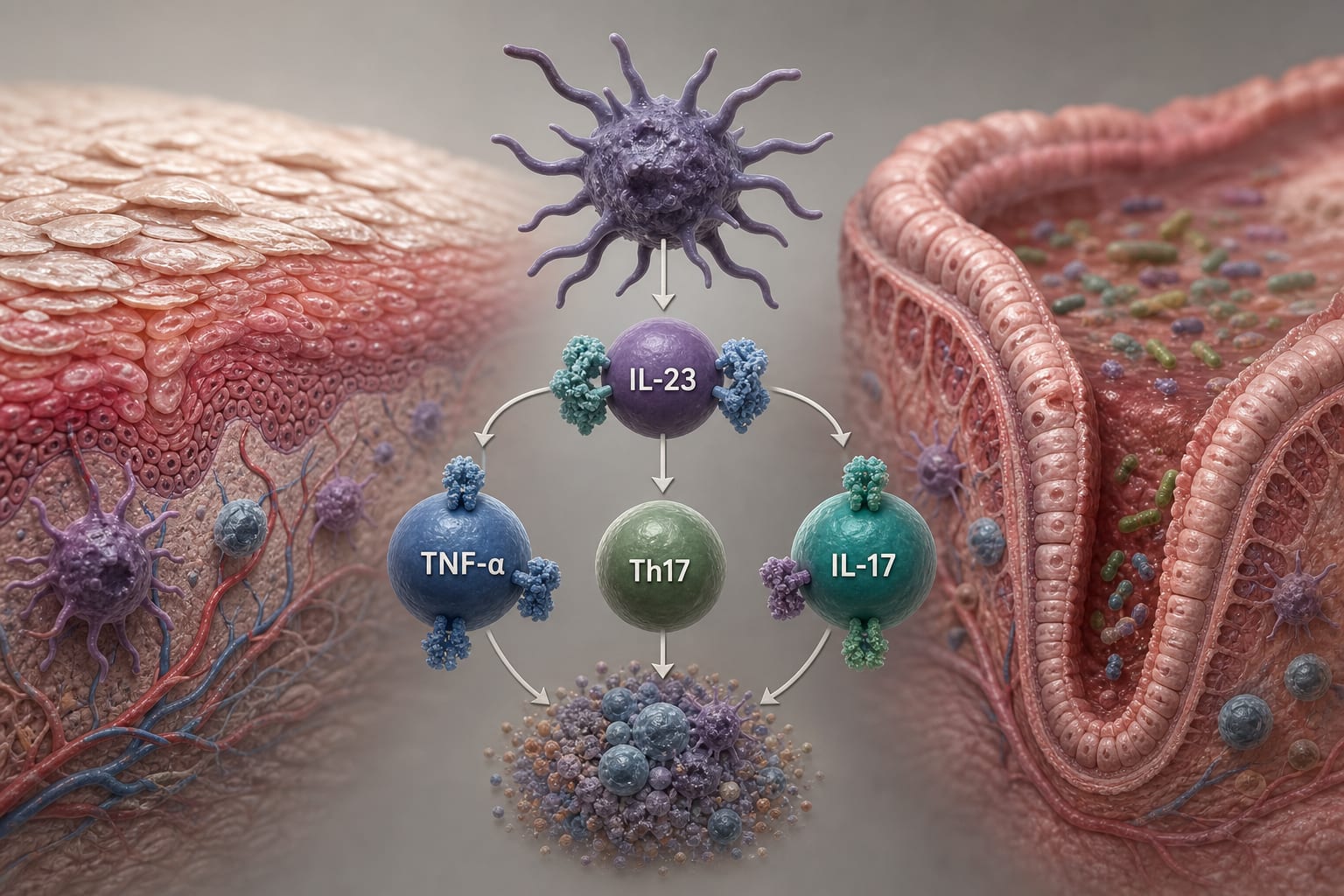
This review highlights the partial immune convergence between psoriasis and Crohn’s disease, emphasizing shared inflammatory pathways such as TNF-α and IL-23.

Background

Psoriasis and Crohn’s disease are chronic immune-mediated inflammatory diseases that affect different barrier organs but share overlapping immune mechanisms.

Data Highlights

No numerical data or trial data provided in the source material.

Key Findings

  • Psoriasis and Crohn’s disease exhibit partial immune convergence shaped by tissue context.
  • Shared upstream pathways include TNF-α and IL-23-centered type 17 immunity.
  • Downstream effector pathways, particularly IL-17 responses, differ based on organ-specific factors.
  • Patients with psoriasis may have an increased prevalence of inflammatory bowel disease, particularly in severe cases.
  • Therapeutic options include TNF inhibitors and IL-23 inhibitors.

Clinical Implications

Consideration of shared immune pathways is important when treating patients with psoriasis and Crohn’s disease.

Conclusion

The relationship between psoriasis and Crohn’s disease highlights the importance of understanding immune mechanisms.

Related Resources & Content

  1. Frontiers in Immunology, 2026 -- Psoriasis as a systemic inflammatory disease: an immune set-point framework for comorbidities and relapse
  2. Dermatology and Therapy, 2026 -- The Role of Inflammatory Biomarkers in Disease Severity and Treatment Response across Psoriasis, Atopic Dermatitis, and Hidradenitis Suppurativa—A Narrative Review
  3. Journal of Gastroenterology, 2020 -- Characterizing the phenotype, underlying mechanisms, and management of spondyloarthritis linked to Crohn's disease
  4. ECCO Guidelines on Therapeutics in Crohn’s Disease: Medical Treatment | Journal of Crohn's and Colitis, 2024
  5. AGA Living Clinical Practice Guideline on the Pharmacologic Management of Moderate-to-Severe Crohn’s Disease - ScienceDirect, 2026
  6. The New Gastroenterologist — Choosing Treatment Options for Moderate to Severe Inflammatory Bowel Disease: Essential Considerations in the Decision-Making Process
  7. Risankizumab versus Ustekinumab for Moderate-to-Severe Crohn’s Disease | New England Journal of Medicine
  8. ECCO Guidelines on Therapeutics in Crohn’s Disease: Medical Treatment | Journal of Crohn's and Colitis | Oxford Academic
  9. AGA Living Clinical Practice Guideline on the Pharmacologic Management of Moderate-to-Severe Crohn’s Disease - ScienceDirect
  10. S3 Guideline for the treatment of psoriasis vulgaris, adapted from EuroGuiDerm - part 1: Treatment recommendations and monitoring - PubMed
  11. U.S. FDA approves TREMFYA® (guselkumab), the first and only IL-23 inhibitor offering both subcutaneous and intravenous induction options, for adult patients with moderately to severely active Crohn's disease
  12. Guselkumab versus secukinumab for the treatment of moderate-to-severe psoriasis (ECLIPSE): results from a phase 3, randomised controlled trial - ScienceDirect
  13. COSENTYX (secukinumab) Highlights of Prescribing Information
  14. S3 Guideline for the Treatment of Psoriasis vulgaris, adapted from EuroGuiDerm – part 2: Specific clinical and comorbid situations - PMC

Original Source(s)

Related Content