Asymmetric surge optimization during peak seasons: a discrete-event simulation of centralized fast-track operating rooms at a China National Children's Medical Center - Report - MDSpire
Conexiant’s news site is now MDSpire News. Learn more
Advertisement
Optimizing Asymmetric Surgical Demand During Peak Seasons: A Discrete-Event Simulation of Centralized Fast-Track Operating Rooms at a Pediatric Medical Center in China
Clinical Report: Optimizing Asymmetric Surgical Demand During Peak Seasons
Overview
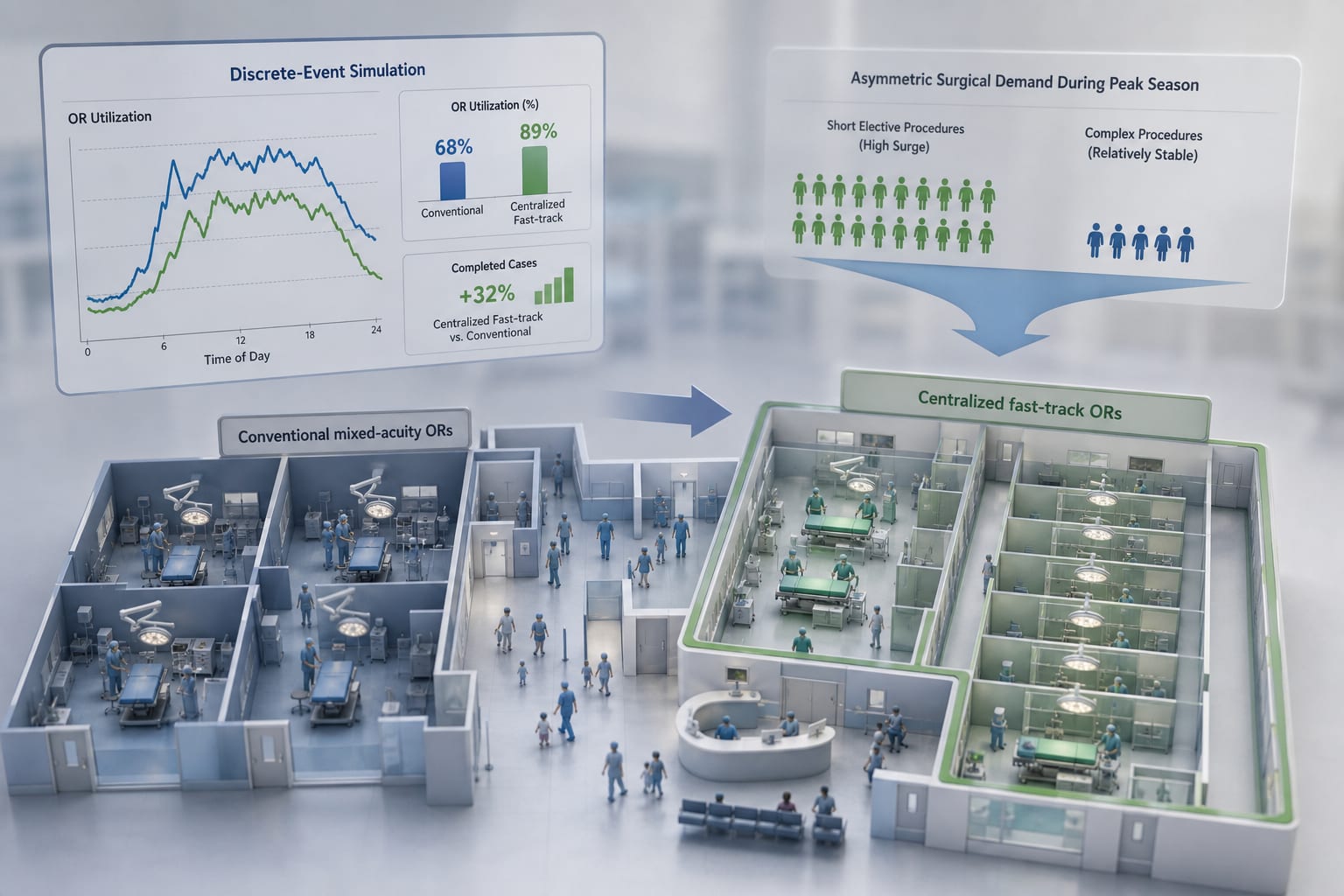
This study employs discrete-event simulation to evaluate a centralized fast-track operating room strategy at a pediatric medical center in China, addressing the surge in pediatric surgeries during peak seasons.
Background
Pediatric medical centers in China face operational challenges during peak seasons, particularly during summer holidays when there is a surge in short elective surgeries. This study explores a discrete-event simulation model to enhance operating room efficiency and throughput during these critical periods.
Data Highlights
Scenario
Mean Total Throughput (cases)
Increase Over Baseline (%)
15-minute turnover reduction
3,588.7
38.29
10-minute turnover reduction
3,208.3
23.63
Key Findings
The optimized 15-minute turnover-reduction scenario achieved a mean throughput of 3,588.7 cases.
This represents a 38.29% increase over the historical baseline of 2,595 cases.
The 10-minute turnover reduction scenario resulted in a mean throughput of 3,208.3 cases, a 23.63% increase.
Centralized fast-track OR allocation protected complex surgery throughput while increasing capacity for short procedures.
Traditional mixed-acuity scheduling led to inefficiencies and idle time.
Implementation of the proposed model depends on staffing flexibility and local cost considerations.
Clinical Implications
The findings suggest that pediatric surgical centers may benefit from adopting centralized fast-track operating room strategies to manage seasonal surges effectively. By optimizing turnover times and separating short procedures from complex surgeries, facilities can enhance overall surgical throughput while maintaining access to necessary complex care.
Conclusion
The study demonstrates the use of discrete-event simulation in optimizing surgical demand management in pediatric settings during peak seasons.