Comparative analysis of two modified TLICS systems in guiding surgical decision-making for thoracolumbar fractures - Report - MDSpire

Comparative analysis of two modified TLICS systems in guiding surgical decision-making for thoracolumbar fractures

  • By

  • Han Zhang

  • Junwei Feng

  • Bing Wu

  • Jiayi Dou

  • Jiale Zhang

  • Huibin Luo

  • Binbin Tang

  • Chen Chen

  • Liqiang Dong

  • Zhongcheng An

  • Tingyuan Lai

  • June 26, 2026

  • 0 min

Share

Clinical Report: Evaluation of Two Altered TLICS Frameworks in Influencing Surgical Choices for Thoracolumbar Fractures

Overview

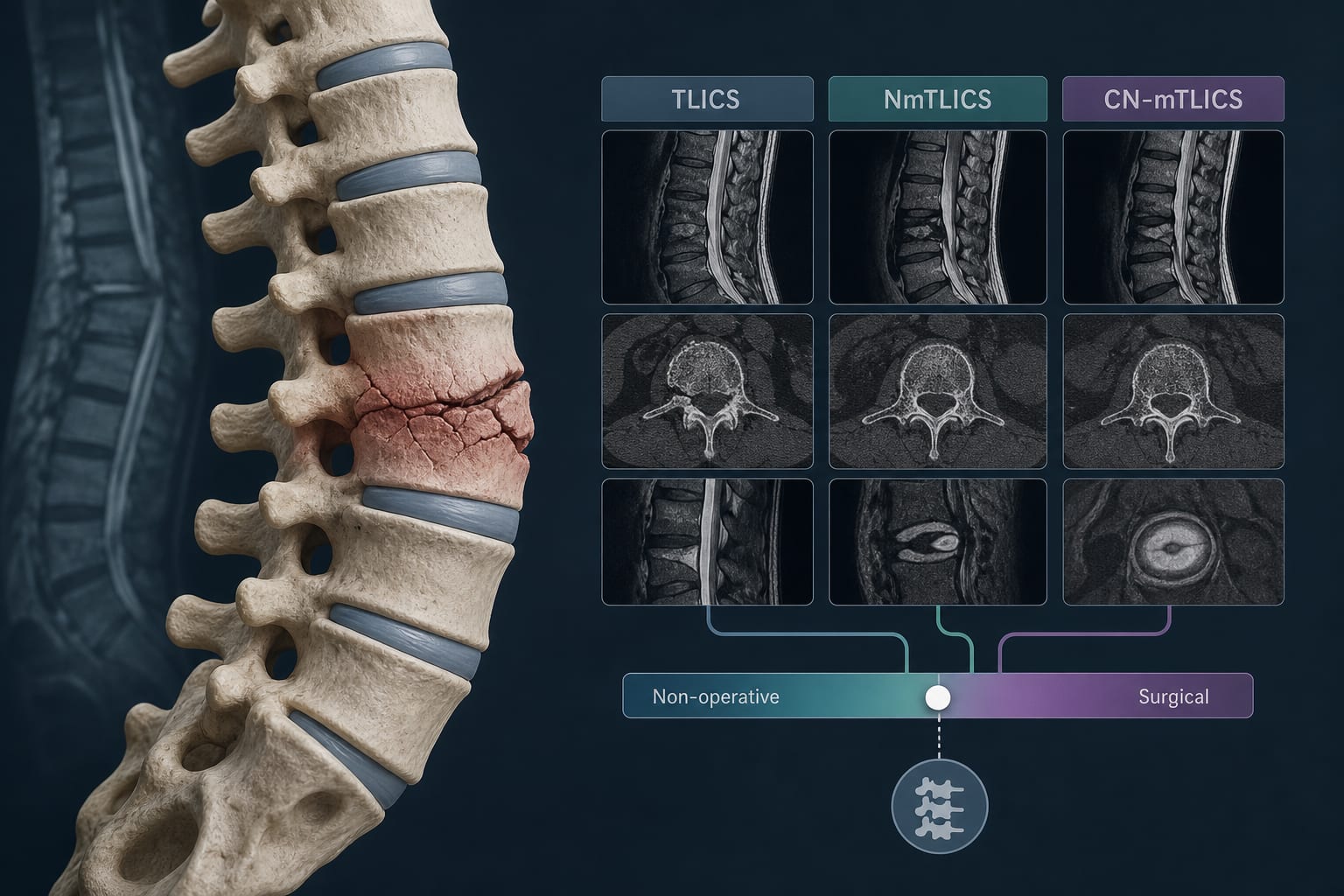
This study compares the Novel Modified Thoracolumbar Injury Classification System (NmTLICS) and the China-modified Thoracolumbar Injury Classification System (CN-mTLICS) in guiding surgical decisions for thoracolumbar fractures.

Background

Thoracolumbar fractures represent a significant portion of spinal injuries, often leading to severe complications if not properly managed. The traditional TLICS has limitations in accurately assessing the need for surgical intervention, particularly in cases of severe burst fractures. Modifications to TLICS, such as NmTLICS and CN-mTLICS, aim to improve diagnostic accuracy and treatment outcomes.

Data Highlights

Scoring SystemInter-Observer Agreement (κ)SensitivityNegative Predictive Value
TLICS0.849Specific numerical valueSpecific numerical value
NmTLICS0.896Specific numerical valueSpecific numerical value
CN-mTLICS0.866Specific numerical valueSpecific numerical value

Key Findings

  • NmTLICS and CN-mTLICS showed higher inter-observer agreement compared to traditional TLICS.
  • Both modified systems demonstrated higher sensitivity and negative predictive value compared to TLICS (P < 0.01).
  • NmTLICS identified 6 cases of severe vertebral collapse missed by CN-mTLICS.
  • CN-mTLICS detected 5 cases of severe intervertebral disc injury missed by NmTLICS.
  • No significant difference in specificity was observed between the modified systems and TLICS (P > 0.05).

Clinical Implications

The findings suggest that NmTLICS and CN-mTLICS may enhance surgical decision-making for thoracolumbar fractures, particularly in identifying cases that require surgical intervention. Clinicians should consider these modified frameworks to improve patient outcomes.

Conclusion

Both NmTLICS and CN-mTLICS effectively reduce the under-triage of severe burst fractures compared to TLICS.

Related Resources & Content

  1. Frontiers in Surgery, 2026 -- Reliability and reproducibility of the modified thoracolumbar injury classification and severity score and the thoracolumbar AO spine injury score for guiding surgical decision-making in thoracolumbar fractures
  2. Assessment of TLICS and AOSpine Injury Scoring Systems for Surgical Intervention in Pediatric Spinal Trauma
  3. Frontiers in Surgery, 2026 -- An innovative 2D optical navigation workflow for percutaneous pedicle screw fixation in thoracolumbar fractures: comparison with O-arm 3D navigation
  4. Surgical Approaches and Indications for Managing Traumatic Lumbosacral Instability: Part 2
  5. Which is the Superior Thoracolumbar Injury Classification Tool? TLICS Versus AOSpine 2013: A Systematic Review
  6. Classification of Injury - Congress of Neurological Surgeons (CNS)
  7. Which is the Superior Thoracolumbar Injury Classification Tool? TLICS Versus AOSpine 2013: A Systematic Review
  8. 2. Classification of Injury - Congress of Neurological Surgeons (CNS)
  9. Operative versus Conservative Management of AO Spine A3 and A4 Thoracolumbar Burst Fractures: A Systematic Review of Outcomes, Risk Factors, and Anatomical Level - ScienceDirect

Original Source(s)

Related Content