A multi-task deep learning framework for simultaneous prediction of microsatellite instability and tumor mutational burden in gastric cancer from histopathological images - Report - MDSpire
Advertisement
A multi-task deep learning framework for simultaneous prediction of microsatellite instability and tumor mutational burden in gastric cancer from histopathological images
Clinical Report: Deep Learning for MSI and TMB Assessment in Gastric Cancer
Overview
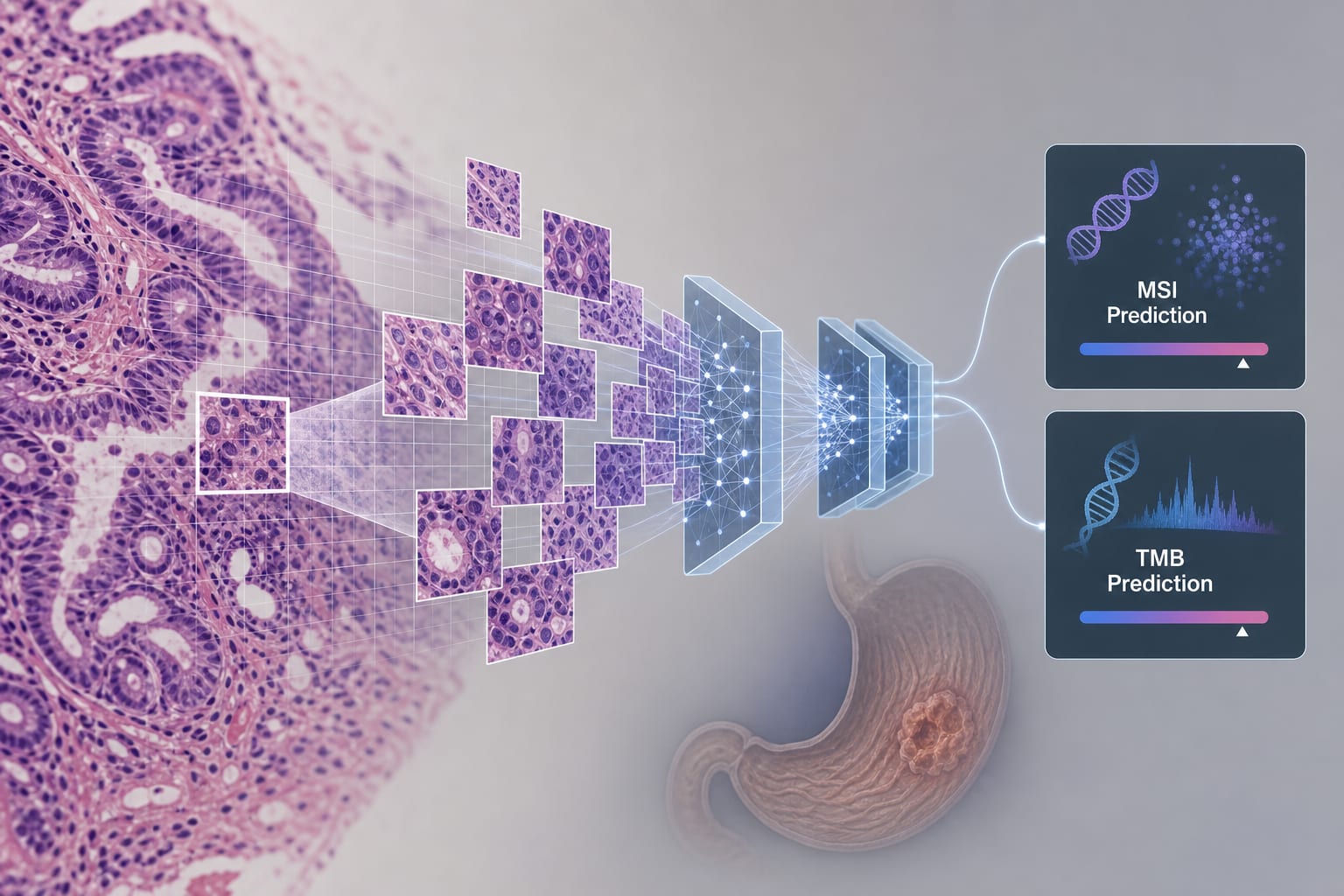
This study presents a novel deep learning framework that accurately predicts microsatellite instability (MSI) and tumor mutational burden (TMB) from histopathological images. The model demonstrates robust performance, suggesting its potential as a cost-effective tool for guiding immunotherapy in gastric cancer.
Background
Gastric cancer is a leading cause of cancer-related mortality, with a significant need for effective biomarkers to guide immunotherapy. Current reliance on costly next-generation sequencing limits the widespread adoption of critical biomarkers like MSI and TMB. This study explores the feasibility of using deep learning to predict these biomarkers from routine histopathological images, potentially transforming clinical practice.
Data Highlights
Biomarker
AUC (Internal Validation)
AUC (External Validation)
MSI
0.828
0.78
TMB
0.836
0.74
Key Findings
The deep learning model achieved AUC values of 0.828 for MSI and 0.836 for TMB in internal validation.
Performance decreased in external validation, with AUCs of 0.78 for MSI and 0.74 for TMB.
Attention heatmaps indicated spatial concordance between predictive regions for MSI and TMB.
The model integrated whole slide images and clinical data for enhanced predictive accuracy.
Robustness was validated using a cohort of 121 gastric cancer patients from an external center.
Clinical Implications
The proposed deep learning framework could serve as a preliminary screening tool for MSI and TMB, facilitating timely immunotherapy decisions in gastric cancer. Its integration into routine clinical workflows may lower costs and improve access to precision oncology.
Conclusion
This study demonstrates the potential of a unified deep learning approach to predict key biomarkers for immunotherapy in gastric cancer, highlighting its promise in enhancing clinical decision-making despite challenges in generalizability.