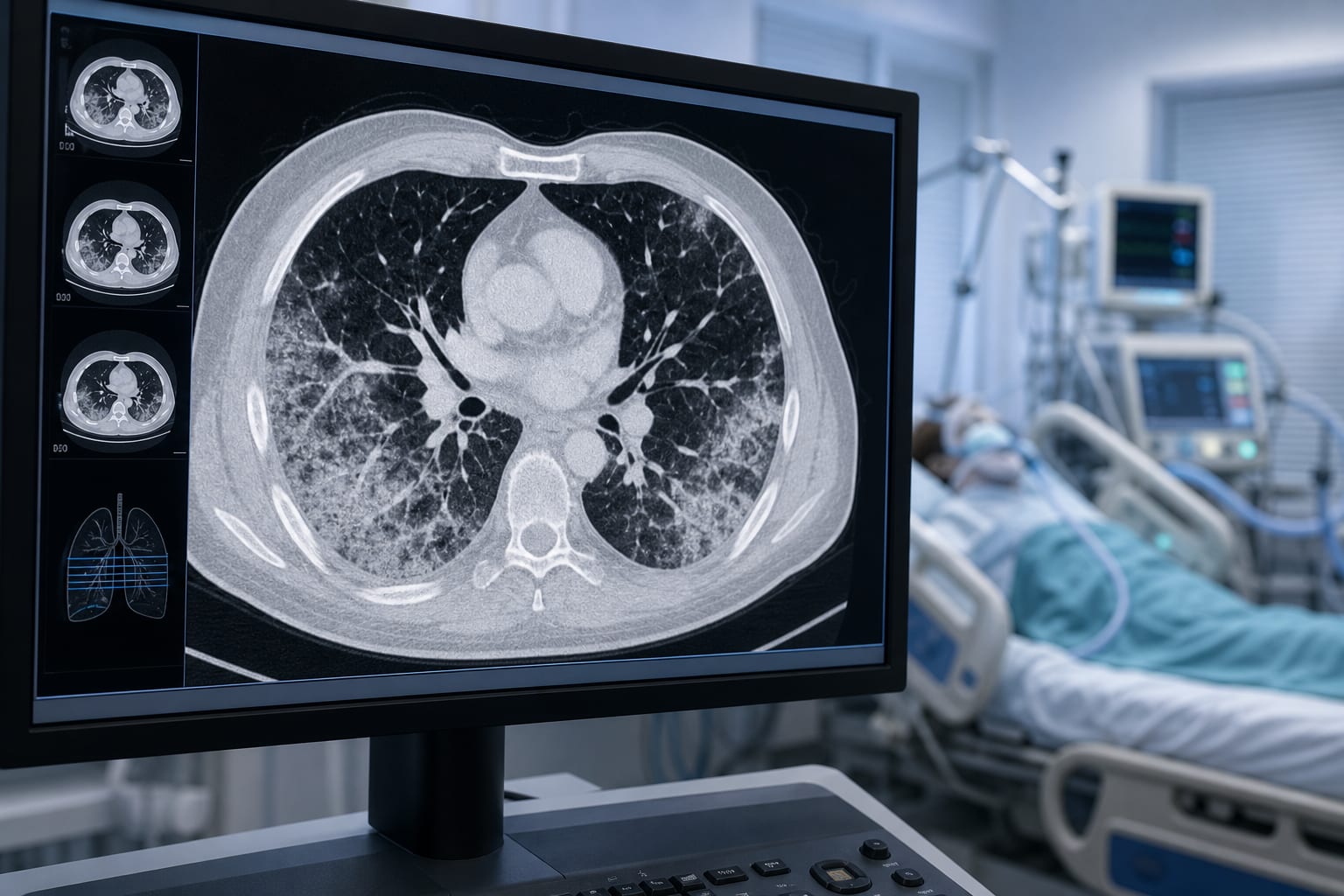
Employing Chest CT Imaging for Diagnosing and Managing COVID-19 Infections in Emergency Intensive Care Settings
-
By
-
Linling Chen
-
Yongjia Wu
-
June 5, 2026
Clinical Report: Employing Chest CT Imaging for Diagnosing COVID-19
Overview
This study evaluates the diagnostic validity of chest CT imaging in symptomatic COVID-19 patients when RT-PCR is unavailable. Findings indicate that chest CT is a crucial tool for early detection and management of COVID-19, particularly within 5 days of symptom onset.
Background
The COVID-19 pandemic has created significant challenges in diagnosis, especially when RT-PCR testing is limited. Accurate and timely diagnosis is essential for effective infection control and resource allocation in emergency and intensive care settings. Chest CT imaging has emerged as a valuable adjunct diagnostic tool, particularly in situations where RT-PCR results are delayed or unavailable.
Data Highlights
| Parameter | Value |
|---|---|
| Mean Age | 67.2 years |
| Male Percentage | 64.9% |
| Common CT Finding | Ground-glass opacity (56.8%) |
Key Findings
- Chest CT demonstrated high sensitivity compared to RT-PCR for diagnosing COVID-19.
- Ground-glass opacity (GGO) was the most common finding, observed in 56.8% of patients.
- CT severity levels were higher in patients, indicating its role in predicting disease severity.
- Two distinct CT phenotypes were identified among the patient group.
- Prompt CT examinations within 5 days of symptom onset improved diagnostic precision.
Clinical Implications
Chest CT can serve as an important diagnostic tool in emergency settings, particularly when RT-PCR is not available. Understanding CT findings and severity can aid in guiding patient management and anticipating clinical deterioration.
Conclusion
Chest CT imaging is a valuable adjunct in the diagnosis and management of COVID-19, especially in resource-limited settings. Its role in early detection and severity assessment is critical for effective patient care.
Related Resources & Content
- European Radiology, Examining Trends in Multicentric Chest Imaging via CT Before, During, and After the COVID-19 Pandemic, 2025
- Intensive Care Medicine, Radiological Findings in Patients with Severe COVID-19 Pneumonia, 2020
- Advanced Chest CT Segmentation for Evaluating the Effects of COVID-19 Infection, 2021
- European Radiology, Comparison of Ultra-Low-Dose and Standard-Dose Chest CT Imaging in Patients Experiencing Post-COVID-19 Symptoms, 2024
- Clinical Presentation | Covid | CDC, 2026
- How accurate is chest imaging for diagnosing COVID-19? | Cochrane, 2023
- Safe, Smart, and Scalable: A Prospective Multicenter Study on Low-Dose CT and CTSS for Emergency Risk Stratification in COVID-19
- Clinical Presentation | Covid | CDC
- How accurate is chest imaging for diagnosing COVID-19? | Cochrane
Based on findings from:
Utilizing CT chest imaging for the diagnosis and monitoring of COVID infections and emergency intensive care unit strategic treatment
Linling Chen, Yongjia Wu. Frontiers In Medicine, 2026.
https://www.frontiersin.org/journals/medicine/articles/10.3389/fmed.2026.1732764/full
This content is an AI-generated, fully rewritten summary based on a published scholarly article. It does not reproduce the original text and is not a substitute for the original publication. Readers are encouraged to consult the source for full context, data, and methodology.