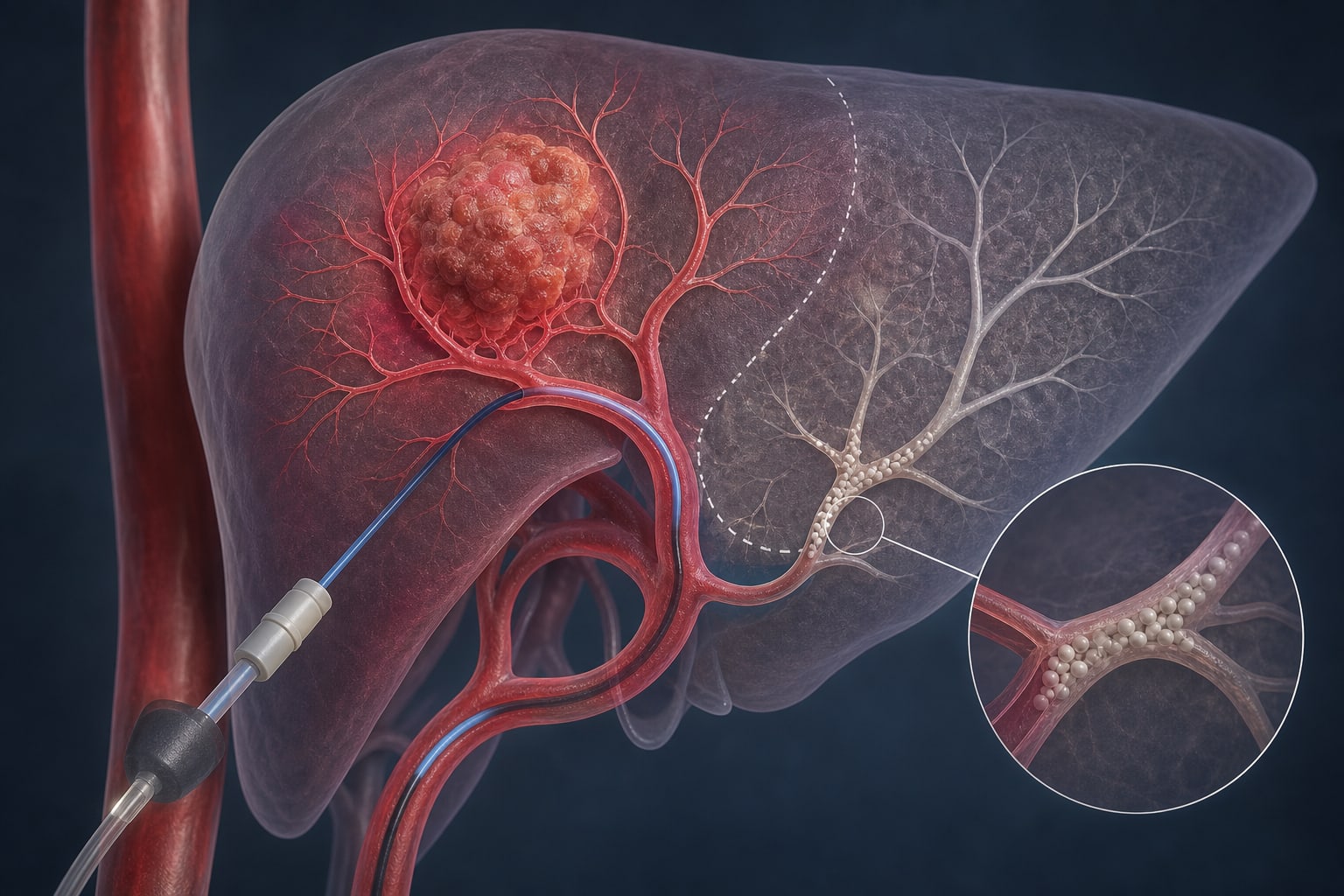
Clinical Report: Temporary Flow Modulation in Y-90 Radioembolization
Overview
SEGWAY is a prospective, single-arm phase II trial designed to assess whether rapidly resorbable gelatin microspheres (RGMs) can protect non-tumorous liver (NTL) during Y-90 radioembolization by temporarily modulating arterial flow. The supplied article excerpt describes the rationale, trial design, eligibility criteria, and intended resorption characteristics; it does not provide clinical outcome or dosimetric results.
Background
Transarterial radioembolization is increasingly used for primary and secondary hepatic tumors, prompting interest in techniques that may improve tumor microsphere deposition while limiting irradiation of non-target tissue. Flow modulation involves embolizing branches supplying NTL within the perfused territory. Permanent embolic agents can prevent later treatment of the protected territory and may compromise regional liver function, while temporary devices such as balloons or plugs can require additional access or larger sheaths. The article presents RGMs as a particle-based approach intended to provide short-lived modulation, addressing limitations of longer-lasting particles and the limited prior evidence described for degradable starch microspheres.
Data Highlights
Measure
Details reported
Trial
SEGWAY (NCT06229080), phase II, prospective, single-arm
Planned enrollment
20 patients with liver cancer
Key eligibility
Adult patients; Child–Pugh class A; NTL volume at least 50% of Y-90-perfused liver volume; no locoregional treatment of the same hepatic lobe in the preceding year
RGM resorption characteristics
Intended to dissolve by approximately 70% within 24 hours in vitro and undergo complete resorption within 3 days
Prior DSM literature, as described in the article
Proof-of-concept reports involved 5 or fewer patients and lacked quantitative dosimetric analysis and assessment of preserved regional liver function
Key Findings
The trial investigates RGMs for temporary protection of NTL during Y-90 radioembolization through arterial flow modulation.
RGMs are physically crosslinked porcine-gelatin sponge particles; their low-temperature crosslinking is described as allowing stability during delivery followed by rapid water penetration and resorption.
The intended in-vitro resorption profile is approximately 70% dissolution within 24 hours and complete resorption within 3 days.
The study was designed as a prospective, single-arm phase II trial with an empirically selected cohort of 20 patients.
Eligibility included Child–Pugh class A status and NTL comprising at least 50% of the Y-90-perfused liver volume; vascular invasion and biliary–enteric anastomosis were exclusion criteria because they could confound image-based assessment of post-treatment NTL function.
The supplied excerpt states that prior DSM reports included no more than five patients and did not provide quantitative dosimetry or determine whether dosimetric modification preserved regional liver function; it does not report SEGWAY outcomes.
Clinical Implications
The source describes RGMs as an investigational method for short-duration flow modulation and does not provide trial results establishing clinical effectiveness or safety. The trial's planned assessment of NTL protection and regional liver function is relevant to evaluating this approach, but no practice recommendation can be drawn from the supplied excerpt.
Conclusion
SEGWAY was designed to evaluate rapidly resorbable gelatin microspheres as a temporary flow-modulation strategy during Y-90 radioembolization. The available source material provides the study rationale and methods but not its clinical findings.