An innovative 2D optical navigation workflow for percutaneous pedicle screw fixation in thoracolumbar fractures: comparison with O-arm 3D navigation - Report - MDSpire
Advertisement
An innovative 2D optical navigation workflow for percutaneous pedicle screw fixation in thoracolumbar fractures: comparison with O-arm 3D navigation
Clinical Report: A Novel 2D Optical Navigation Approach for PPSF in TLFs
Overview
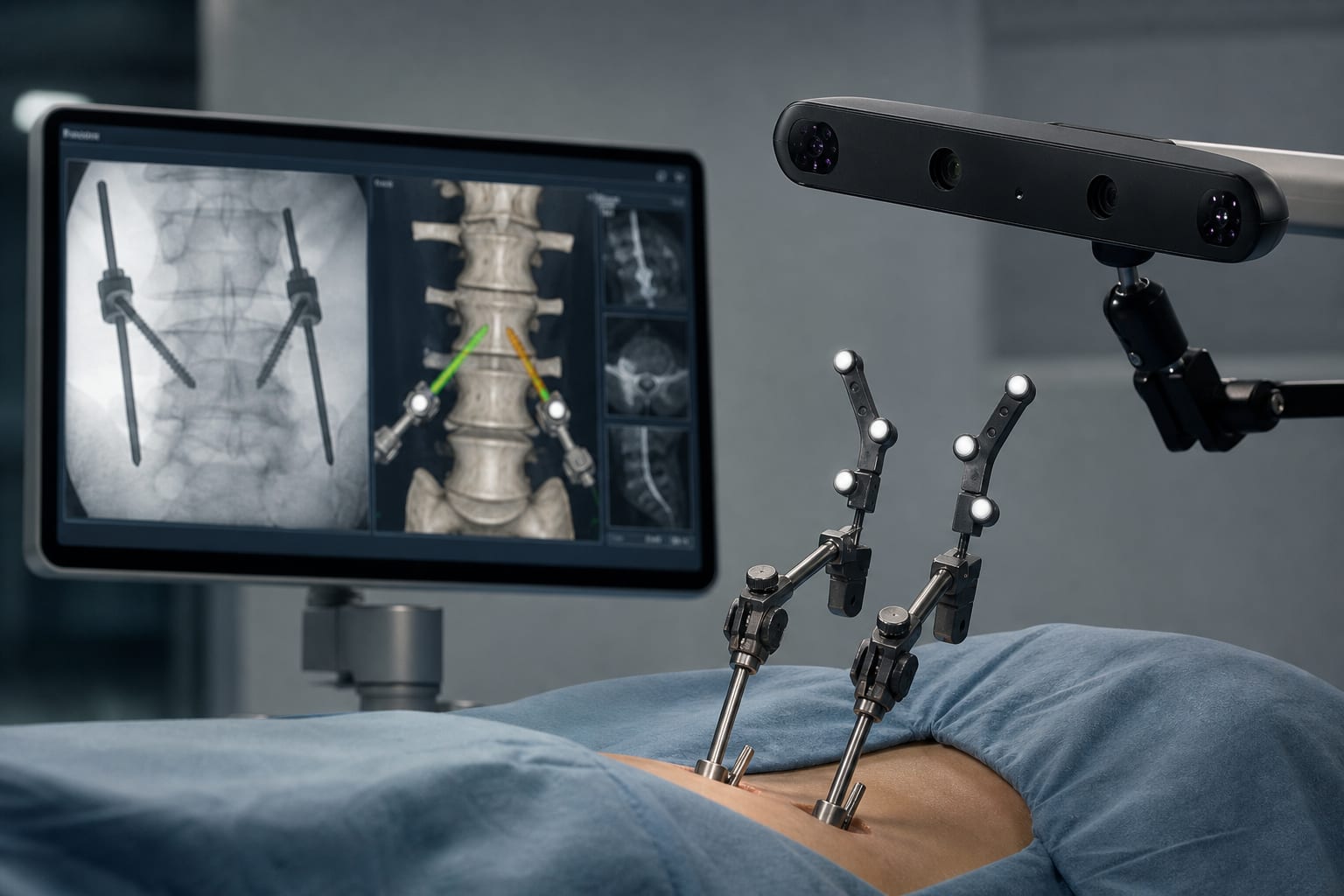
This study compares 2D optical navigation and 3D navigation systems for percutaneous pedicle screw fixation in thoracolumbar fractures. The 2D navigation approach demonstrated shorter operative times and reduced radiation exposure while maintaining comparable screw placement accuracy.
Background
Thoracolumbar fractures are prevalent spinal injuries often requiring surgical intervention to restore stability and prevent neurological deterioration. Traditional open surgery can lead to significant complications, prompting the adoption of percutaneous pedicle screw fixation (PPSF) as a minimally invasive alternative. However, PPSF poses technical challenges, particularly in screw placement accuracy, which can be improved through advanced navigation systems.
Data Highlights
Outcome
2D Navigation
3D Navigation
Operative Time (min)
94.71 ± 14.38
105.40 ± 11.22
Radiation Dose (µGy·m2)
81.0 ± 16.9
137.2 ± 43.0
Screw Placement Accuracy
99.2%
98.1%
Key Findings
The 2D-navigation group had significantly shorter operative times compared to the 3D-navigation group (P < 0.05).
Radiation doses were lower in the 2D-navigation group (P < 0.05).
Screw placement accuracy was comparable between both groups (P > 0.05).
Both groups showed significant postoperative improvements in VAS and ODI scores.
No serious complications were observed in either group.
Proficiency was achieved earlier with 2D navigation (15 cases) than with 3D navigation (29 cases).
Clinical Implications
The findings indicate that 2D optical navigation may improve procedural efficiency in PPSF for thoracolumbar fractures by reducing operative time and radiation exposure.
Conclusion
The study indicates that 2D optical navigation is an alternative to 3D navigation for PPSF in thoracolumbar fractures, offering advantages in operative time and radiation exposure.