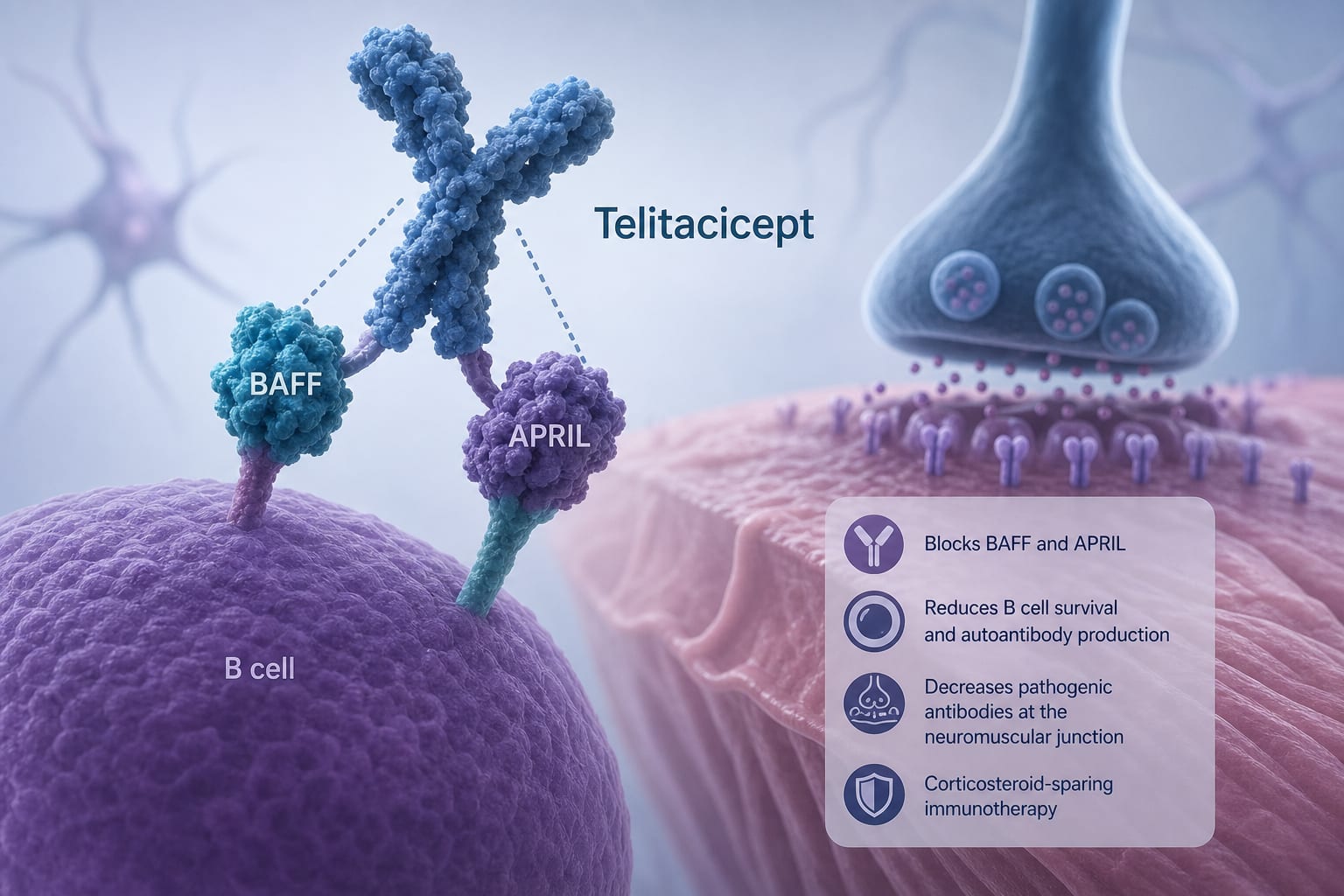
Clinical Report: Telitacicept for Treatment-Resistant Juvenile Generalized Myasthenia Gravis
Overview
This report evaluates the efficacy and tolerability of telitacicept in a case of juvenile refractory generalized myasthenia gravis (gMG).
Background
Juvenile generalized myasthenia gravis (gMG) presents a therapeutic challenge due to limited treatment options and the adverse effects associated with corticosteroids. Telitacicept, a dual inhibitor of BAFF and APRIL, has shown efficacy in adult gMG, but data in pediatric populations are limited.
Data Highlights
Outcome
Baseline
Week 12
Week 32
MG-ADL Score
3
0
0
QMG Score
10
3
2
Corticosteroid Dose Reduction
-
-
41.6%
Key Findings
Telitacicept reduced the MG-ADL score from 3 to 0 by week 12 in the index case.
The QMG score decreased from 10 to 3 by week 12 and further to 2 by week 32.
A 41.6% reduction in corticosteroid dose was achieved by week 32.
Three out of four pediatric cases showed marked improvement (≥3-point reduction in MG-ADL score) at 3 months.
All patients exhibited sustained clinical improvement with a ≥2-point reduction in MG-ADL score by 5–6 months.
No severe adverse events were reported in the collective analysis of cases.
Clinical Implications
Telitacicept may provide a viable treatment option for juvenile patients with refractory gMG, potentially reducing reliance on corticosteroids. Monitoring for mild adverse effects, such as injection-site reactions, is advisable.
Conclusion
The findings suggest that telitacicept is well-tolerated and may offer significant clinical benefits in juvenile refractory gMG. Further studies are needed to validate these preliminary observations.
A large audit of biomedical publications suggests fabricated references are increasingly appearing in peer-reviewed papers — often in ways that are difficult for reviewers and readers to detect.
In a multicenter registry study, genetic diagnoses were associated with substantially lower cognitive, language, and motor scores; while birth weight, surgical timing, hospitalization burden, and caregiver education were also associated with outcomes.