Disease severity prognostication in primary sclerosing cholangitis: a validation of the Anali scores and comparison with the potential functional stricture - Report - MDSpire
Advertisement
Disease severity prognostication in primary sclerosing cholangitis: a validation of the Anali scores and comparison with the potential functional stricture
Validation of Anali Scores and Functional Stricture Potential in PSC Prognosis
Overview
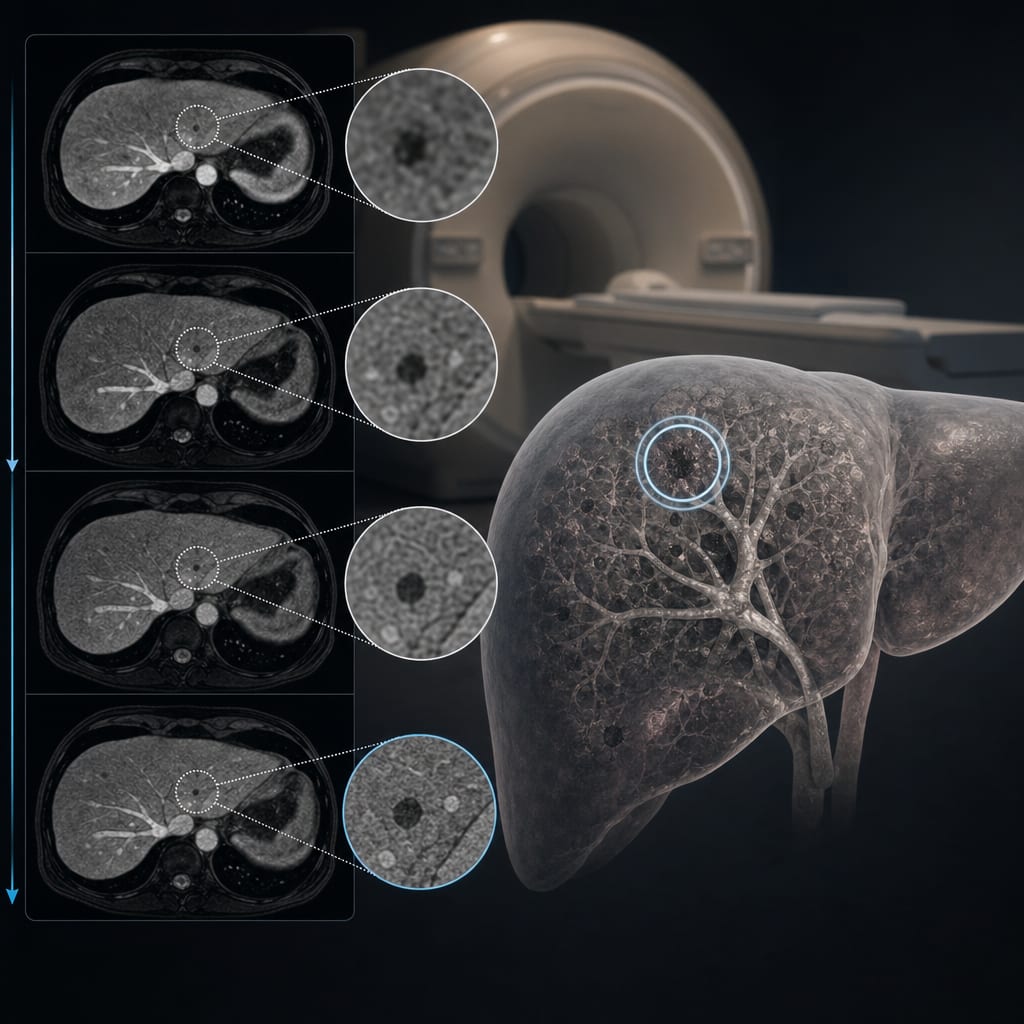
This study validated the Anali scoring systems with and without gadolinium contrast in predicting disease severity and outcomes in primary sclerosing cholangitis (PSC) using gadoxetic acid-enhanced MRI. It also compared these scores against the potential functional stricture (PFS) assessment, demonstrating the prognostic value of MRI in PSC management.
Background
Primary sclerosing cholangitis is a chronic progressive inflammatory liver disease with a median duration of 12–20 years. Traditional cholestatic laboratory tests are insufficient for diagnosis or monitoring disease activity. Non-invasive imaging, particularly magnetic resonance cholangiopancreatography (MRCP), is the preferred diagnostic modality due to its high specificity. The Anali scoring system was developed to predict PSC outcomes including liver decompensation and transplant need. Recently, gadoxetic acid-enhanced MRI has been proposed to identify functional strictures that correlate with advanced disease and prognosis.
Data Highlights
Parameter
Measurement/Classification
Patient Cohort
Adults with large-duct PSC, n=varied after exclusions
The Anali scores with and without gadolinium (ANALIGdAP, ANALIGdHBP, ANALINoGd) were validated using gadoxetic acid-enhanced MRI in PSC patients.
Both Anali scores correlated with clinical outcomes including liver decompensation, liver-related death, and need for orthotopic liver transplantation.
Potential functional stricture (PFS) identified by GA-MRI was effective in diagnosing strictures requiring intervention and predicting advanced disease outcomes.
Simultaneous evaluation of Anali scores and PFS on GA-MRI provides complementary prognostic information in PSC.
Inter-reader agreement for Anali scores varies depending on contrast agent used, but prognostic value remains significant.
Clinical Implications
Gadoxetic acid-enhanced MRI incorporating Anali scoring and PFS assessment offers a robust non-invasive approach to stratify PSC severity and predict clinical outcomes. This imaging strategy can guide timely interventions and monitoring, potentially improving patient management by identifying those at higher risk for liver-related complications and transplant. Clinicians should consider integrating these MRI-based tools into routine PSC evaluation protocols.
Conclusion
The study confirms that Anali scores and potential functional stricture assessment using gadoxetic acid-enhanced MRI are valuable prognostic tools in PSC. Their combined use enhances the ability to predict disease progression and adverse outcomes, supporting MRI’s central role in PSC management.
References
Ruiz et al 2017 -- Development of the Anali scoring system for PSC prognosis
Lemoinne et al 2019 -- External validation of Anali scores
Grave et al 2020 -- Inter-reader agreement and predictive value of Anali scores
Grigoriadis et al 2021 -- Evaluation of Anali scores with gadoxetic acid
Poetter-Lang et al 2022 -- Functional stricture potential in PSC using GA-MRI
European Association for the Study of the Liver (EASL) 2017 -- PSC clinical practice guidelines
by Sarah Poetter-Lang, Ahmed Ba-Ssalamah, Alina Messner, Nina Bastati, Raphael Ambros, Antonia Kristic, Jakob Kittinger, Svitlana Pochepnia, Sami A. Ba-Ssalamah, Jacqueline. C. Hodge, Emina Halilbasic, Sudhakar K. Venkatesh, Nikolaos Kartalis, Kristina Ringe, Lionel Arrivé, Michael Trauner