Development and Internal Validation of a Perioperative Nomogram for Predicting Postoperative Delirium in Geriatric Patients with Intertrochanteric Fractures Undergoing Internal Fixation with Preoperative Low-Dose Dexamethasone - Report - MDSpire

Development and Internal Validation of a Perioperative Nomogram for Predicting Postoperative Delirium in Geriatric Patients with Intertrochanteric Fractures Undergoing Internal Fixation with Preoperative Low-Dose Dexamethasone

  • By

  • Liu, Wanshun

  • Lu, Yunxi

  • Chen, Jun

  • Lv, Yuanhao

  • Wa, Qingde

  • May 25, 2026

  • 0 min

Share

Clinical Report: Nomogram for Predicting Postoperative Delirium in Elderly

Overview

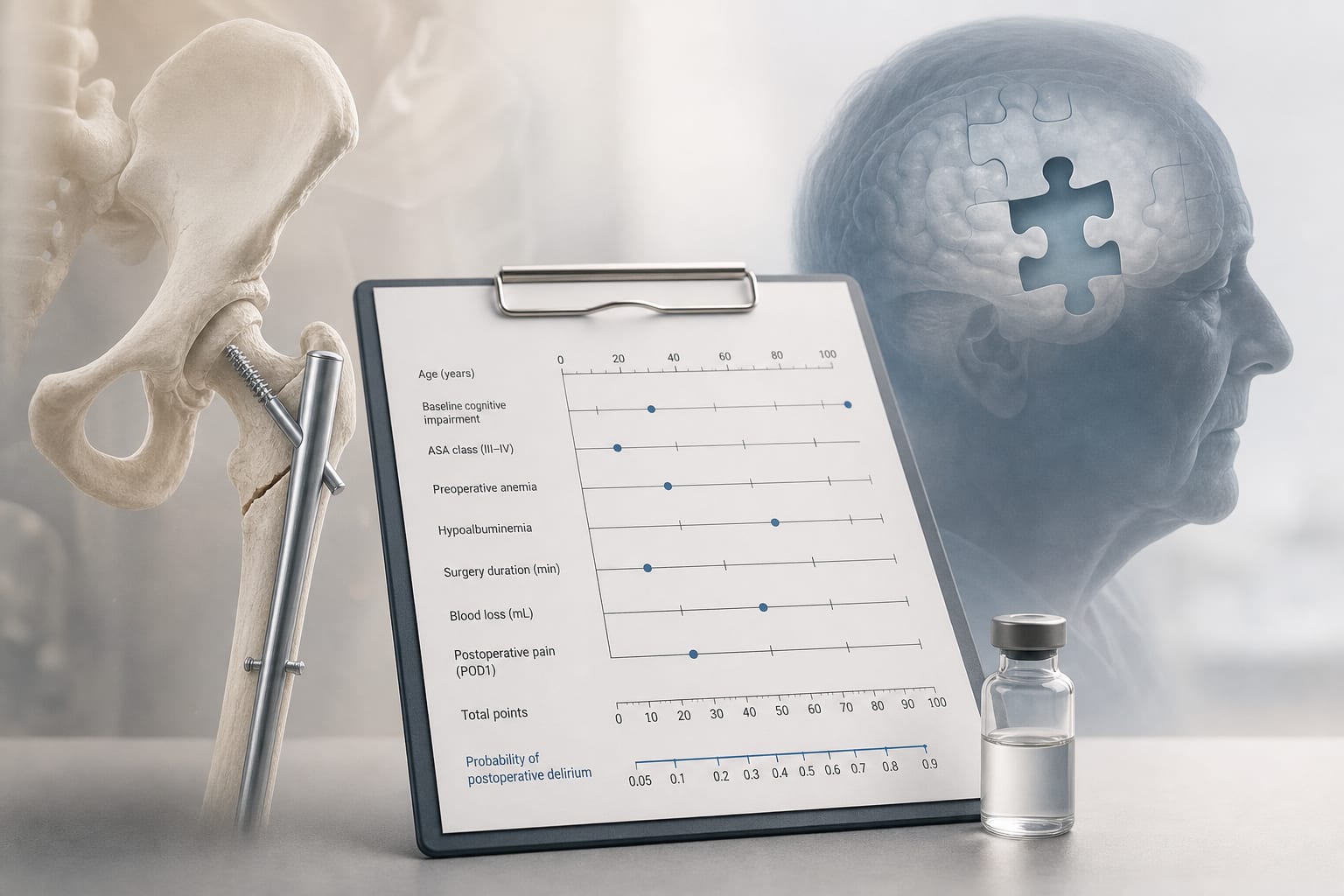
This study developed and validated a nomogram to predict postoperative delirium (POD) in elderly patients undergoing internal fixation for intertrochanteric fractures after receiving low-dose dexamethasone. The nomogram demonstrated good predictive ability with an AUC of 0.803 and identified key risk factors including age, preoperative monocyte count, and postoperative ICU transfer.

Background

Postoperative delirium (POD) is a common complication in elderly surgical patients, associated with increased morbidity, prolonged hospital stays, and higher mortality rates. Identifying patients at risk for POD is crucial for implementing preventive strategies. This study addresses the need for a predictive tool tailored for elderly patients undergoing specific surgical procedures.

Data Highlights

VariableOdds Ratio (OR)95% Confidence Interval (CI)P-value
Age1.1021.029–1.1870.007
Preoperative Monocyte Count7.5661.047–59.1830.047
Postoperative ICU Transfer2.9231.164–7.3080.021

Key Findings

  • The incidence of POD in the study cohort was 12.5% (31/248).
  • The nomogram achieved an AUC of 0.803, indicating good discriminative ability.
  • Age was identified as a significant predictor of POD (OR = 1.102).
  • Preoperative monocyte count was a strong predictor (OR = 7.566).
  • Postoperative transfer to ICU also increased the risk of POD (OR = 2.923).
  • Calibration and decision curve analyses confirmed the clinical utility of the nomogram.

Clinical Implications

The nomogram can assist clinicians in identifying elderly patients at high risk for POD, allowing for targeted preventive measures. Incorporating this tool into clinical practice may enhance patient outcomes and reduce the incidence of POD in this vulnerable population.

Conclusion

The development of this nomogram represents a significant advancement in predicting POD among elderly patients undergoing intertrochanteric fracture surgery. Its implementation could lead to improved perioperative care and outcomes.

Related Resources & Content

  1. Frontiers in Cardiovascular Medicine, 2026 -- Development and validation of a predictive model for postoperative delirium in patients undergoing cardiac surgery
  2. conexiant -- Preop Cognitive Impairment Tied to TKA Delirium
  3. BMC Psychiatry (Springer) -- Machine Learning-Based prediction models for postoperative delirium: a systematic review and Meta-Analysis
  4. 2025 American Society of Anesthesiologists Practice Advisory for Perioperative Care of Older Adults Scheduled for Inpatient Surgery - PubMed
  5. Effect of combination of multiple anti-inflammatory drugs strategy on postoperative delirium among older patients undergoing hip fracture surgery: a pilot randomized controlled trial | BMC Medicine | Springer Nature Link
  6. Frontiers in Neurology — Effects of Different Sedation Regimens on Delirium in ICU Patients
  7. Machine Learning-Based prediction models for postoperative delirium: a systematic review and Meta-Analysis
  8. 2025 American Society of Anesthesiologists Practice Advisory for Perioperative Care of Older Adults Scheduled for Inpatient Surgery - PubMed
  9. Effect of combination of multiple anti-inflammatory drugs strategy on postoperative delirium among older patients undergoing hip fracture surgery: a pilot randomized controlled trial | BMC Medicine | Springer Nature Link

Original Source(s)

Related Content