Association of plasma homocysteine with the atherogenic index of plasma and modification by body mass index: a cross-sectional study - Report - MDSpire
Advertisement
Association of plasma homocysteine with the atherogenic index of plasma and modification by body mass index: a cross-sectional study
Relationship Between Plasma Homocysteine Levels and the Atherogenic Index of Plasma
Overview
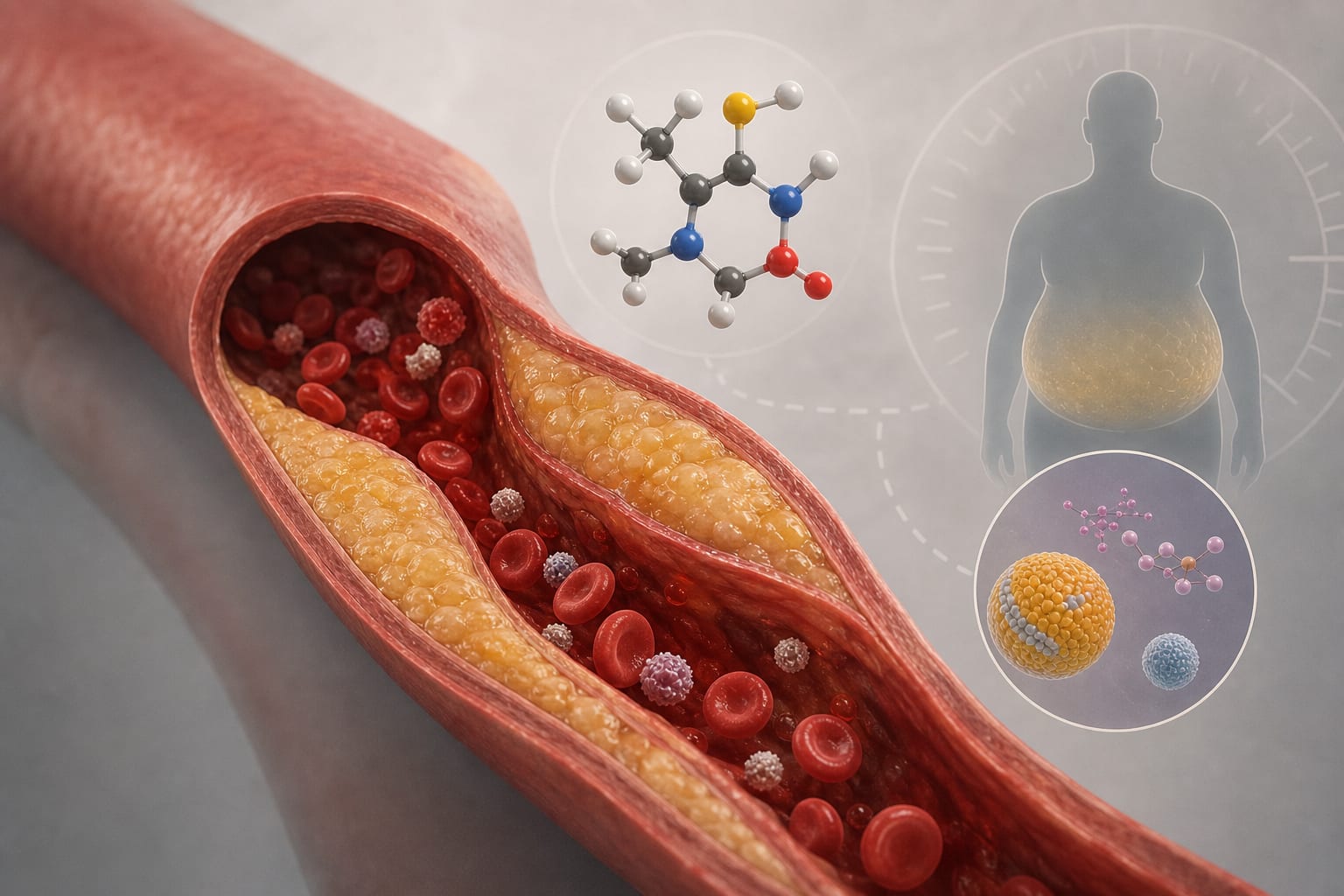
This study investigates the relationship between plasma homocysteine (HCY) levels and the atherogenic index of plasma (AIP) in a cohort of 887 adults. It finds a positive correlation between HCY and AIP.
Background
Atherosclerotic cardiovascular disease (ASCVD) remains a leading cause of morbidity and mortality globally. Hyperhomocysteinemia has been identified as an independent risk factor for cardiovascular disease, yet its specific relationship with AIP, a measure of lipid-related atherogenic risk, has not been thoroughly explored.
Data Highlights
Measure
Value
Correlation between HCY and AIP
r = 0.294, P < 0.001
Increase in AIP per 1 μmol/L HCY
0.0113 units, P < 0.001
Odds Ratio for high AIP risk per 1 μmol/L HCY
OR = 1.282 (95% CI: 1.186–1.387)
Effect modification by BMI
P for interaction = 0.006
Key Findings
Plasma HCY is positively correlated with AIP (r = 0.294, P < 0.001).
Each 1 μmol/L increase in HCY is associated with a 0.0113-unit increase in AIP (P < 0.001).
Logistic regression indicates that each 1 μmol/L increase in HCY raises the likelihood of high AIP risk (OR = 1.282, 95% CI: 1.186–1.387).
The association between HCY and AIP is stronger in individuals with BMI ≥ 24 kg/m compared to those with BMI < 24 kg/m.
Mediation analysis did not find significant indirect effects through white blood cell count or alanine aminotransferase.
Significant effect modification by BMI was observed (P for interaction = 0.006).
Clinical Implications
The findings suggest that BMI may influence the relationship between HCY and lipid-related atherogenic risk.
Conclusion
The study establishes a significant independent association between plasma HCY and AIP. Further research may be needed to explore the underlying mechanisms.