Automated Prediction of Glasgow Coma Scale Scores From Unstructured Electronic Health Records Using Natural Language Processing: Development and Validation Study - Report - MDSpire

Automated Prediction of Glasgow Coma Scale Scores From Unstructured Electronic Health Records Using Natural Language Processing: Development and Validation Study

  • By

  • Marta Fernandes

  • Niels Turley

  • Haoqi Sun

  • Shibani S Mukerji

  • Lidia M V R Moura

  • M Brandon Westover

  • Sahar F Zafar

  • June 29, 2026

  • 0 min

Share

Clinical Report: Predicting Glasgow Coma Scale Scores from EHRs via NLP

Overview

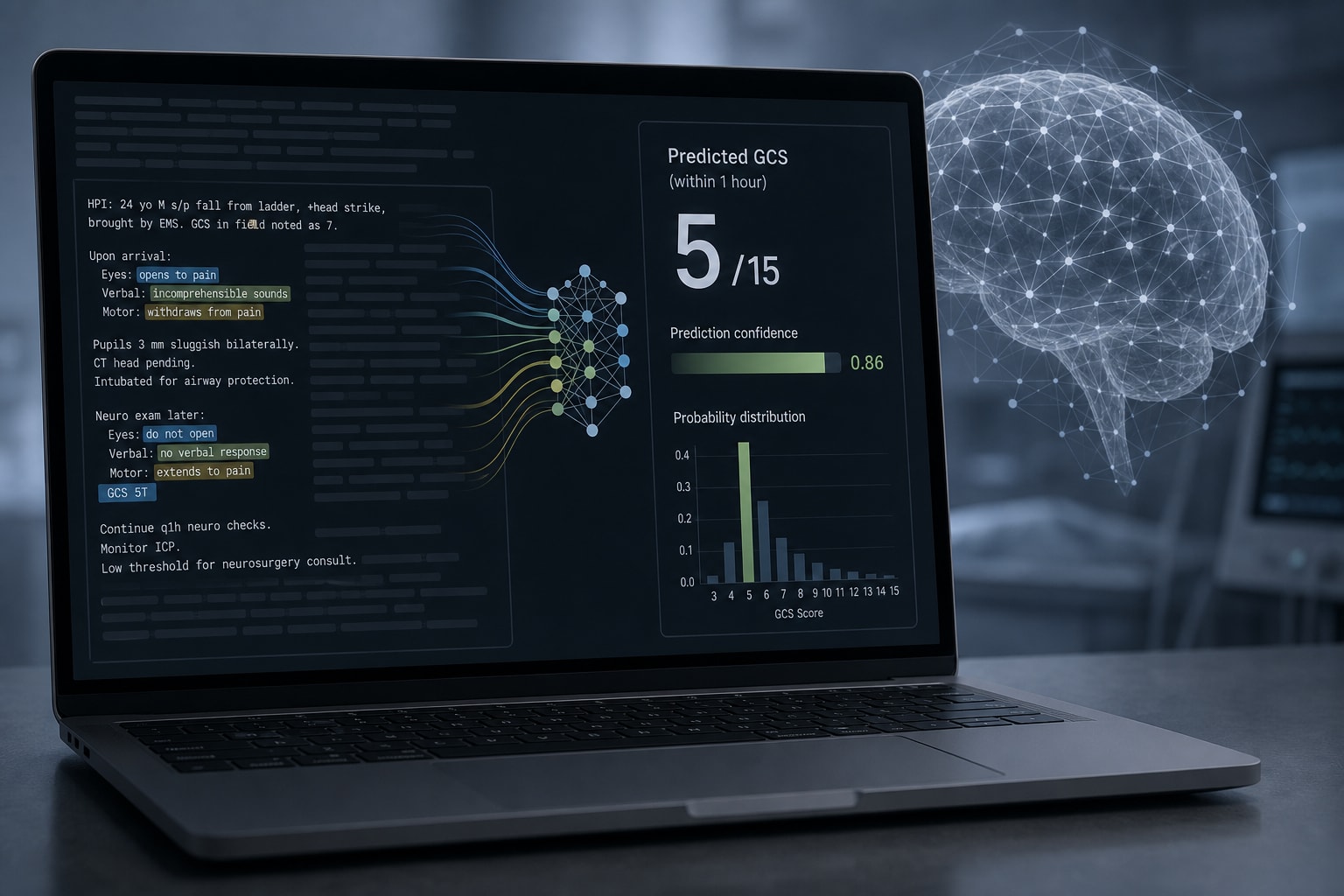
This study developed and validated a natural language processing (NLP) model to estimate Glasgow Coma Scale (GCS) scores from unstructured electronic health records (EHRs). The model addresses the frequent absence of GCS documentation in EHRs.

Background

The Glasgow Coma Scale (GCS) is essential for assessing consciousness in critically ill patients and is a key variable in various severity scoring systems. However, GCS data is often missing in electronic health records, complicating the evaluation of illness severity. This study focuses on NLP to extract GCS scores from unstructured data.

Data Highlights

No numerical or trial data provided in the source material.

Key Findings

  • The study utilized a cohort of adult patients from two sources: Mass General Brigham and the MIMIC-III database.
  • The NLP model was designed to estimate GCS scores from unstructured clinical notes where structured documentation was lacking.
  • Gold standard GCS scores were obtained from structured information tables for validation purposes.
  • Text features related to sedative and anesthetic medications were excluded to enhance the model's clinical validity.
  • The study adhered to the TRIPOD-AI reporting guidelines for prediction models.

Clinical Implications

The development of an NLP model for estimating GCS scores could facilitate assessments of neurological status in patients with incomplete documentation.

Conclusion

The study presents a novel approach to estimating GCS scores from unstructured EHR data.
Related Resources & Content

  1. npj Digital Medicine, 2026 -- Enhanced Transferability of Predictions from Electronic Health Records Across Different Countries and Coding Frameworks Using Large Language Models
  2. npj Digital Medicine, 2025 -- Natural language processing techniques to detect delirium in hospitalized patients from clinical notes: a systematic review
  3. npj Digital Medicine, 2026 -- Systematic Evaluation of Wearable EEG Technology for Identifying Mild Cognitive Impairment
  4. JMIR Medical Informatics, 2026 -- Large Language Model Automated Extraction of Clinical Signs and Symptoms From Emergency Department Reports for Machine Learning Prediction Models: Development and Validation Study
  5. NICE, 2023 -- Recommendations | Head injury: assessment and early management | Guidance
  6. Journals.sagepub.com, 2024 -- Clinical Assessment on Days 1–14 for the Characterization of Traumatic Brain Injury: Recommendations from the 2024 NINDS Traumatic Brain Injury Classification and Nomenclature Initiative Clinical/Symptoms Working Group
  7. Brain Trauma Foundation, 2026 -- Validation of the GCS−Pupil Scale in Traumatic Brain Injury
  8. BMC Emergency Medicine, 2025 -- Comparison of Glasgow coma scale, motor component, eye component, and simplified motor scale for predicting trauma outcomes: a 13-year multicenter retrospective cohort study
  9. Neurocritical Care, 2024 -- The Predictive Validity of the Full Outline of UnResponsiveness Score Compared to the Glasgow Coma Scale in the Intensive Care Unit: A Systematic Review
  10. Recommendations | Head injury: assessment and early management | Guidance | NICE
  11. Clinical Assessment on Days 1–14 for the Characterization of Traumatic Brain Injury: Recommendations from the 2024 NINDS Traumatic Brain Injury Classification and Nomenclature Initiative Clinical/Symptoms Working Group
  12. NEU-D-25-01311 6..164
  13. Validation of the GCS−Pupil Scale in Traumatic Brain Injury: Incremental Prognostic Value of Pupillary Reactivity with GCS in the Prospective Observational Cohorts CENTER-TBI and TRACK-TBI - Rick J.G. Vreeburg, Florian D. van Leeuwen, Geoffrey T. Manley, John K. Yue, Paul M. Brennan, Xiaoying Sun, Sonia Jain, Thomas A. van Essen, Wilco C. Peul, Andrew I.R. Maas, David K. Menon, Ewout W. Steyerberg, , on behalf of the CENTER-TBI, TRACK-TBI participants and investigators, and the members of the clinical working group of the National Institutes of Health–National Institute of Neurological Disorders and Stroke initiative on classification and nomenclature of traumatic brain injury, on behalf of the CENTER-TBI, TRACK-TBI participants and investigators, and the members of the clinical working group of the National Institutes of Health–National Institute of Neurological Disorders and Stroke initiative on classification and nomenclature of traumatic brain injury, 2025
  14. Comparison of Glasgow coma scale, motor component, eye component, and simplified motor scale for predicting trauma outcomes: a 13-year multicenter retrospective cohort study | BMC Emergency Medicine | Springer Nature Link
  15. The Predictive Validity of the Full Outline of UnResponsiveness Score Compared to the Glasgow Coma Scale in the Intensive Care Unit: A Systematic Review | Neurocritical Care | Springer Nature Link

Original Source(s)

Related Content