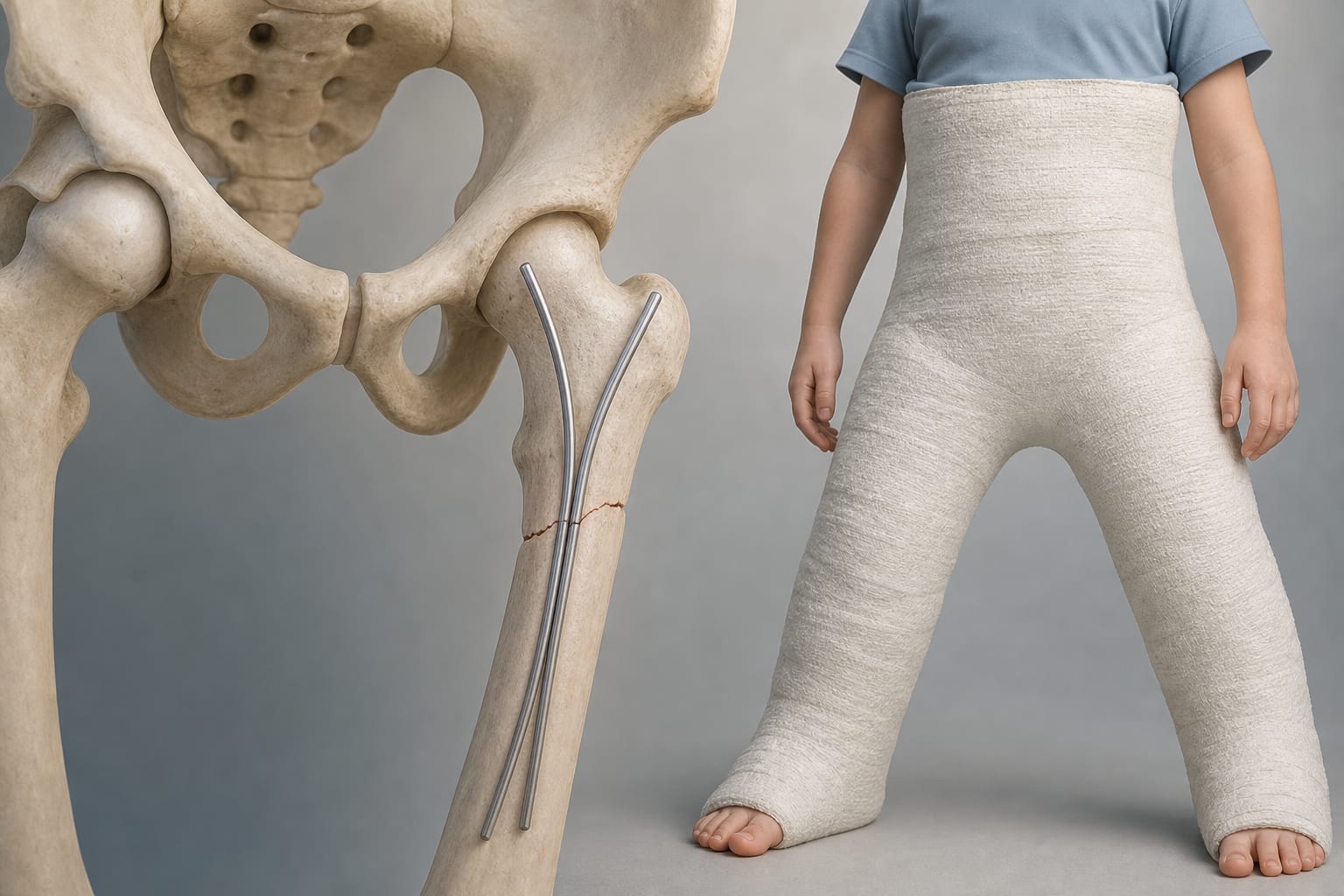
Comparison of Elastic Stable Intramedullary Nailing and Hip Spica Casting for Managing Postoperative Femoral Fractures in Pediatric Patients with Developmental Dysplasia of the Hip
-
By
-
Yongfu Wang
-
Li Yang
-
Qiang Shi
-
June 22, 2026
Clinical Report: Comparison of ESIN and Hip Spica Casting for Femoral Fractures
Overview
This study compares the outcomes of elastic stable intramedullary nailing (ESIN) and hip spica casting for managing postoperative femoral fractures in pediatric patients with developmental dysplasia of the hip (DDH). Significant differences were found in hospitalization duration and surgical time between the two treatment methods.
Background
Proximal femoral osteotomy (PFO) is commonly performed to correct proximal femoral deformities in children with DDH. Postoperative femur fractures can occur, necessitating effective management strategies. The choice between ESIN and hip spica casting remains unclear.
Data Highlights
| Group | Average Hospitalization (days) | Surgical Time (min) |
|---|---|---|
| ESIN | 6.4 | 34.7 ± 5.1 |
| Hip Spica Casting | 9.5 | 24.8 ± 4.5 |
Key Findings
- 18 patients with postoperative femur fractures were included in the study.
- Significant differences in age and fracture pattern were noted (P < 0.001).
- Average hospitalization was longer for hip spica casting compared to ESIN (9.5 days vs. 6.4 days, P < 0.001).
- Surgical time was shorter for hip spica casting than for ESIN (24.8 min vs. 34.7 min, P < 0.05).
- Hip spica casting is suggested for undisplaced femoral fractures in patients aged 2–5 years.
- ESIN is recommended for displaced femoral fractures in patients aged 5–8 years.
Clinical Implications
The findings suggest that hip spica casting may be more suitable for younger patients with undisplaced fractures, while ESIN offers a quicker and less invasive option for older children with displaced fractures. Clinicians should consider these factors when determining treatment strategies.
Conclusion
Both ESIN and hip spica casting yield good radiological outcomes for postoperative femoral fractures in children with DDH.
Related Resources & Content
- Author(s)/Org, Source, Year -- Title
- Outcomes of Spica Cast Immobilization Following Hip Reconstruction in 95 Patients: Evaluating the Need for Alternative Approaches
- conexiant — Can Casting Match Surgery for Pediatric Fractures?
- Archives of Orthopaedic and Trauma Surgery — Assessing PHILOS plate as an alternative fixation method for pediatric femoral neck fractures: a biomechanical comparison with cannulated screws
- Longitudinal Analysis of Hip Geometry and Lateralization in Pediatric Patients with DDH, NDH, and LCPD After Reconstructive Surgery: Findings from a Cohort of 73 Individuals Over an Average of 4.9 Years
- Outcomes of Spica Cast Immobilization Following Hip Reconstruction in 95 Patients
- Can Casting Match Surgery for Pediatric Fractures?
- Assessing PHILOS plate as an alternative fixation method for pediatric femoral neck fractures
- PowerPoint Presentation
- Frontiers | Elastic nailing versus plate and screws fixation for pediatric femoral shaft fractures: a systematic review and meta-analysis of high quality randomized controlled trials
- Submuscular Plating, Titanium Elastic Nailing, and External Fixation for Pediatric Femoral Shaft Fractures: A Comparative Systematic Review and Meta-Analysis - PMC
- Single-leg versus double-leg hip spica casts in the management of paediatric femoral shaft fractures? A systematic review and meta-analysis - PMC
- Survey finds variable treatment of pediatric femur fractures by surgeon age, geographic location, type of practice
- Frontiers | Elastic stable intramedullary nailing vs. hip spica casting management for postoperative femoral fractures in children with developmental dysplasia of the hip
- Risk factors for implant-related fractures after proximal femoral osteotomy in children with developmental dysplasia of the hip: a case-control study - PubMed
Based on findings from:
Elastic stable intramedullary nailing vs. hip spica casting management for postoperative femoral fractures in children with developmental dysplasia of the hip
Yongfu Wang, Li Yang, Qiang Shi. Frontiers In Pediatrics, 2026.
https://www.frontiersin.org/journals/pediatrics/articles/10.3389/fped.2026.1765117/full
This content is an AI-generated, fully rewritten summary based on a published scholarly article. It does not reproduce the original text and is not a substitute for the original publication. Readers are encouraged to consult the source for full context, data, and methodology.