Editorial: Harnessing machine learning for enhanced biomedical diagnosis and early disease detection: bridging data science and healthcare - Report - MDSpire

Editorial: Harnessing machine learning for enhanced biomedical diagnosis and early disease detection: bridging data science and healthcare

  • By

  • Mahendra Gawali

  • Hsiang-Chen Wang

  • Arvind Mukundan

  • June 22, 2026

  • 0 min

Share

Clinical Report: Leveraging Machine Learning for Biomedical Diagnostics

Overview

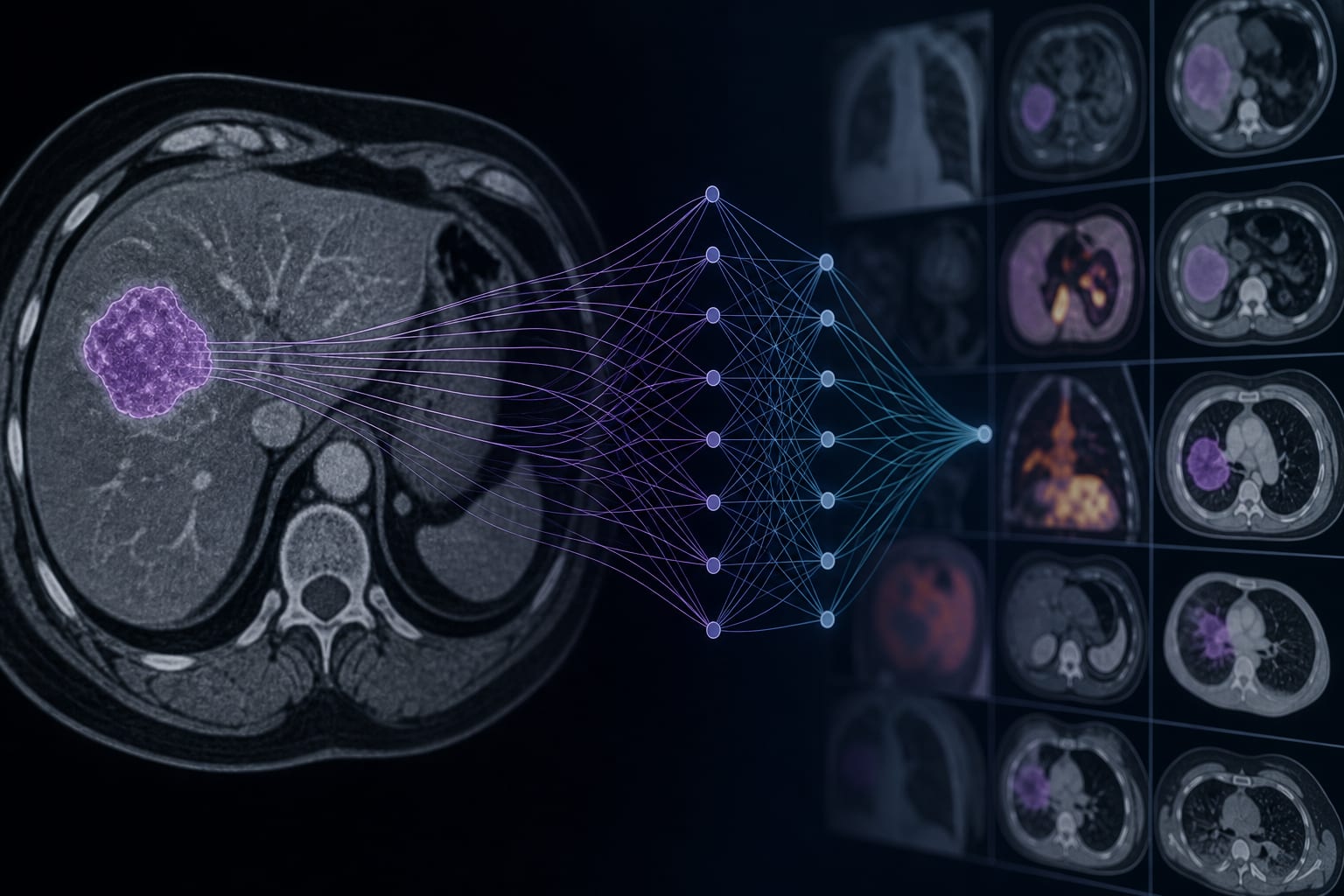
This editorial discusses the impact of machine learning (ML) and deep learning (DL) on healthcare, particularly in disease prediction and diagnosis. It highlights various studies demonstrating the effectiveness of ML models in cancer detection and management of diabetic complications.

Background

The integration of ML and DL technologies in healthcare is important for improving diagnostic accuracy. As cancer detection rates improve, timely interventions and personalized treatment strategies become more feasible. This editorial emphasizes the importance of research in bridging data science with healthcare.

Data Highlights

No specific numerical data table provided in the source material.

Key Findings

  • Liu et al. achieved an AUC of 0.95 with a classification algorithm using endoscopic ultrasonography images.
  • Xiao et al. found that the Gradient Boosting Decision Tree model outperformed others in categorizing diabetic microvascular complications.
  • Li et al. demonstrated a logistic regression model with an AUC of 0.918 for predicting STAS in lung cancer patients.
  • Li et al. developed a noninvasive radiomics-based ML model with an AUC of 0.99 for predicting instability status in right colon cancer.
  • Beaumont et al. evaluated CAD in breast cancer screening, achieving 82.2% effectiveness in classifying masses.
  • Yao et al. reported a combined radiomics model with an AUC of 0.925 for predicting tumor deposits in advanced cancer patients.

Clinical Implications

Healthcare professionals should consider integrating these technologies to optimize disease detection and treatment planning.

Conclusion

The editorial underscores the potential of machine learning to revolutionize biomedical diagnostics and emphasizes the need for ongoing research to fully realize its benefits in healthcare.
Related Resources & Content

  1. Liu et al., Source, Year -- Classification Algorithm for Endoscopic Ultrasonography Images
  2. Xiao et al., Source, Year -- ML Model for Diabetic Microvascular Complications
  3. Li et al., Source, Year -- Predicting STAS in Lung Cancer Patients
  4. Li et al., Source, Year -- Noninvasive Radiomics-Based ML Model
  5. Beaumont et al., Source, Year -- CAD in Breast Cancer Screening
  6. Yao et al., Source, Year -- Radiomics Model for Tumor Deposits
  7. American Journal of Epidemiology — Commentary: Enhancing Epidemiological Data Collection and Analysis Through Deep Learning Techniques
  8. Frontiers in Digital Health — Editorial: Application of computational intelligence techniques for lifestyle related diseases management
  9. the pathologist — Breaking the Biomarker Bottlenecks: Part 2
  10. Frontiers in Medicine — AI-driven cardiovascular risk prediction in patients with diabetes: bridging algorithmic innovation to equitable clinical application
  11. Enhancing Epidemiological Data Collection and Analysis Through Deep Learning Techniques
  12. Application of Computational Intelligence Techniques for Lifestyle Related Diseases Management
  13. Breaking the Biomarker Bottlenecks: Part 2
  14. ACR Approves First Practice Parameter for Imaging Artificial Intelligence
  15. Marketing Submission Recommendations for a Predetermined Change Control Plan for Artificial Intelligence-Enabled Device Software Functions | FDA
  16. IEC PAS 63621:2026 | IEC
  17. Detection of undiagnosed liver cirrhosis via AI-enabled electrocardiogram: a pragmatic, cluster-randomized clinical trial | Nature Medicine
  18. AI-based chest X-ray prioritization in the lung cancer diagnostic pathway: the LungIMPACT randomized controlled trial
  19. Artificial Intelligence-Assisted Lung Nodule Evaluation on Low-Dose Chest CT in Asymptomatic Individuals: A Prospective Randomized Controlled Trial - PubMed
  20. Impact of AI-Based Clinical Decision Support Systems on Diagnostic Accuracy Among Healthcare Professionals: A Systematic Review and Meta-Analysis of Randomized Controlled Trials | MDPI
  21. FUTURE-AI: international consensus guideline for trustworthy and deployable artificial intelligence in healthcare | The BMJ

Original Source(s)

Related Content