Association of serum 25-hydroxyvitamin D levels with indicators of target organ damage in patients with diabetes: a cross-sectional study - Report - MDSpire

Association of serum 25-hydroxyvitamin D levels with indicators of target organ damage in patients with diabetes: a cross-sectional study

  • By

  • Min Wang

  • Yanrong Huang

  • Yilun Gong

  • Lina Li

  • Zhenxing Zeng

  • Chuanfang Jiang

  • Guozhong Ji

  • June 29, 2026

  • 0 min

Share

Clinical Report: Relationship Between Serum 25-Hydroxyvitamin D and Target Organ Damage

Overview

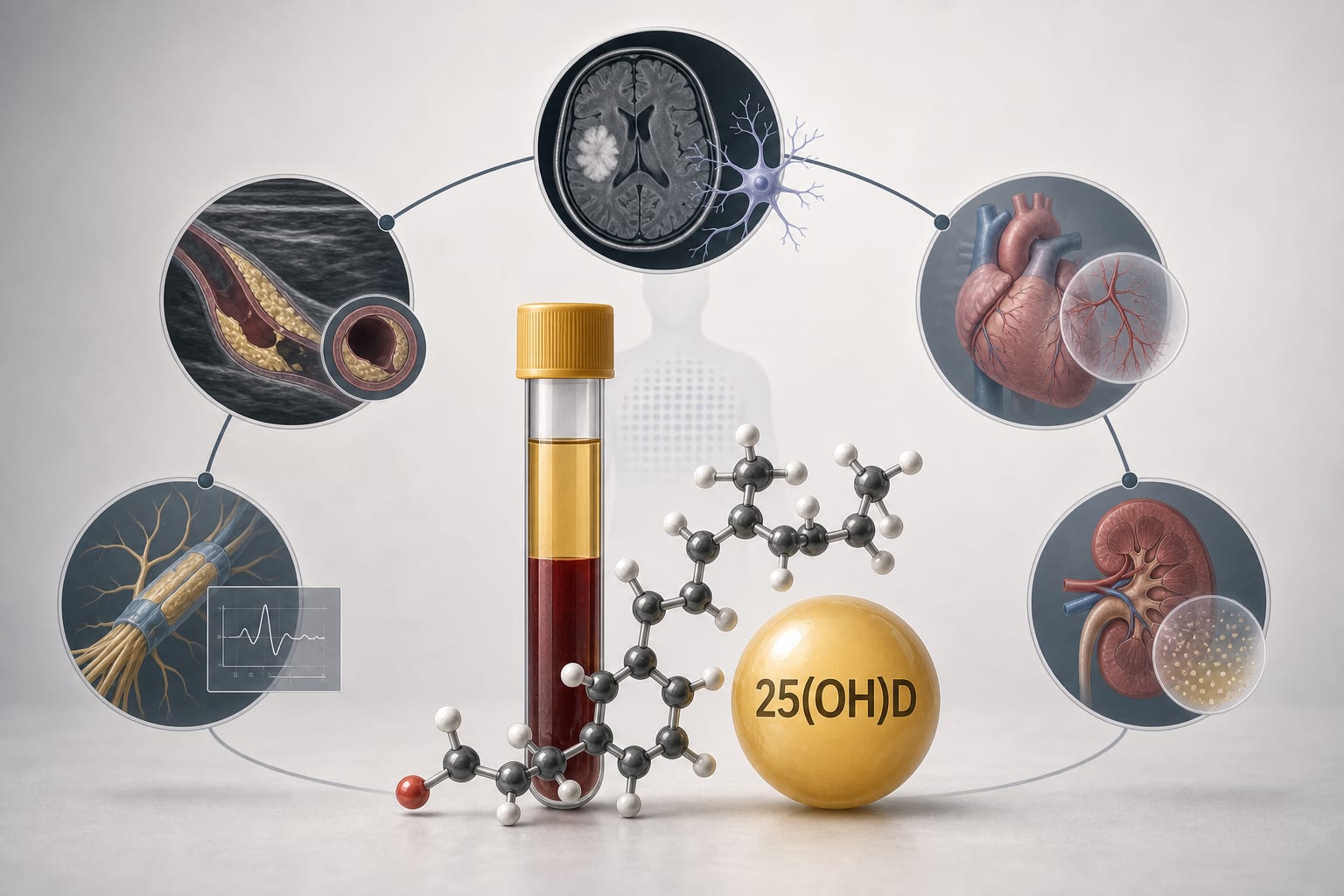
This study investigates the association between serum 25-hydroxyvitamin D levels and indicators of target organ damage in diabetic patients.

Background

Diabetes is a prevalent chronic disease that leads to significant complications affecting various organs, contributing to morbidity and mortality. Identifying modifiable factors associated with target organ damage is crucial for early detection and prevention of complications.

Data Highlights

ParameterOdds Ratio (OR)95% Confidence Interval (CI)P-value
Peripheral Nerve Damage0.9410.905–0.9760.001
Carotid Plaque0.9420.906–0.9770.002
Log-transformed mALB-0.035-0.057 to -0.0130.002
Cerebral Infarction0.8960.816–0.9710.013
Coronary Heart Disease0.9020.835–0.9660.006

Key Findings

  • Lower serum 25(OH)D levels are associated with increased peripheral nerve damage.
  • Serum 25(OH)D levels inversely correlate with carotid plaque formation.
  • Higher serum 25(OH)D is linked to lower urinary microalbumin levels.
  • Increased serum 25(OH)D is associated with reduced odds of cerebral infarction.
  • Serum 25(OH)D levels are inversely related to the risk of coronary heart disease.

Clinical Implications

Clinicians should consider evaluating vitamin D status as part of comprehensive diabetes management.

Conclusion

The study highlights a significant association between serum 25(OH)D levels and indicators of diabetes-related target organ damage.

Related Resources & Content

  1. Frontiers in Endocrinology, 2026 -- Serum 25-hydroxyvitamin D is associated with islet function in postmenopausal women with type 2 diabetes and osteoporosis
  2. Frontiers in Endocrinology, 2026 -- Association of 25(OH)D status with calcium metabolism, inflammation, and thyroid autoimmunity in patients with type 2 diabetes mellitus
  3. Diabetes Care, 2026 -- Chronic Kidney Disease and Risk Management: Standards of Care in Diabetes
  4. Nature Medicine, 2026 -- A meta-analysis of albuminuria as a surrogate endpoint for kidney failure
  5. Clinical Rheumatology — An Analysis of Vitamin D Levels Among a Large Group of Patients with Rheumatic Disorders
  6. Frontiers in Endocrinology — A preliminary study on the combined assessment of 25-hydroxyvitamin D and thyroid function for predicting diabetic foot risk and amputation in type 2 diabetes
  7. 11. Chronic Kidney Disease and Risk Management: Standards of Care in Diabetes—2026 | Diabetes Care | American Diabetes Association
  8. Association between serum vitamin D levels and the risk of diabetic retinopathy: a meta-analysis
  9. A meta-analysis of albuminuria as a surrogate endpoint for kidney failure | Nature Medicine

Original Source(s)

Related Content