The safety of Ipsilateral high-frequency repetitive Transcranial Magnetic Stimulation in brain tumour patients - Report - MDSpire

The safety of Ipsilateral high-frequency repetitive Transcranial Magnetic Stimulation in brain tumour patients

  • By

  • Ali, Ahmad M. S.

  • Asman, Priscella

  • Chilakapati, Sai S.

  • Jenkinson, Michael D.

  • Zakaria, Rasheed

  • Prabhu, Sujit

  • May 7, 2026

  • 0 min

Share

Clinical Report: Evaluating the Safety of Ipsilateral High-Frequency rTMS

Overview

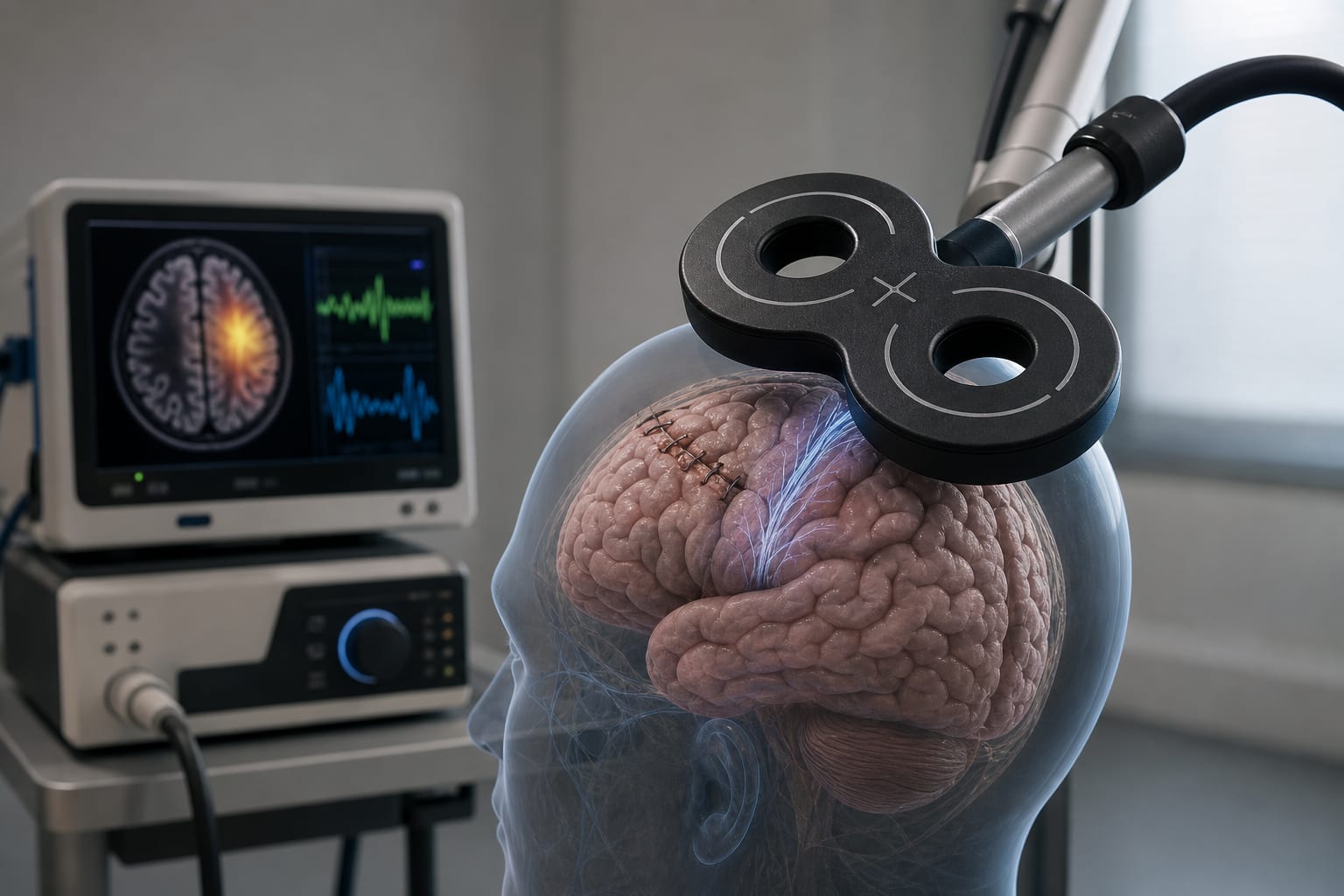
This study evaluates the safety and efficacy of ipsilateral high-frequency repetitive transcranial magnetic stimulation (IL-HFS) in patients with brain tumors. Results indicate significant improvements in muscle strength without notable adverse events, suggesting IL-HFS may be a safe option for motor rehabilitation post-surgery.

Background

Motor deficits following brain tumor resection can significantly impair patients' quality of life and survival. While contralesional low-frequency stimulation has been explored, the safety and efficacy of ipsilateral high-frequency stimulation remain largely untested in this population. Understanding the potential of IL-HFS could enhance rehabilitation strategies for patients recovering from brain tumor surgeries.

Data Highlights

GroupPatientsSignificant Improvement (p-value)
IL-HFS4< 0.05
CL-LFS6< 0.05

Key Findings

  • All patients showed significant improvements in myotomal strength (MRC grade).
  • Strength gains were more pronounced in lower-limb myotomes.
  • AMPAC scores improved in both IL-HFS and CL-LFS groups.
  • No seizures or heating effects were reported during the study.
  • One patient required wound revision, and another experienced transient paraesthesia.
  • No changes in shunt settings were observed in a patient with ventriculoperitoneal shunts.

Clinical Implications

The findings suggest that IL-HFS is a safe intervention in the early postoperative period for patients with brain tumors. Clinicians may consider IL-HFS as a viable option for enhancing motor recovery in this patient population.

Conclusion

IL-HFS appears to be a safe and effective approach for motor rehabilitation following brain tumor resection, warranting further investigation in larger prospective trials.
Related Resources & Content

  1. Author(s)/Org, Source, Year -- Prehabilitation of Motor Networks Using Low-Frequency Repetitive Transcranial Magnetic Stimulation: A Conceptual Study
  2. Author(s)/Org, Source, Year -- Enhancing Recovery from Postsurgical Paresis in Brain Tumor Patients through Transcranial Magnetic Stimulation
  3. Author(s)/Org, Source, Year -- Evaluation of Direct Cortical Stimulation versus Transcranial Magnetic Stimulation in Surgical Management of Brain Tumors: A Systematic Review and Meta-Analysis
  4. Author(s)/Org, Source, Year -- Preoperative nTMS Evaluation: An Effective Method for Identifying Potential Motor Impairments in Patients with Brain Tumors
  5. Author(s)/Org, Source, Year -- FACTORS RELATED TO PERMANENT AND TEMPORARY MOTOR DEFICITS IN PATIENTS UNDERGOING GLIOMA RESECTION: A SYSTEMATIC REVIEW AND META-ANALYSIS
  6. Author(s)/Org, Source, Year -- Low-frequency repetitive transcranial magnetic stimulation in patients with motor deficits after brain tumor resection: a randomized, double-blind, sham-controlled trial
  7. Author(s)/Org, Source, Year -- Functional gradient analysis reveals potential therapeutic mechanisms of nrTMS for postoperative motor deficits in glioma patients: A randomized controlled trial
  8. NCMP-20. FACTORS RELATED TO PERMANENT AND TEMPORARY MOTOR DEFICITS IN PATIENTS UNDERGOING GLIOMA RESECTION: A SYSTEMATIC REVIEW AND META-ANALYSIS - PMC
  9. Low-frequency repetitive transcranial magnetic stimulation in patients with motor deficits after brain tumor resection: a randomized, double-blind, sham-controlled trial - PMC
  10. Functional gradient analysis reveals potential therapeutic mechanisms of nrTMS for postoperative motor deficits in glioma patients: A randomized controlled trial - PMC

Original Source(s)

Related Content