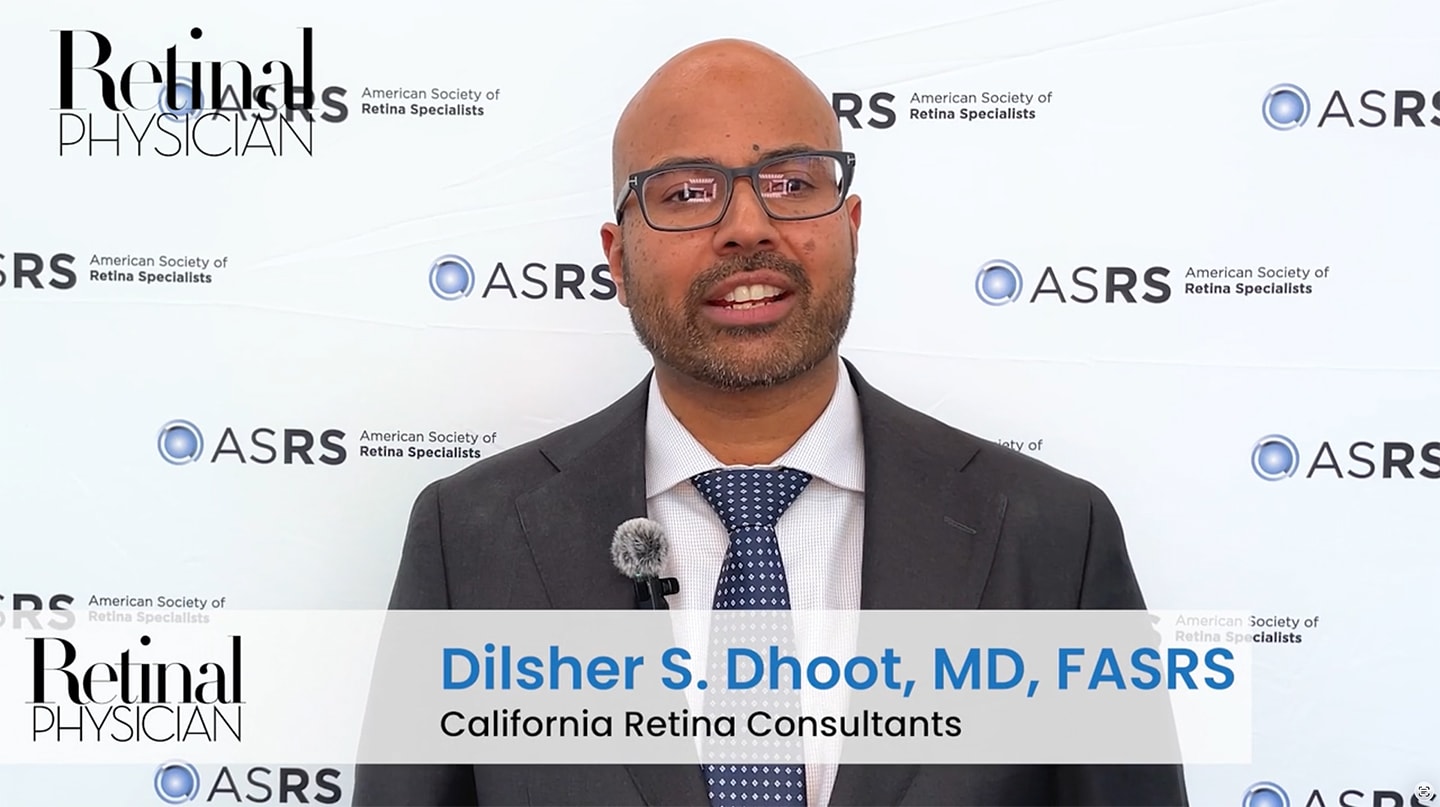
At ASRS 2026, Dilsher S. Dhoot, MD, FASRS, shared additional phase 3 SOL-1 data on vision maintenance, rescue treatment, and safety with investigational OTX-TKI (Axpaxli) in neovascular AMD.
The SOL-1 trial evaluated OTX-TKI (Axpaxli) against aflibercept in treatment-naïve patients with neovascular AMD. Key findings included a percentage of patients maintaining vision and time to rescue treatment.
Background
Neovascular age-related macular degeneration (AMD) is a leading cause of vision loss in older adults, making effective treatment crucial. The SOL-1 trial evaluates OTX-TKI, a novel intravitreal hydrogel implant, against the standard of care, aflibercept, to determine its efficacy in vision maintenance and safety profile.
Data Highlights
Parameter
OTX-TKI
Aflibercept
Vision Maintenance at Week 36
74%
56%
Vision Maintenance at Week 52
66%
44%
Rescue Treatment by Week 52
30%
Proportion by Week 28
Mean Visual Acuity (letters)
80
80
Fluid Stability (nL difference)
30
60
Key Findings
74% of patients in the OTX-TKI arm maintained vision at Week 36 compared to 56% in the aflibercept arm.
At Week 52, 66% of OTX-TKI patients maintained vision versus 44% of those on aflibercept.
30% of patients in the OTX-TKI arm required rescue treatment by Week 52, compared to 30% in the aflibercept arm by Week 28.
OTX-TKI demonstrated fluid stability with a 30-nL difference over 36 weeks compared to 60 nL in the aflibercept arm.
Common adverse events were similar to those expected for intravitreal injections, with no serious treatment-related adverse events reported.
Clinical Implications
The SOL-1 trial results suggest that OTX-TKI may provide a more effective option for maintaining vision in patients with neovascular AMD compared to aflibercept. The safety profile appears favorable, with no serious adverse events reported.
Conclusion
The findings from the SOL-1 trial indicate that OTX-TKI is a promising treatment for neovascular AMD, showing superior vision maintenance and a favorable safety profile compared to aflibercept.
Phase 1b data for ASP7317, presented at ASRS, showed a favorable safety profile, encouraging visual acuity findings, and stabilization of geographic atrophy in patients with advanced disease.
Margaret A. Chang, MD, MS, discusses how findings from the phase 2 ARCHER trial informed the design of the ongoing phase 3 ARCHER II study of vonaprument, which is expected to read out later this year.