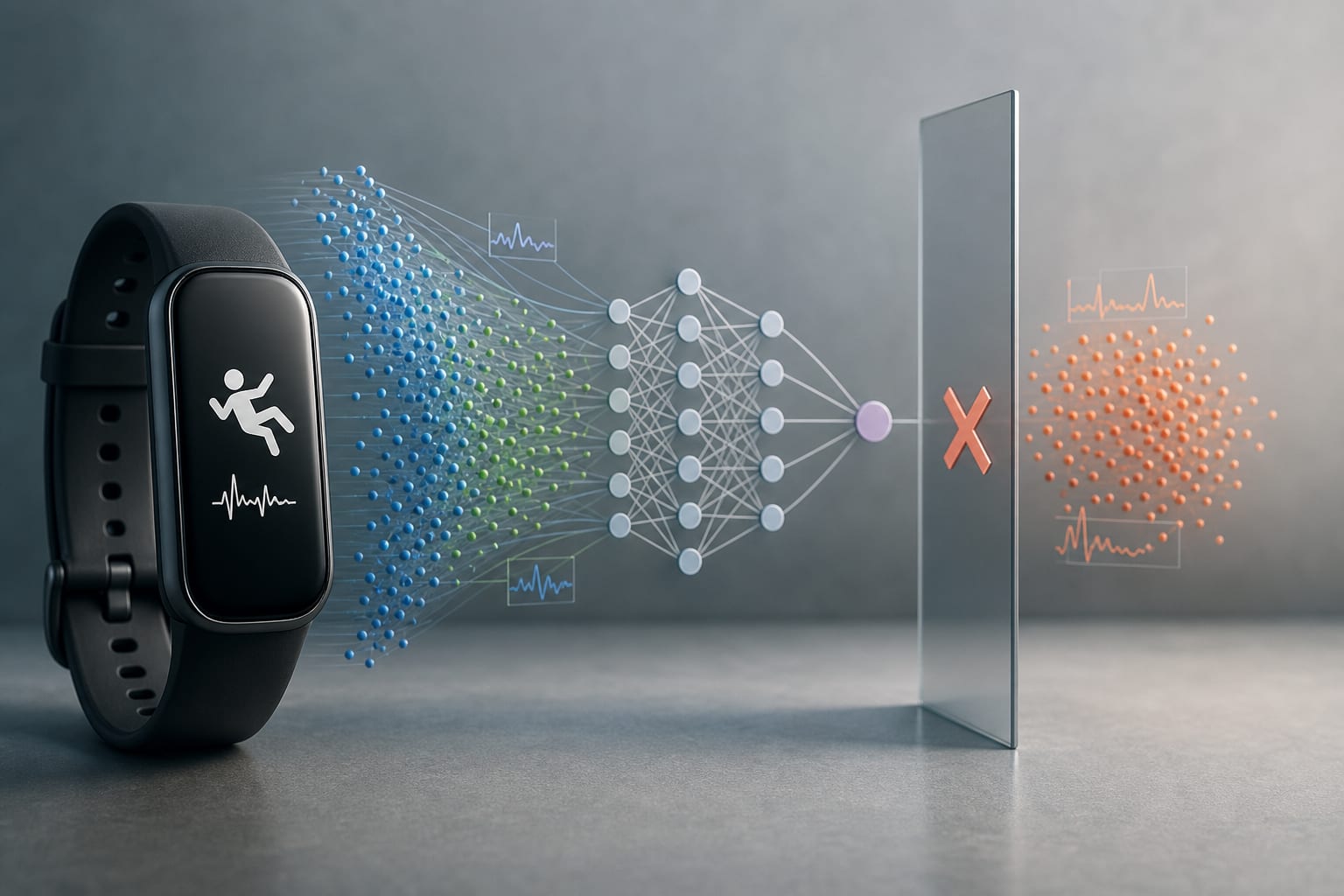
Concerns regarding test-set independence in the evaluation of LiteFallNet
-
By
-
Yibo Wang
-
July 15, 2026
Issues Related to Test-Set Independence in Assessing LiteFallNet's Performance
Overview
The evaluation of LiteFallNet's performance raises concerns regarding test-set independence due to the use of augmented data.
Background
The deployment of machine learning models in digital health, particularly for fall detection, necessitates rigorous evaluation protocols to ensure their effectiveness in real-world settings. Current practices, such as record-wise splitting of datasets, can lead to identity confounding.
Data Highlights
No numerical data provided in the source material.
Key Findings
- LiteFallNet was reported to have speed, accuracy, and transparency suitable for deployment.
- Augmentation of fall instances in datasets can lead to non-independent test sets.
- Record-wise splitting may allow participant-specific movement signatures in both training and test sets.
- Subject-wise evaluation is recommended to avoid identity confounding in performance assessments.
Clinical Implications
The findings highlight the importance of using independent test sets in evaluating machine learning models for fall detection.
Conclusion
Addressing these methodological concerns will strengthen the case for its real-world application.
Related Resources & Content
- Owusu et al., npj Digital Medicine, 2023 -- Issues Related to Test-Set Independence in Assessing LiteFallNet's Performance
- npj Digital Medicine — A New Benchmark for Assessing Safety and Efficacy of Medical Large Language Models in Clinical Settings
- Frontiers in Digital Health — Assessment of frontier Large Language Models in sleep medicine
- Evaluation of Neurosurgery-Focused Peer-Reviewed AI Chatbots Compared to General AI Chatbots in Bilingual Board Exams: Analyzing Accuracy, Consistency, and Strategies for Minimizing Errors
- Falls Prevention in Community-Dwelling Older Adults: Interventions | USPSTF
- About STEADI | CDC
- Falls: assessment and prevention in older people | NICE
- Assessment and prevention of falls in older people and in people 50 and over at higher risk—summary of updated NICE guidance | The BMJ
- Falls: assessment and prevention in older people and in people 50 and over at higher risk - NCBI Bookshelf
- https://academic.oup.com/ageing/article/54/4/afaf108/8116345
- Risk prediction models for falls in hospitalized older patients: a systematic review and meta-analysis | BMC Geriatrics | Springer Nature Link
- The STARD-AI reporting guideline for diagnostic accuracy studies using artificial intelligence | Nature Medicine
- https://pure-oai.bham.ac.uk/ws/files/280588163/bmj-2024-082505.full.pdf
- TRIPOD+AI statement: updated guidance for reporting clinical prediction models that use regression or machine learning methods | The BMJ
- Marketing Submission Recommendations for a Predetermined Change Control Plan for Artificial Intelligence-Enabled Device Software Functions | FDA
This content is an AI-generated, fully rewritten summary based on a published scholarly article. It does not reproduce the original text and is not a substitute for the original publication. Readers are encouraged to consult the source for full context, data, and methodology.