The high-risk phenotype for gastrointestinal vulnerability in sepsis and 28-day mortality: an integrative study based on clinical association and cross-level biological support - Report - MDSpire
Advertisement
The high-risk phenotype for gastrointestinal vulnerability in sepsis and 28-day mortality: an integrative study based on clinical association and cross-level biological support
Clinical Report: Identifying a High-Risk Gastrointestinal Vulnerability Phenotype in Sepsis
Overview
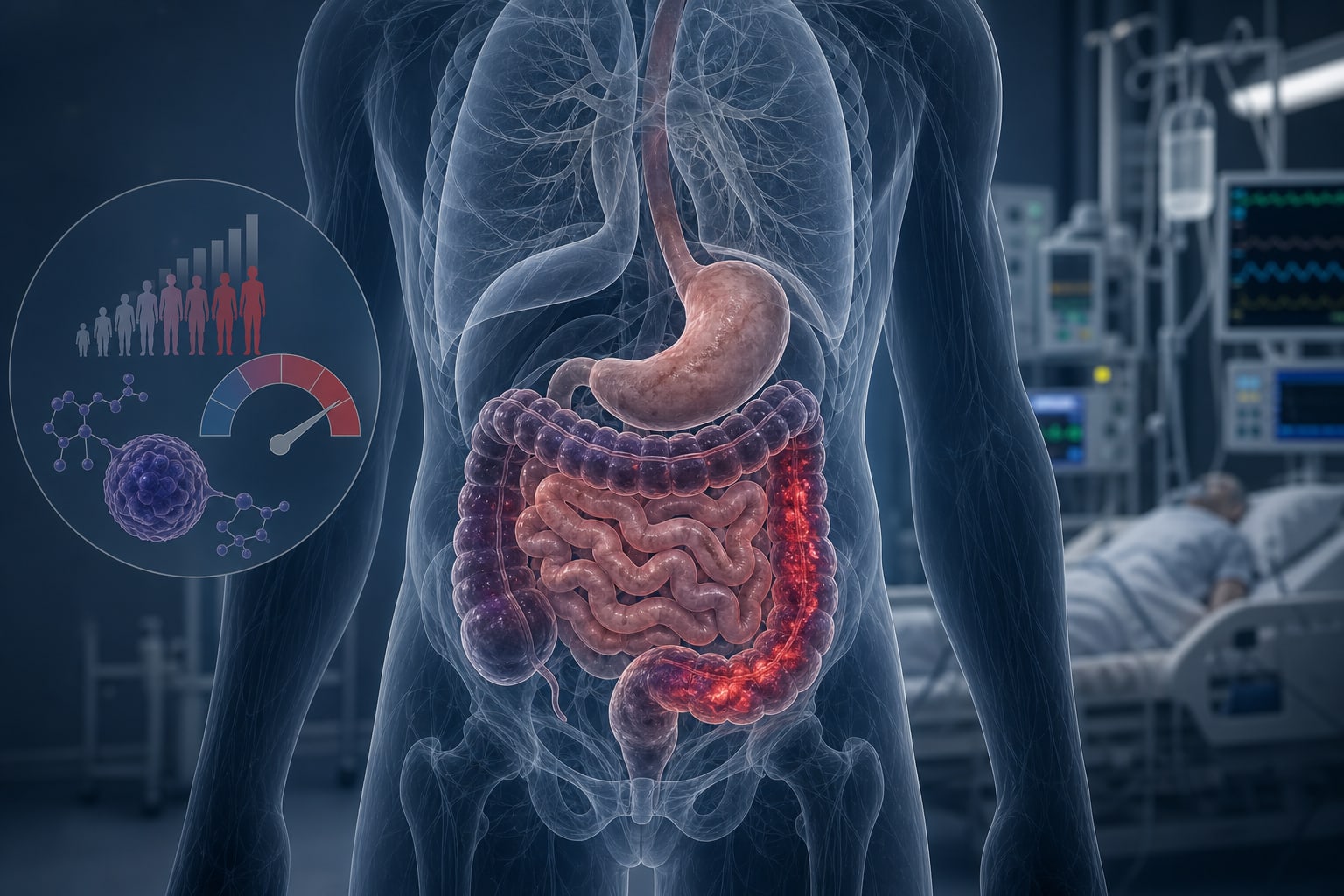
This study identifies a gastrointestinal vulnerability phenotype (GIVP) in sepsis. The GIVP high-risk phenotype is associated with 28-day mortality.
Background
Gastrointestinal dysfunction is prevalent in sepsis but is often overlooked in risk stratification frameworks. This study aims to recognize gastrointestinal factors that contribute to mortality in sepsis.
Data Highlights
Metric
Value
Adjusted OR for GIVP high-risk and 28-day mortality
1.216 (95% CI 1.143–1.295; P < 0.001)
Maximum ΔNB in full cohort
0.00291266
Maximum ΔNB in high-SOFA subgroup
0.00474649
Key Findings
The GIVP high-risk phenotype is associated with increased 28-day mortality in sepsis patients.
In the primary analysis cohort, 6,862 out of 28,224 ICU admission events resulted in 28-day mortality.
Incremental prediction analysis showed minimal discrimination improvement across the full cohort.
External validation in the eICU-CRD supported the prognostic directionality of the GIVP phenotype.
Cross-level analyses indicated a correlation with an interferon-high host-response pattern.
Clinical Implications
Clinicians should consider the GIVP high-risk phenotype when assessing sepsis patients, especially in higher-severity cases. Incorporating gastrointestinal factors into risk stratification may improve prognostic assessments and inform clinical decision-making.
Conclusion
The GIVP high-risk phenotype retains a prognostic association with 28-day mortality in sepsis.