Donor–recipient HLA molecular mismatch and T follicular helper-related genetic variants are associated with dnDSA development after kidney transplantation - Report - MDSpire

Donor–recipient HLA molecular mismatch and T follicular helper-related genetic variants are associated with dnDSA development after kidney transplantation

  • By

  • Hidetoshi Shidahara

  • Kentaro Ide

  • Aiko Yamaoka

  • Yuki Imaoka

  • Seiichi Shimizu

  • Hiroyuki Tahara

  • Masahiro Ohira

  • Yuka Tanaka

  • Hideki Ohdan

  • July 6, 2026

  • 0 min

Share

Association of HLA Molecular Discrepancies and T Follicular Helper Gene Variants

Overview

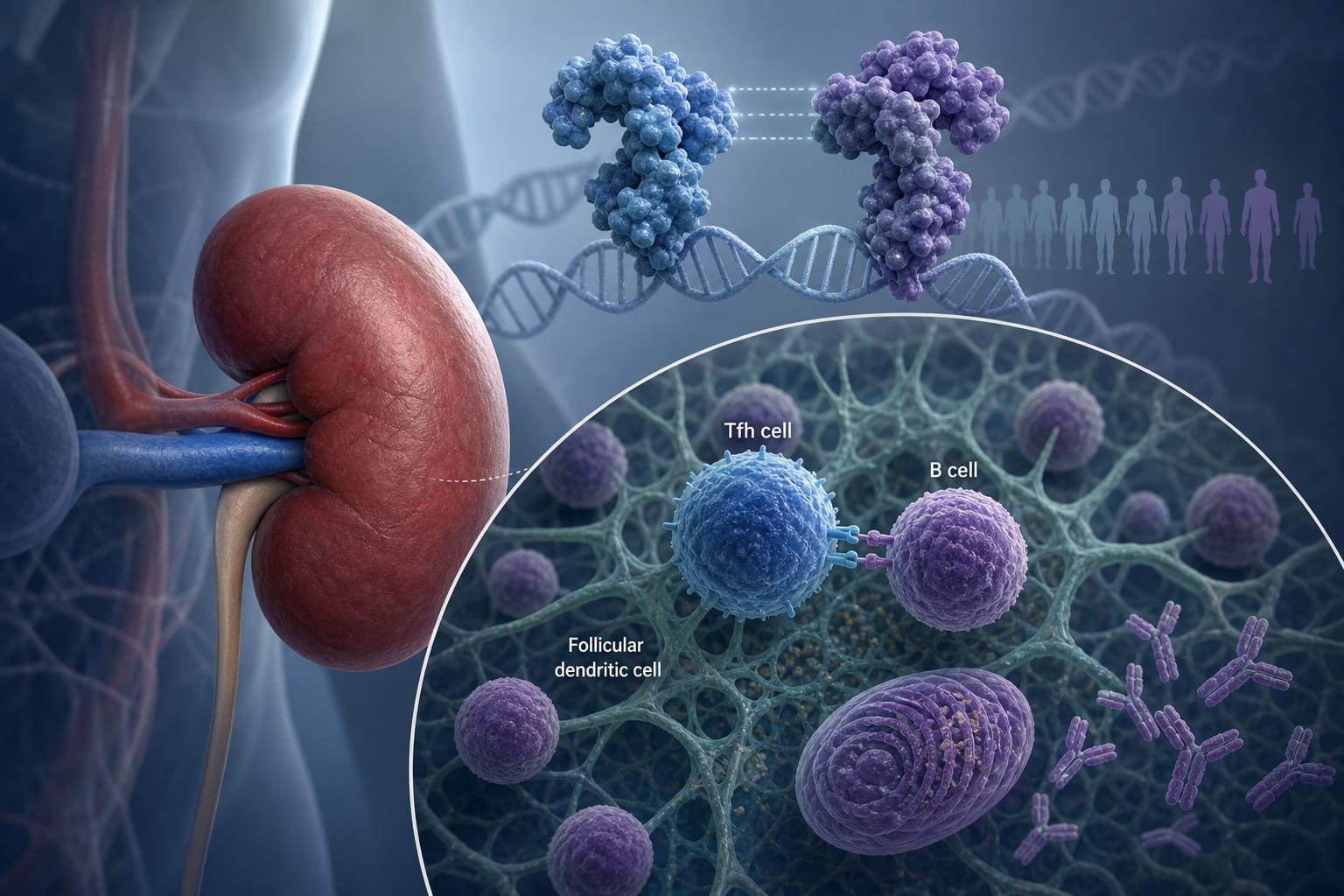
This study investigates the relationship between HLA molecular mismatch and T follicular helper (Tfh) gene variants in the development of de novo donor-specific antibodies (dnDSAs) following kidney transplantation.

Background

The emergence of dnDSAs post-kidney transplantation is a critical factor in antibody-mediated rejection (AMR), influencing graft survival. Understanding the immunogenetic factors contributing to dnDSA development is essential.

Data Highlights

MetricAssociation with dnDSA Development
HLA-EMMA Class II LoadStrongly associated
Tfh-related Genetic VariationsIndependently associated
Overall dnDSA Development Rate9.5%

Key Findings

  • 20 out of 210 recipients (9.5%) developed class II dnDSAs during follow-up.
  • Higher class II molecular mismatch loads were significantly associated with dnDSA development.
  • HLA-EMMA showed the strongest association among the mismatch metrics evaluated.
  • Both high HLA-EMMA class II load and Tfh-related polymorphisms were independently linked to dnDSA development.
  • Recipients with both high HLA-EMMA class II load and Tfh-related polymorphisms exhibited the highest cumulative incidence of dnDSA.

Clinical Implications

The findings indicate that assessing both HLA molecular mismatch and recipient Tfh-related genetic variations may be relevant for dnDSA development.

Conclusion

Further validation in independent cohorts is necessary before clinical application.

Related Resources & Content

  1. Frontiers in Immunology, 2026 -- Intragraft donor-specific antibodies reflect histologic heterogeneity in kidney allografts with concurrent serum DSA
  2. Frontiers in Immunology, 2026 -- Risk-adapted HLA delisting and imlifidase-enabled deceased-donor kidney transplantation in highly sensitized kidney transplant candidates: a German expert consensus report
  3. Frontiers in Immunology, 2026 -- Highly sensitized kidney transplant candidates: integrating acceptable mismatch, desensitization, imlifidase, and emerging immune-cell targeting strategies
  4. Bone Marrow Transplantation — Are Donor Specific Antibodies (DSA) the Sole Contributing Factor to Primary Graft Failure?
  5. A Hitchhiker’s Guide to Antibody-Mediated Rejection | New England Journal of Medicine
  6. Defining Relationships Among Tests for Kidney Transplant Antibody-Mediated Rejection - PubMed
  7. The clinical utility of post-transplant monitoring of donor-specific antibodies in stable renal transplant recipients: A consensus report with guideline statements for clinical practice • ESOT
  8. Antibody-mediated rejection-treatment standard - PubMed
  9. Frontiers Publishing Partnerships | The Progress and Challenges of Implementing HLA Molecular Matching in Clinical Practice
  10. De Novo donor-specific anti-HLA antibody risk stratification in kidney transplantation using a combination of B cell and T cell molecular mismatch assessment - PubMed
  11. Variations in de novo donor-specific antibody development among HLA-DQ mismatches in kidney transplant recipients | PLOS One
  12. Persistent versus resolved donor-specific antibodies predict 10-year antibody-mediated rejection and kidney transplant outcomes in Thailand | Scientific Reports
  13. Genome-wide donor–recipient non-HLA mismatch and graft loss | Nephrology Dialysis Transplantation | Oxford Academic
  14. Increased Proportion of Circulating T Follicular Helper Cells and Serum Levels of IL-21 in Antibody-Mediated Rejection of Renal Allograft - PubMed
  15. CXCR5+PD1+ICOS+ Circulating T Follicular Helpers Are Associated With de novo Donor-Specific Antibodies After Renal Transplantation - PMC
  16. Genetic Polymorphisms in Follicular Helper T Cell–Related Molecules Predispose Patients to De Novo Donor-Specific Antibody Formation After Kidney Transplantation - ScienceDirect

Original Source(s)

Related Content