Modified Snare-Ride Technique for Target Vessel Stenting in FB-EVAR - Report - MDSpire

Modified Snare-Ride Technique for Target Vessel Stenting in FB-EVAR

  • By

  • Victor A. Nunes

  • Vivian C. Gomes

  • Jacob C. Wood

  • F. Ezequiel Parodi

  • Mark A. Farber

  • June 29, 2026

  • 0 min

Share

Clinical Report: Enhanced Snare-Ride Approach for Stenting Target Vessels in FB-EVAR Procedures

Overview

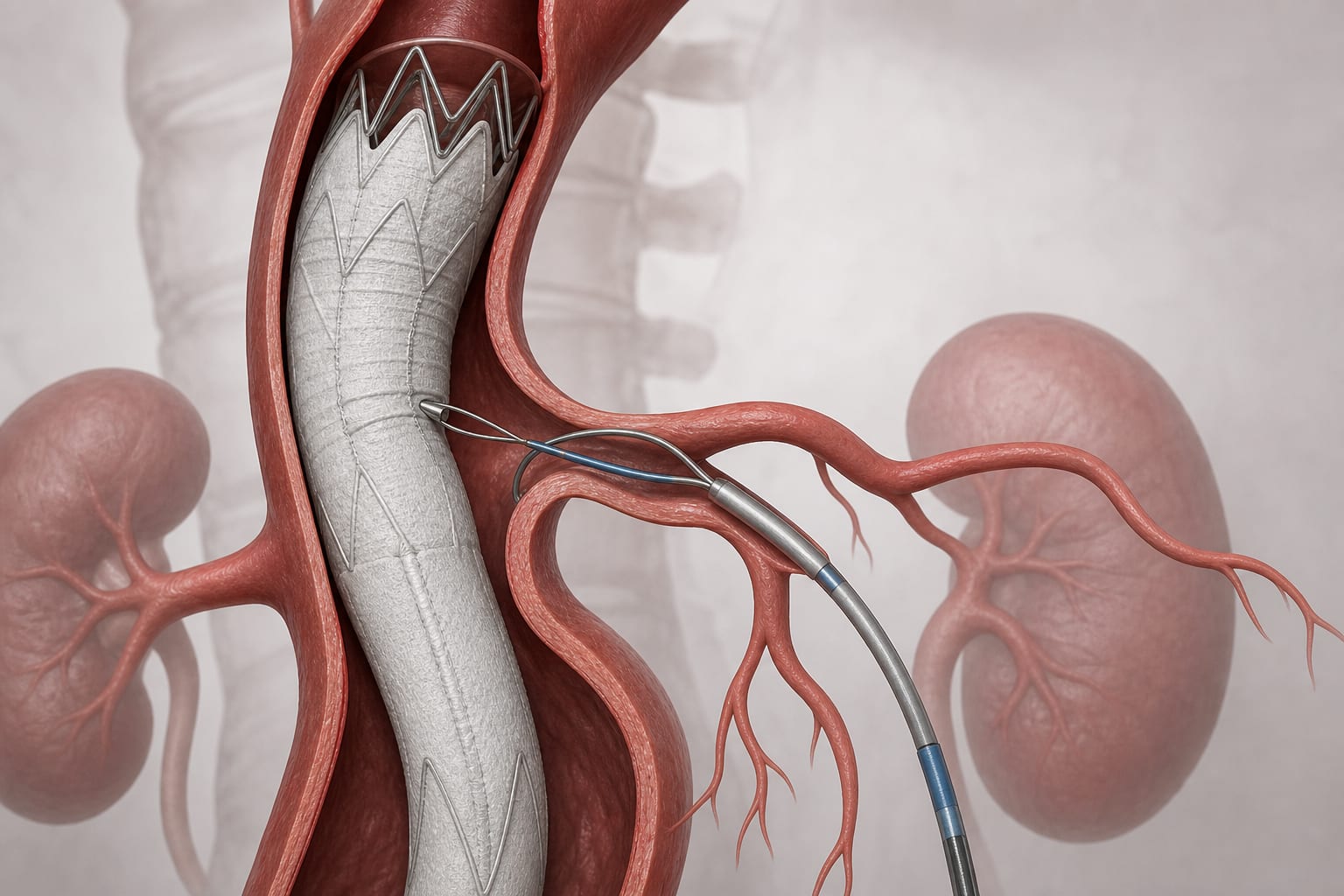
The modified Snare-Ride technique provides a practical solution for achieving stable target vessel access during fenestrated branched endovascular aortic repair (FB-EVAR) in challenging anatomical scenarios.

Background

The endovascular approach has become essential in managing complex aortic aneurysms, particularly through fenestrated and branched endovascular repair (FB-BEVAR). Target vessel catheterization is often complicated by hostile anatomy, necessitating effective bailout techniques to ensure procedural success. The modified Snare-Ride technique addresses these challenges by enhancing access and stability during stent delivery.

Data Highlights

No numerical data provided in the source material.

Key Findings

  • A modified Snare-Ride technique allows through-and-through access to target vessels.
  • This technique stabilizes the delivery sheath at the target vessel origin, improving procedural success.
  • It reduces the risk of intimal injury and vessel dissection compared to the classic Snare-Ride technique.
  • The modified approach serves as a bailout option when standard catheterization fails.
  • Successful application demonstrated in a case involving a patient with complex aortic anatomy.

Clinical Implications

The modified Snare-Ride technique can be considered a valuable option for clinicians facing difficulties in target vessel catheterization during FB-EVAR procedures.

Conclusion

The modified Snare-Ride technique represents a significant advancement in the management of challenging anatomical scenarios during FB-EVAR.

Related Resources & Content

  1. Frontiers in Cardiovascular Medicine, 2026 -- Snare Technique for Valve-in-Valve Transcatheter Aortic Valve Replacement in a Stented Coarctation of the Aorta: A Case Report
  2. Sentara, Abdominal Aortic Aneurysm: When Endovascular Repair Is the Right Option
  3. Journal of Endovascular Therapy, Endovascular Conversion of a Failed Fenestrated Anaconda Endograft Using a Branched Custom-Made Device
  4. Feasibility Study of Combined FEM and EM Tracking for Aortic Roadmapping in Endovascular Aneurysm Repair
  5. 2022 ACC/AHA Guideline for the Diagnosis and Management of Aortic Disease
  6. ESVS 2024 Clinical Practice Guidelines on the Management of Abdominal Aorto-Iliac Artery Aneurysms
  7. 2024 ESC Guidelines for PAD and Aortic Diseases: Key Points
  8. Fenestrated-Branched Endovascular Thoracoabdominal AA Repair - American College of Cardiology
  9. Systematic review and meta-analysis on the outcomes after fenestrated-branched endovascular repair in post-dissection thoraco-abdominal aortic aneurysms - PubMed
  10. Systematic review and meta-analysis of cerebrospinal fluid drain-related mortality and morbidity after fenestrated-branched endovascular aortic repair - ScienceDirect
  11. "snare-Ride": A Bailout Technique to Catheterize Target Vessels with Unfriendly Anatomy in Branched Endovascular Aortic Repair - Mayo Clinic
  12. The Elevator Technique: A New Bailout Maneuver to Achieve Target Vessel Patency During Challenging BEVAR - Erol Lerisson, Thomas Le Houérou, Mark Rockley, Antoine Gaudin, Alessandro Costanzo, Dominique Fabre, Stéphan Haulon, 2025
  13. The “Lasso-Technique”: A Maneuver to Stabilize a Steerable Sheath for Transfemoral Access to Antegrade Branches in Branched Endovascular Aortic Repair—A Report of Four Cases - Heiko Wendorff, Maryna Jensch, Felix Kirchhoff, Michael Kallmayer, Daniela Branzan, Angelos Karlas, Christoph Knappich, 2025
  14. Stabilization of a steerable sheath during retrograde access to antegrade-oriented branches in complex endovascular aortic aneurysm repair - PMC

Original Source(s)

Related Content