Application of laparoscopy, choledochoscopy, and duodenoscopy in the treatment of gallstones with choledocholithiasis - Report - MDSpire

Application of laparoscopy, choledochoscopy, and duodenoscopy in the treatment of gallstones with choledocholithiasis

  • By

  • Wei Wu

  • Xinhua Wu

  • Rixin Zhang

  • Xiaowan Li

  • Ting Li

  • Ling Zhu

  • Bing Wang

  • Zhi Zheng

  • June 22, 2026

  • 0 min

Share

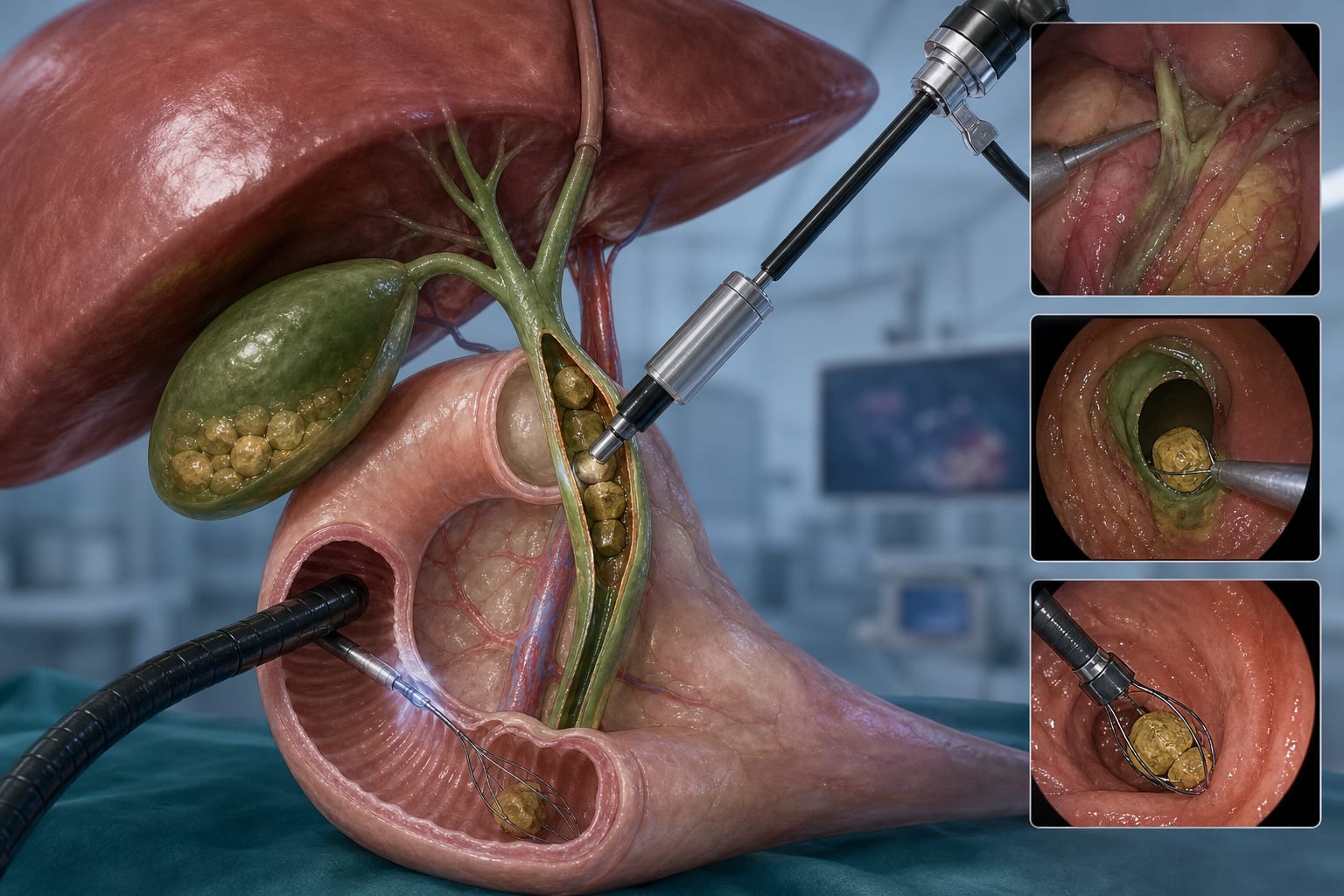
Clinical Report: Utilization of Laparoscopy, Choledochoscopy, and Duodenoscopy for Managing Gallstones Associated with Choledocholithiasis

Overview

This study evaluates the effectiveness of a combined approach using laparoscopy, choledochoscopy, and duodenoscopy for managing gallstones associated with choledocholithiasis. The findings indicate increased operative time and blood loss, with a shorter hospital stay.

Background

Gallstone disease is prevalent among adults, with a significant proportion developing choledocholithiasis, which can lead to severe complications such as pancreatitis and cholangitis. Current treatment strategies often involve either endoscopic retrograde cholangiopancreatography (ERCP) followed by laparoscopic cholecystectomy or laparoscopic common bile duct exploration (LCBDE), but the optimal management strategy remains debated. This study aims to explore a combined approach to enhance treatment outcomes.

Data Highlights

GroupMean Age (years)Operative Time (min)Estimated Blood Loss (mL)Postoperative Complications (%)Hospital Stay (days)
Experimental (n=30)631524610%Shorter
Control (n=10)N/AN/AN/AN/ALonger

Key Findings

  • The experimental group (n=30) utilized a combined approach of laparoscopy, choledochoscopy, and duodenoscopy.
  • The mean operative time for the experimental group was 152 minutes.
  • Postoperative pancreatitis occurred in 6.7% of patients in the experimental group.
  • One patient (3.3%) in the experimental group developed a biliary fistula.
  • Hospital stay was significantly shorter in the experimental group compared to the control group.
  • Increased operative blood loss and time were noted in the experimental group compared to the control group.

Clinical Implications

The findings indicate that the combined endoscopic approach may provide an alternative for managing gallstones with choledocholithiasis.

Conclusion

The study presents a combined approach for managing gallstones associated with choledocholithiasis.
Related Resources & Content

  1. Surgical Endoscopy, 2021 -- Surgical Approaches for Treating Cholecystolithiasis with Concurrent Choledocholithiasis: Insights from Six Years at a Single Institution
  2. Obesity Surgery, 2026 -- Laparoscopic Transcystic Common Bile Duct Exploration for the Treatment of Choledocholithiasis Following Roux-en-Y Gastric Bypass
  3. Surgical Endoscopy, 2026 -- Clinical outcomes of immediate, 24-h, and 24–72-h laparoscopic cholecystectomy after endoscopic stone clearance: a matched cohort analysis
  4. Surgical Endoscopy, 2026 -- Through the scope, through the years: declining trends in laparoscopic common bile duct exploration
  5. ESGE Guidelines, 2019 -- Guideline framework
  6. ASGE guideline on the role of endoscopy in the evaluation and management of choledocholithiasis - PMC
  7. ASGE guideline on the role of endoscopy in the evaluation and management of choledocholithiasis - ScienceDirect
  8. BMC Surgery, 2025 -- Laparoscopic one-stage vs. two-stage management for choledocholithiasis: a systematic review and meta-analysis
  9. 17662 472..491
  10. ASGE guideline on the role of endoscopy in the evaluation and management of choledocholithiasis - PMC
  11. ASGE guideline on the role of endoscopy in the evaluation and management of choledocholithiasis - ScienceDirect
  12. Laparoscopic one-stage (intraoperative-cholangiopancreatography / laparoscopic cholecystectomy or laparoscopic common bile duct exploration / laparoscopic cholecystectomy) vs. two-stage (pre-op cholangiopancreatography → laparoscopic cholecystectomy) for choledocholithiasis: a systematic review and meta-analysis | BMC Surgery | Springer Nature Link
  13. Meta-analysis of randomized controlled trials comparing single-stage laparoscopic versus two-stage endoscopic management followed by laparoscopic cholecystectomy of preoperatively diagnosed common bile duct stones - PMC
  14. Peroral cholangioscopy for detecting residual stones missed by cholangiography: Systematic review and meta-analysis - PubMed
  15. Papillary cannulation and sphincterotomy techniques at ERCP: ESGE Clinical Guideline | ESGE

Original Source(s)

Related Content