Blood urea nitrogen to albumin ratio and 1-year mortality after hip fracture surgery in older adults: a retrospective cohort study - Report - MDSpire

Association of Blood Urea Nitrogen to Albumin Ratio with One-Year Mortality Following Hip Fracture Surgery in Elderly Patients: A Retrospective Cohort Analysis

  • By

  • Jian Wang

  • Liuyang Shi

  • Zihan Zhang

  • Jiale Guo

  • Junjie Xu

  • July 17, 2026

Share

Clinical Report: Association of Blood Urea Nitrogen to Albumin Ratio with One-Year Mortality Following Hip Fracture Surgery in Elderly Patients

Overview

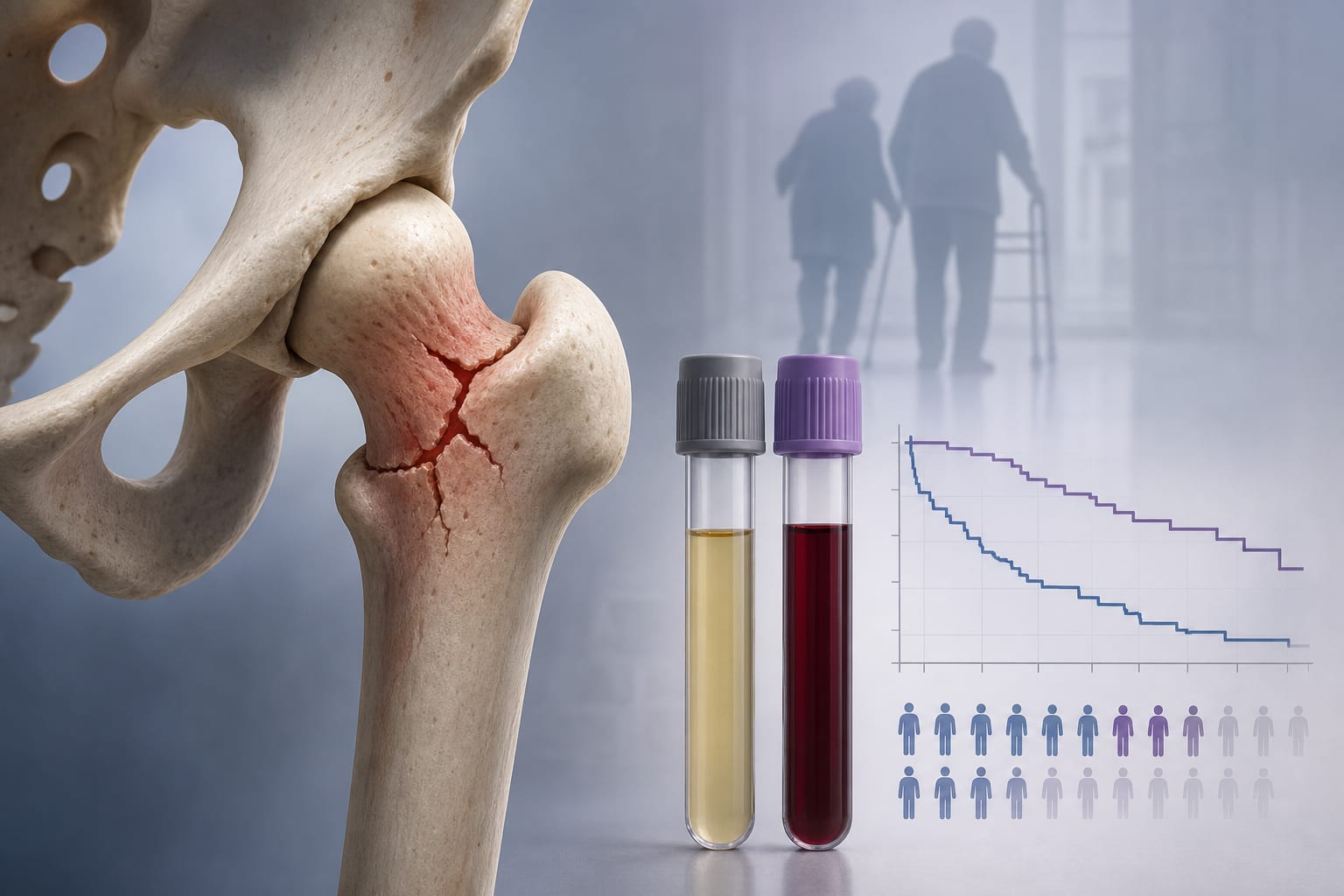
This study evaluates the association between the blood urea nitrogen to albumin ratio (BAR) and one-year all-cause mortality in elderly patients post-hip fracture surgery.

Background

Hip fractures in older adults are associated with high mortality rates, particularly within the first year following surgery. Understanding prognostic indicators like BAR can aid in risk stratification and management of these patients.

Data Highlights

MeasureValue
Patients Included521
1-Year Mortality Rate14.8%
Odds Ratio for Higher BAR1.13 (95% CI: 1.05–1.22, P < 0.01)
Area Under Curve (AUC) for BAR0.67

Key Findings

  • Higher BAR is associated with increased risk of 1-year all-cause mortality after hip fracture surgery.
  • In univariate analysis, BAR was associated with mortality risk.
  • After adjusting for confounders, BAR remained associated with mortality.
  • The AUC for BAR was 0.67.
  • No significant nonlinear association was observed in the RCS analysis.

Clinical Implications

BAR may serve as a useful indicator for assessing mortality risk in elderly patients following hip fracture surgery.

Conclusion

The study finds that higher BAR is associated with increased mortality risk in older patients after hip fracture surgery.
Related Resources & Content

  1. Conexiant, Conexiant, 2023 -- BAR Could Predict Mortality After Hip Fracture
  2. NICE, NICE, 2023 -- Recommendations | Hip fracture: management | Guidance
  3. AAOS, AAOS, 2023 -- Hip Fractures in the Elderly Clinical Practice Guideline
  4. Frontiers in Endocrinology — Association of the serum uric acid to high-density lipoprotein cholesterol ratio with in-hospital mortality in patients with acute kidney injury: a retrospective cohort study
  5. Frontiers in Medicine — Elevated neutrophil percentage–to–albumin ratio is associated with postoperative pneumonia in patients with hip fractures
  6. Elderly patients with obesity and hip fractures may experience improved survival rates post-surgery
  7. Recommendations | Hip fracture: management | Guidance | NICE
  8. https://new.aaos.org/globalassets/quality-and-practice-resources/hip-fractures-in-the-elderly/hipfxcpg.pdf
  9. Comparing Two Types of Anesthesia for Hip Fracture Surgery – The REGAIN Trial - NCBI Bookshelf
  10. Myocardial injury in hip fractures: a HIP ATTACK-1 randomized trial substudy | European Heart Journal | Oxford Academic
  11. Pain as a Driver of Myocardial Injury in Hip Fracture Patients: A Hip Fracture Accelerated Surgical Treatment and Care Track (HIP ATTACK) Trial Secondary Analysis - PubMed
  12. Effects of Orthogeriatric Care Models on Outcomes of Hip Fracture Patients: A Systematic Review and Meta-Analysis - PMC
  13. Prognostic Role of BUN-to-Albumin Ratio, Albumin-to-ALP Ratio, and Mortality in Critically Ill Patients With Hip Fracture: Analysis of the MIMIC-IV Database, 2008 to 2019 - PubMed
  14. Association of serum high creatinine-to-albumin ratio with increased 1-year mortality in older patients following hip fracture surgery - PubMed
  15. Geriatric nutritional risk index as an independent predictor of 1-year mortality in elderly patients with hip fractures

Original Source(s)

Related Content