Labial-gland artificial intelligence model screening for autoimmune thyroiditis among patients with connective tissue disease - Report - MDSpire

Labial-gland artificial intelligence model screening for autoimmune thyroiditis among patients with connective tissue disease

  • By

  • Jia-yun Wu

  • Yuening Kang

  • Xiao-min Li

  • Wen-qi Xia

  • Ru-yi Liao

  • Zhi-yang He

  • Yu-ling Chen

  • Ya Wen

  • Fan-xuan Meng

  • Jing-yu Zhang

  • Zheng Yang

  • Yong Ren

  • Qing Lv

  • June 23, 2026

  • 0 min

Share

Clinical Report: AI Model for Screening Autoimmune Thyroiditis in CTD Patients

Overview

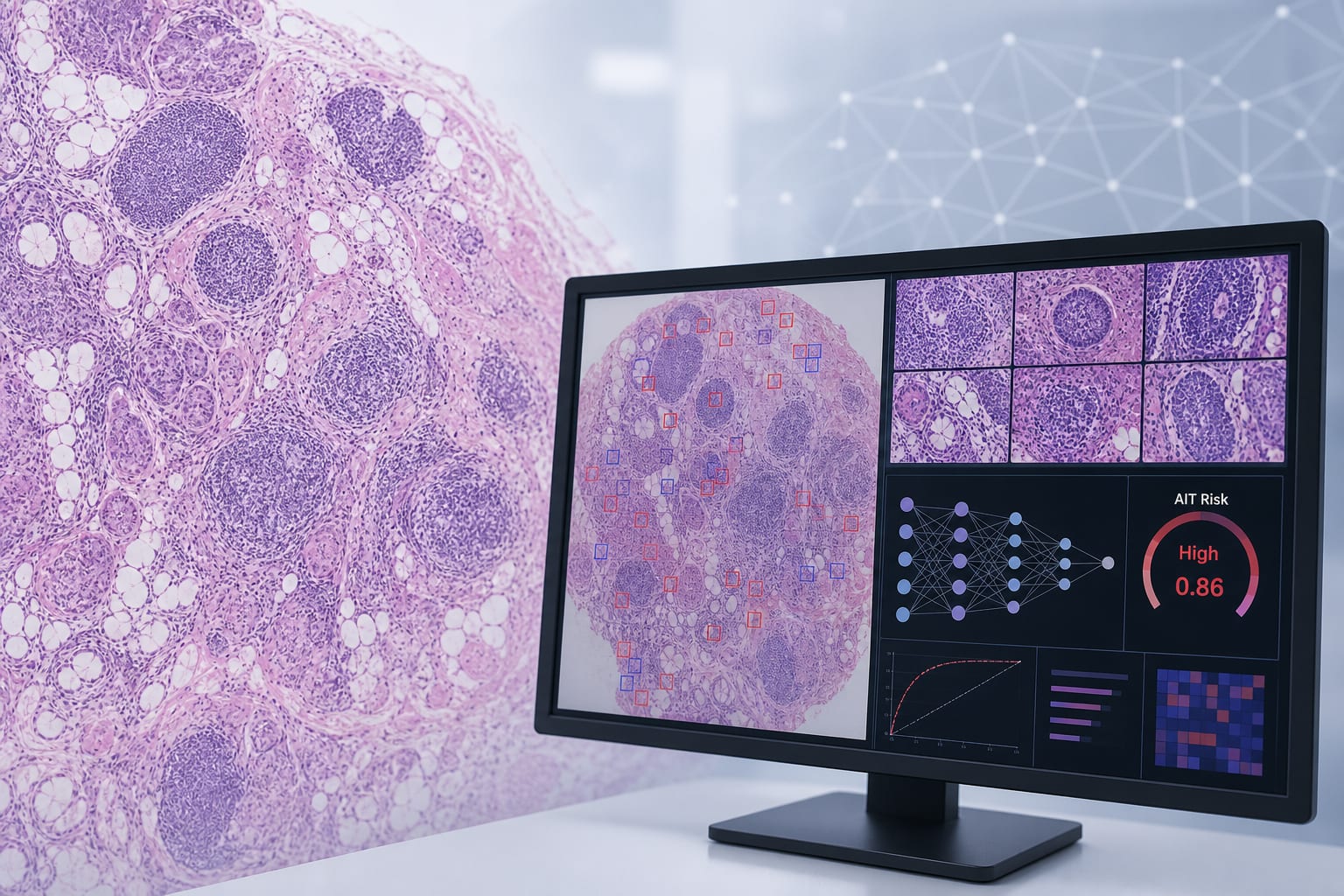
This study presents a deep learning-based model for predicting autoimmune thyroiditis (AIT) risk in connective tissue disease (CTD) patients using labial gland pathology images. The model demonstrated strong predictive performance with an AUC of 0.829.

Background

Autoimmune thyroiditis (AIT) is a significant concern in patients with connective tissue diseases (CTD). The identification of AIT risk in CTD patients is crucial for diagnosis and treatment strategies. This study leverages advanced machine learning techniques to enhance the accuracy of AIT risk prediction based on labial gland pathology.

Data Highlights

The study analyzed labial gland pathological sections from 121 CTD patients, categorizing them into positive and negative groups based on thyroid autoantibody results. The model achieved an AUC of 0.829 in both internal and external validation sets.

Key Findings

  • The study utilized a pre-trained EfficientNet-B5 model for feature extraction from labial gland images.
  • Patients were divided into positive (Ab+ Group) and negative (Ab- Group) based on thyroid autoantibody presence.
  • The integrated model effectively identified key pathological features related to AIT risk in CTD patients.
  • The model's predictive performance was validated with an AUC of 0.829.

Clinical Implications

The development of this AI model provides a new tool for clinicians to assess the risk of AIT in CTD patients.

Conclusion

The study confirms the efficacy of a deep learning-based prediction model in evaluating AIT risk among CTD patients.

Related Resources & Content

  1. The ASCO Post, 2022 -- AI Model May Aid in Screening, Staging, and Treatment Planning for Thyroid Cancer
  2. AACE Endocrine AI, 2026 -- AI model may help to standardize thyroid eye disease grading
  3. Clinical Rheumatology, 2025 -- Utilizing Artificial Intelligence to Forecast Organ Involvement in Sjogren’s Syndrome Through Whole-Slide Imaging of Labial Gland Biopsies
  4. PMC, 2016 -- 2016 ACR-EULAR Classification Criteria for primary Sjögren’s Syndrome
  5. Frontiers in Endocrinology, 2026 -- Association between autoimmune thyroiditis and rheumatoid arthritis
  6. conexiant — Evaluating AI for thyroid nodule diagnosis
  7. Evaluating AI for thyroid nodule diagnosis
  8. 2016 ACR-EULAR Classification Criteria for primary Sjögren’s Syndrome: A Consensus and Data-Driven Methodology Involving Three International Patient Cohorts - PMC
  9. Association between autoimmune thyroiditis and rheumatoid arthritis: a cross-sectional risk stratification study
  10. Artificial intelligence-based prediction of organ involvement in Sjogren’s syndrome using labial gland biopsy whole-slide images | Clinical Rheumatology | Springer Nature Link

Original Source(s)

Related Content