A Practical Primary Care Guide to Assessing and Managing Long COVID
-
By
-
Anita Chopra
-
Hector F. Bonilla
-
Abby L. Cheng
-
October 9, 2026
Clinical Report: A Practical Primary Care Guide to Assessing and Managing Long COVID
Overview
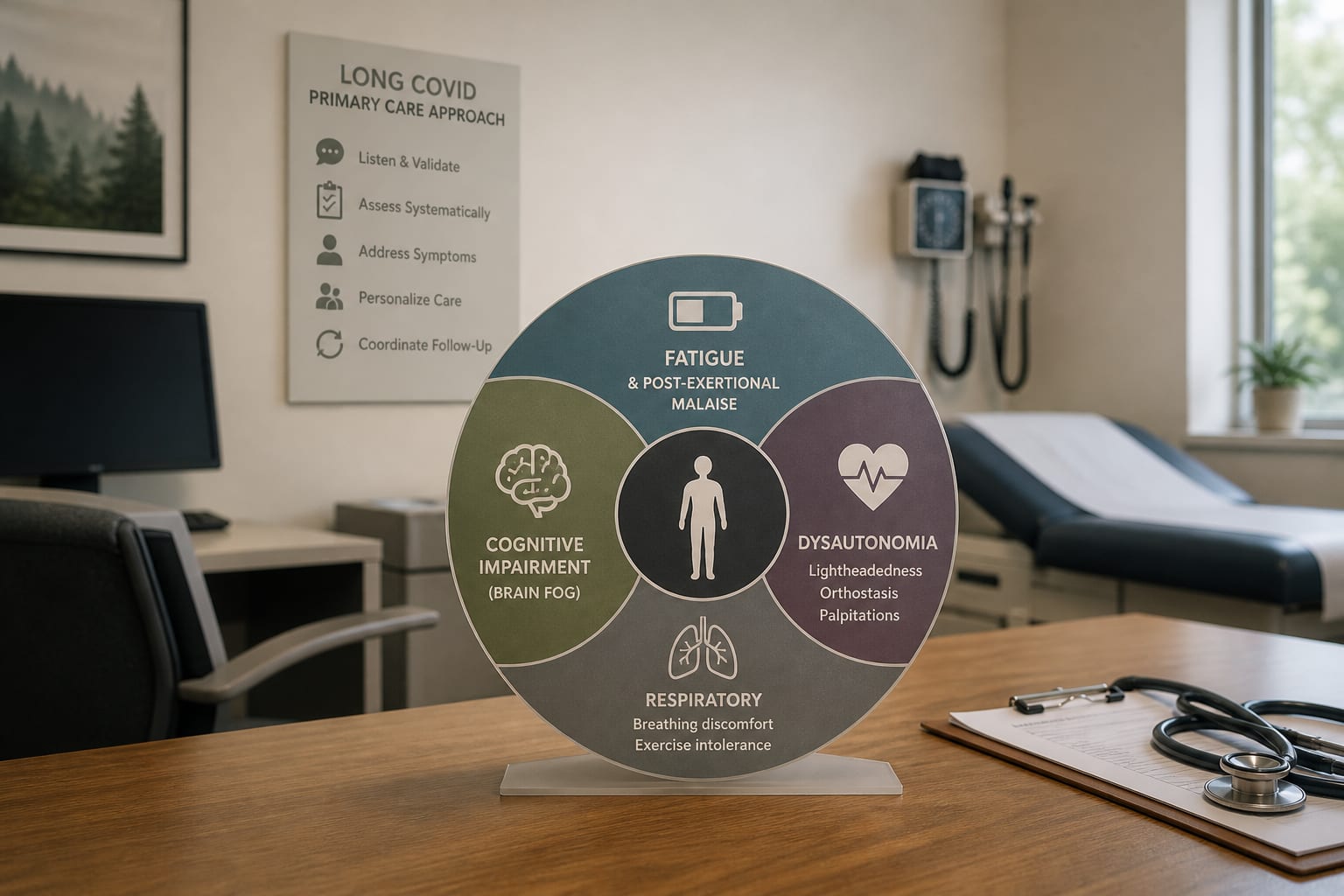
The article presents a primary-care framework for recognizing and assessing possible Long COVID, which may be considered when new or worsened symptoms persist beyond 3 months after confirmed or suspected SARS-CoV-2 infection. It highlights fatigue and post-exertional malaise, dysautonomia, and cognitive impairment as common presentations, while noting that diagnosis and care can be challenging in the absence of validated biomarkers or curative treatment.
Background
The article reports estimates that approximately 6% of US adults and 0.5% of children and adolescents continue to experience new or persistently worsened symptoms beginning soon after acute SARS-CoV-2 infection. Symptoms vary in type and severity; fatigue, post-exertional malaise, cognitive impairment, and lightheadedness or orthostasis are among those reported most often. Definitions differ in timing, duration, functional impact, and whether laboratory confirmation is required; in clinical settings, the article describes Long COVID as new or worsened symptoms after confirmed or suspected infection that continue beyond 3 months. Primary care clinicians are positioned to provide longitudinal, holistic care, although limited visit time and access to subspecialty consultation can complicate assessment.
Data Highlights
| Measure or presentation | Source-reported detail |
|---|---|
| Estimated prevalence | Approximately 6% of US adults and 0.5% of children and adolescents experience new or persistently worsened symptoms that began soon after acute SARS-CoV-2 infection. |
| Clinical time frame | The article describes Long COVID in clinical settings as new or worsened symptoms following confirmed or suspected acute infection that continue beyond 3 months. |
| Common symptoms | Fatigue, post-exertional malaise, cognitive impairment (“brain fog”), and lightheadedness or orthostasis are reported most often. |
| Case 1 | Symptoms began approximately one month after mild COVID-19; fatigue and post-exertional worsening impaired daily activities and work. |
| Case 2 | Three months of palpitations, lightheadedness, and near-syncope on standing followed a possible preceding infection. |
| Case 3 | Persistent newly developed cognitive impairment was reported five months after mild COVID-19; the supplied case description is incomplete. |
Key Findings
- Long COVID symptoms can vary substantially in type and severity and may include fatigue, post-exertional malaise, cognitive impairment, orthostatic symptoms, gastrointestinal symptoms, sleep disturbance, pain, or breathing discomfort.
- The article advises considering Long COVID when symptoms are new or worsened after confirmed or suspected SARS-CoV-2 infection and continue beyond 3 months; research definitions may additionally require laboratory confirmation.
- Symptom clusters may help clinicians recognize Long COVID and associated conditions, including myalgic encephalomyelitis/chronic fatigue syndrome and postural orthostatic tachycardia syndrome.
- The fatigue and post-exertional malaise vignette describes symptom exacerbation after minimal activity, prolonged “crashing,” and reduced capacity for routine tasks and work.
- The dysautonomia vignette describes palpitations, lightheadedness, and near-syncope when standing, with relief when lying down and reduced tolerance for customary activity.
- The article identifies the lack of validated diagnostic biomarkers and curative treatment, brief primary-care visits, clinician burnout, and restricted subspecialty access as challenges to Long COVID care.
Clinical Implications
The article’s framework supports asking about prior confirmed or suspected infection and the timing of symptom onset, and assessing symptom patterns and their effects on daily function. It describes symptom-based management, counseling, and consideration of specialty referral as components of primary-care care, while acknowledging that the supplied excerpt does not provide detailed evaluation or treatment protocols.
Conclusion
Long COVID may present with diverse, functionally limiting symptoms after confirmed or suspected SARS-CoV-2 infection, and primary care is positioned to recognize and assess these presentations. The article frames its practical approach around focused evaluation, counseling, symptom-based management, and decisions about referral.
Related Resources & Content
- Article supplied in prompt, publication details not provided -- A Practical Primary Care Guide to Assessing and Managing Long COVID
- National Academies of Sciences, Engineering, and Medicine, New England Journal of Medicine, 2024 -- Long Covid Defined
- World Health Organization, Post COVID-19 condition, year not specified -- Post COVID-19 condition
- Frontiers in Cardiovascular Medicine, 2026 -- Unraveling the cardiovascular burden of long COVID: symptom profiles, underlying mechanisms, and clinical management insights
- Frontiers in Medicine, 2026 -- Long COVID as a network disorder: a mechanism-anchored framework for biological stratification and therapeutic targeting
- Frontiers in Immunology, 2026 -- Editorial: Immune Mechanisms and Treatment Approaches for Long-Term and Post-COVID Syndromes
- JAMA Network Open — Cognitive Rehabilitation and Functional Outcomes in Long COVID–Related Cognitive Impairment: A Randomized
- Long Covid Defined
- Post COVID-19 condition
- Unraveling the cardiovascular burden of long COVID: symptom profiles, underlying mechanisms, and clinical management insights
- Long COVID as a network disorder: a mechanism-anchored framework for biological stratification and therapeutic targeting
- Editorial: Immune Mechanisms and Treatment Approaches for Long-Term and Post-COVID Syndromes
- Long Covid Defined | New England Journal of Medicine
- Nirmatrelvir-Ritonavir and Symptoms in Adults With Postacute Sequelae of SARS-CoV-2 Infection: The STOP-PASC Randomized Clinical Trial - PMC
Based on findings from:
Long COVID in Primary Care: A Practical Approach to Evaluation and Management
Anita Chopra, Hector F. Bonilla, Abby L. Cheng. Journal Of General Internal Medicine, 2026.
https://link.springer.com/article/10.1007/s11606-026-10901-w
This content is an AI-generated, fully rewritten summary based on a published scholarly article. It does not reproduce the original text and is not a substitute for the original publication. Readers are encouraged to consult the source for full context, data, and methodology.