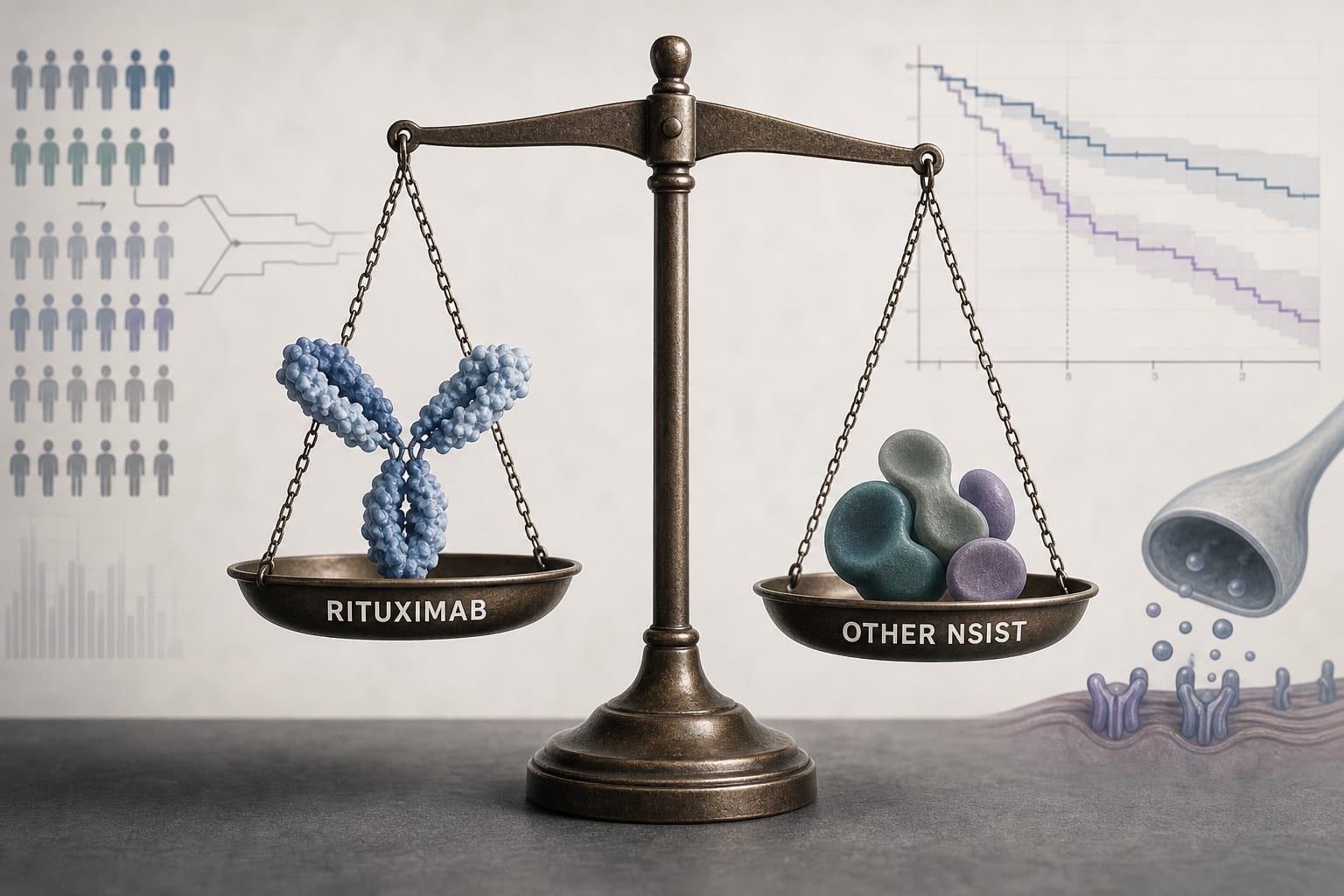
Clinical Report: Evaluating Rituximab's Effectiveness in Myasthenia Gravis
Overview
This study evaluates the effectiveness of rituximab compared to a second non-steroidal immunosuppressive therapy (NSIST) in patients with acetylcholine-receptor-antibody positive myasthenia gravis (MG). There was no statistical difference in the time to achieving a composite clinical outcome between the two treatment options.
Background
Myasthenia gravis is an autoimmune disease characterized by fluctuating muscle weakness due to antibody-mediated dysfunction at the neuromuscular junction. Rituximab, an anti-CD20 monoclonal antibody, is often used in refractory cases of MG, but its comparative effectiveness against other NSISTs remains unclear.
Data Highlights
No statistical difference was found in the hazard ratio between rituximab and a second NSIST in achieving the composite clinical outcome (HR = 1.27, 95% CI 0.66–2.45, p = 0.48).
Key Findings
169 patients were included in the time-to-event analysis.
Inverse probability of treatment weighting (IPTW) was used to balance baseline characteristics between treatment groups.
The primary outcome was defined as a composite clinical endpoint representing a patient acceptable symptom state (PASS).
Rituximab did not improve time-to-improvement compared to a second NSIST in AChR-Ab-positive MG.
Rituximab's role in MG treatment remains uncertain due to limited randomized controlled evidence.
Clinical Implications
The findings indicate that rituximab did not provide a significant advantage over other NSISTs in achieving clinical improvement in AChR-Ab-positive MG patients.
Conclusion
In this analysis, rituximab did not demonstrate improved effectiveness compared to a second NSIST in AChR-Ab-positive myasthenia gravis.
by Yong Lin Wang, Chao Zhu, Mahima Kapoor, Gary Cutter, Carolina Barnett-Tapia, Helmut Butzkueven, Wenwen Zhang, Gabor Lovas, Csilla Rozsa, Jeannine Heckmann, Stefan Blum, Laurie McLaughlin, Katherine Buzzard, Yi Chao Foong, Elisabeth Chroni, Dimitra Veltsista, Belinda Cruse, Mina Botrous, Stephen Reddel, Mastura Monif, Anneke van der Walt