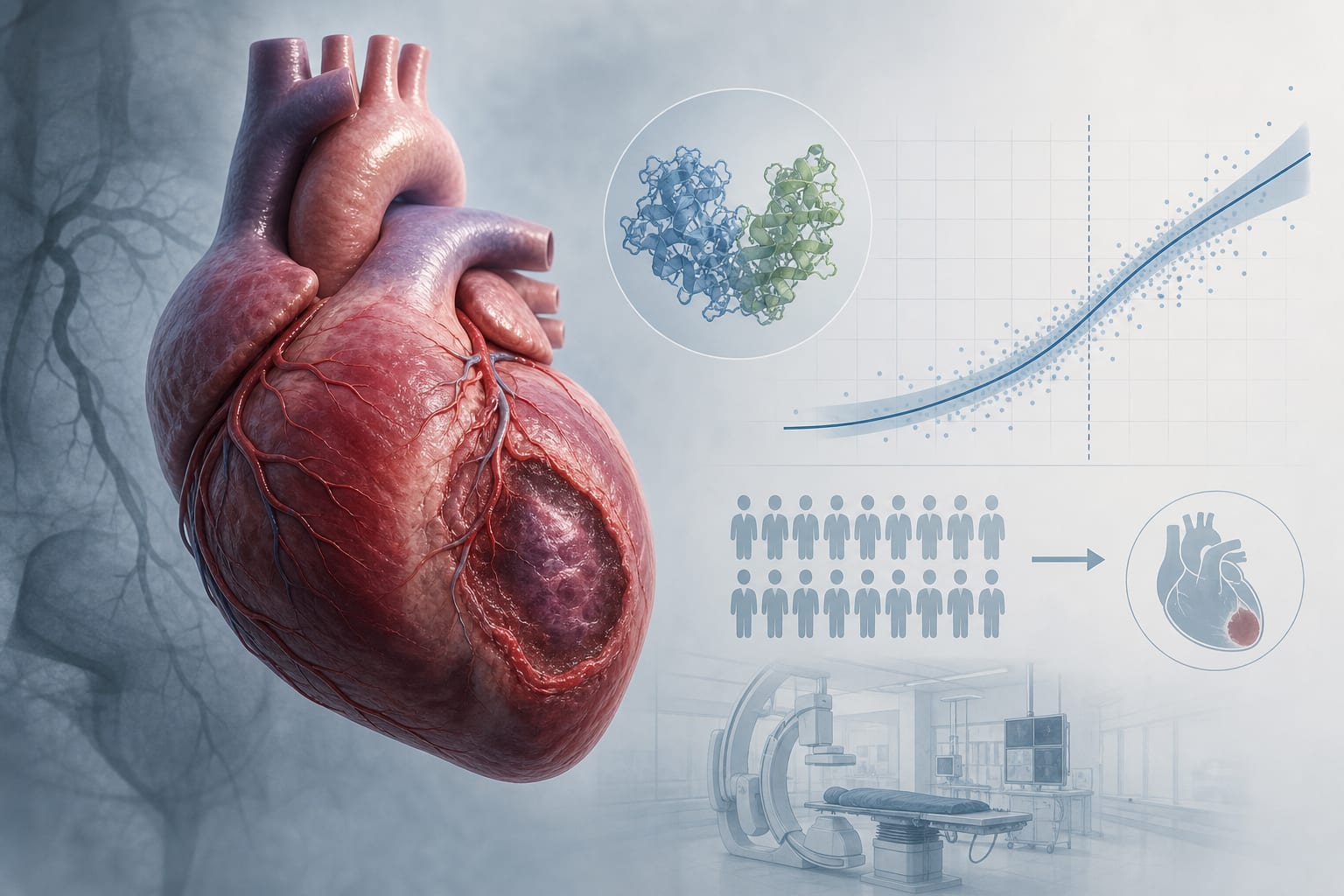
Clinical Report: Independent Prediction of Left Ventricular Aneurysm in STEMI Patients by Fibrinogen-to-Albumin Ratio
Overview
This study identifies the fibrinogen-to-albumin ratio (FAR) as an independent predictor of left ventricular aneurysm (LVA) in STEMI patients. Elevated FAR is associated with increased LVA risk.
Background
Left ventricular aneurysm (LVA) is a serious complication following ST-elevation myocardial infarction (STEMI), significantly impacting patient prognosis. Identifying patients at high risk for LVA is crucial for improving clinical outcomes, as LVA can lead to heart failure and increased mortality. Inflammatory biomarkers like the fibrinogen-to-albumin ratio (FAR) are being investigated for their potential role in LVA risk assessment.
Data Highlights
Study Cohort
FAR Association with LVA
AUC
Development Cohort
OR = 2.10 (95% CI: 1.09–4.04, P = 0.027)
0.933 (95% CI: 0.914–0.952)
Validation Cohort
Retained performance
0.934 (95% CI: 0.894–0.974)
Key Findings
High FAR is independently associated with LVA in STEMI patients (OR = 2.10).
The combined prediction model includes FAR, left ventricular ejection fraction (LVEF), and NT-proBNP.
The prediction model demonstrated high discrimination with an AUC of 0.933 in the development cohort.
Temporal validation confirmed the model's performance with an AUC of 0.934.
Mean absolute error for calibration was 0.021 after bootstrap resampling.
Clinical Implications
Measuring FAR may assist in identifying STEMI patients at risk for developing LVA.
Conclusion
Elevated FAR is a significant predictor of LVA in STEMI patients.