Changes in Academic Standardized Testing After Pediatric Intensive Care - Report - MDSpire

Changes in Academic Standardized Testing After Pediatric Intensive Care

  • By

  • Claire C. Foster

  • Melanie Boyd

  • Erin F. Carlton

  • Jill Fussell

  • Chayla R. Slaton

  • Sarah McKenzie

  • Katherine Irby

  • Peter M. Mourani

  • Clare C. Brown

  • Aline B. Maddux

  • April 30, 2026

  • 0 min

Share

Clinical Report: Impact of Pediatric Intensive Care on Academic Performance

Overview

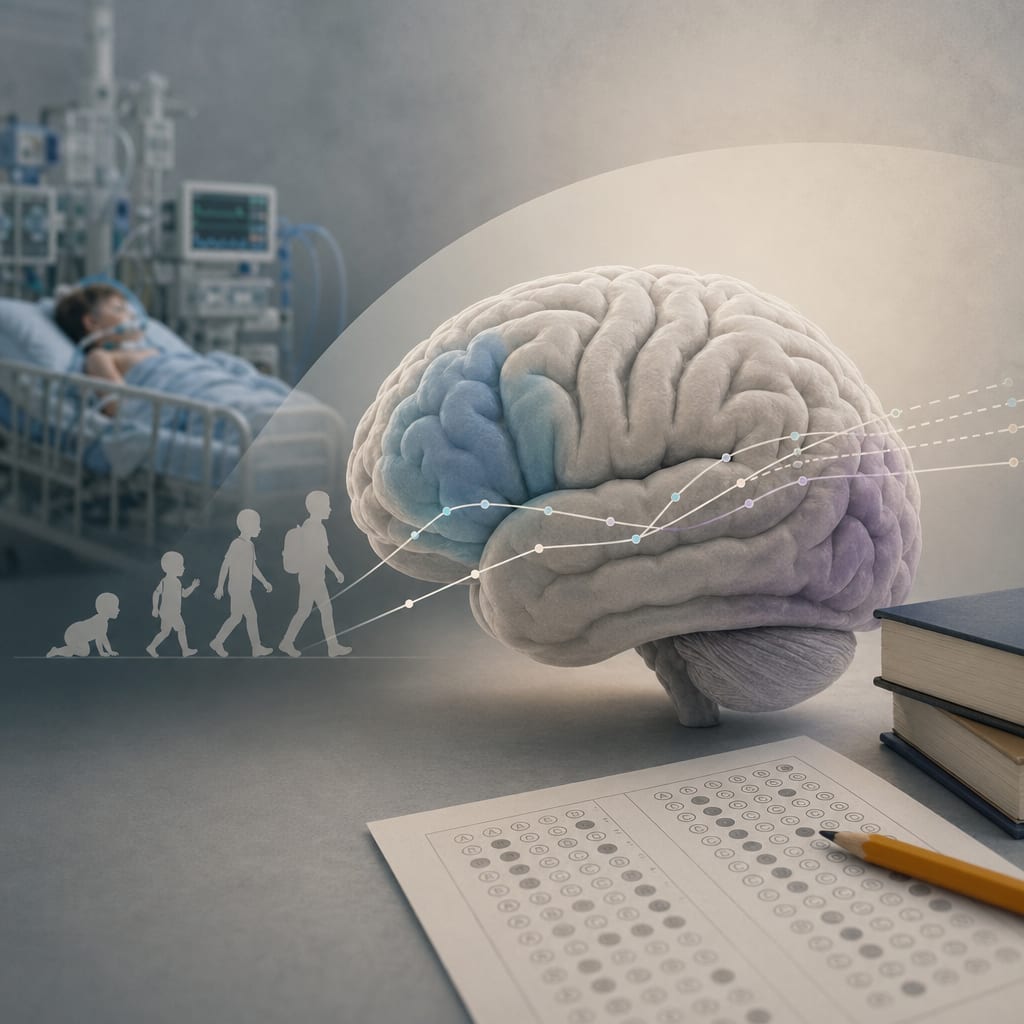
This study investigates the impact of pediatric intensive care unit (PICU) admission on academic achievement in mathematics and reading among children aged 7 to 17. Findings indicate that PICU patients are less likely to participate in standardized testing and demonstrate lower scores compared to matched controls.

Background

Pediatric critical illness can lead to significant long-term morbidities, including cognitive impairments that affect academic performance. Understanding the relationship between PICU admissions and academic outcomes is crucial for developing interventions to support affected children. This study utilizes a statewide educational database to provide insights into the cognitive health of children post-PICU admission.

Data Highlights

OutcomeFindings
Return to TestingLower likelihood of participation in standardized testing post-PICU
Mathematics ScoresDecreased scores in mathematics compared to matched controls
Reading ScoresDecreased scores in reading compared to matched controls

Key Findings

  • PICU patients had a lower likelihood of returning to standardized testing within 2 years post-admission.
  • Mathematics and reading scores were significantly lower for PICU patients compared to non-PICU controls.
  • The study utilized a robust control cohort from the Arkansas Department of Education.
  • Standardized test scores were converted to statewide z scores for accurate comparison.
  • Educational accommodations were considered in the analysis of outcomes.

Clinical Implications

Healthcare providers should be aware of the potential long-term cognitive impacts of PICU admissions on children's academic performance. Early identification and support for educational challenges in PICU survivors are essential for optimizing their recovery and reintegration into school settings.

Conclusion

The findings underscore the need for ongoing monitoring of academic performance in children post-PICU admission, highlighting the importance of targeted educational interventions.

References

  1. Intensive Care Medicine, 2008 -- Outcomes in Pediatric Intensive Care: Physical Health Assessment at Three Months Post-Discharge
  2. Intensive Care Medicine, 2023 -- Utilizing Machine Learning to Forecast Academic Challenges in Pediatric ICU Survivors
  3. Intensive Care Medicine, 2009 -- Annual Overview of Intensive Care Medicine, 2008: III. Pediatric Care
  4. Intensive Care Medicine, 2015 -- Neuropsychological Outcomes in Pediatric and Adolescent Survivors of Cardiac Arrest
  5. Haute Autorité de Santé -- Diagnosis and Management of Children with Post Intensive Care Syndrome in Paediatrics (PICS-p)
  6. Critical Care Medicine -- Educational Outcomes of Childhood Survivors of Critical Illness
  7. Pediatric Post-Intensive Care Syndrome Guidance
  8. Haute Autorité de Santé - Diagnosis and Management of Children with Post Intensive Care Syndrome in Paediatrics (PICS-p)
  9. Critical Care Medicine

Original Source(s)

Related Content