Clinical Report: Evaluating the Frontal-Plane QRS-T Angle for HCM Screening
Overview
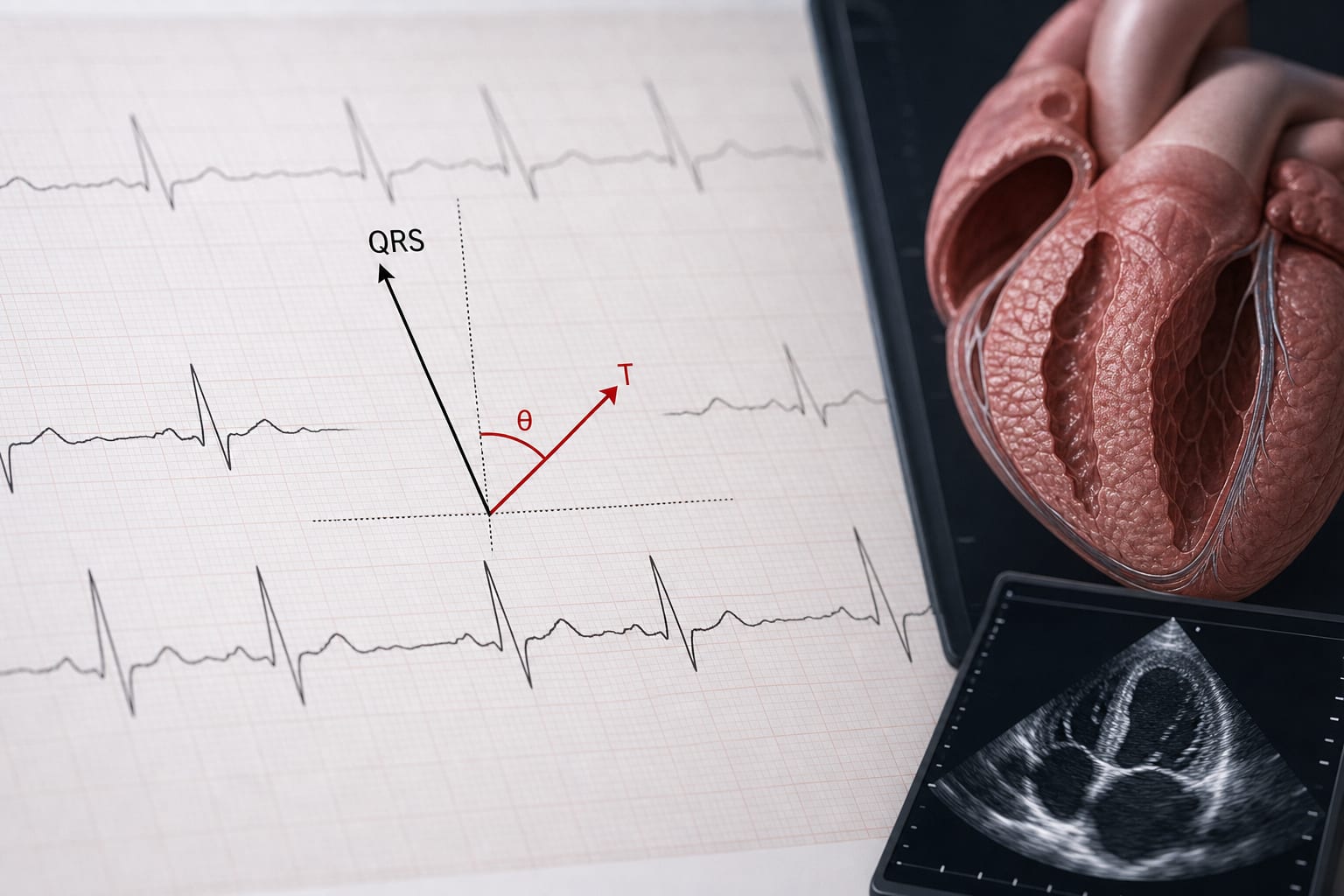
This study assesses the frontal QRS-T angle as a potential screening tool for hypertrophic cardiomyopathy (HCM) in a community population aged 3 to 30 years. The findings suggest that a frontal QRS-T angle greater than 90° may effectively identify individuals at risk for HCM, particularly in asymptomatic youth.
Background
Hypertrophic cardiomyopathy (HCM) is a prevalent inherited cardiac condition that can lead to serious outcomes, including sudden cardiac death, especially in young athletes. Current screening methods often miss asymptomatic individuals, highlighting the need for effective, non-invasive screening tools. The frontal QRS-T angle, easily calculable from standard ECGs, may offer a promising alternative for early detection of HCM.
Data Highlights
Parameter
Value
Participants Analyzed
6,128
Frontal QRS-T Angle Threshold for HCM
> 90°
Key Findings
The study included 6,128 participants aged ≤ 30 years from community screenings.
A frontal QRS-T angle greater than 90° was proposed as a threshold for identifying HCM.
Prior studies indicated high sensitivity and specificity of the spatial QRS-T angle for HCM detection.
Current screening methods often fail to identify asymptomatic individuals.
Frontal QRS-T angle can be derived from standard 12-lead ECGs without specialized equipment.
Clinical Implications
The frontal QRS-T angle may serve as a valuable, non-invasive screening tool for HCM in young populations, particularly athletes. Incorporating this measure into routine ECG assessments could enhance early detection and risk stratification for sudden cardiac death.
Conclusion
The frontal QRS-T angle shows promise as a screening tool for hypertrophic cardiomyopathy in younger populations. Further validation in diverse cohorts is necessary to establish its clinical utility.