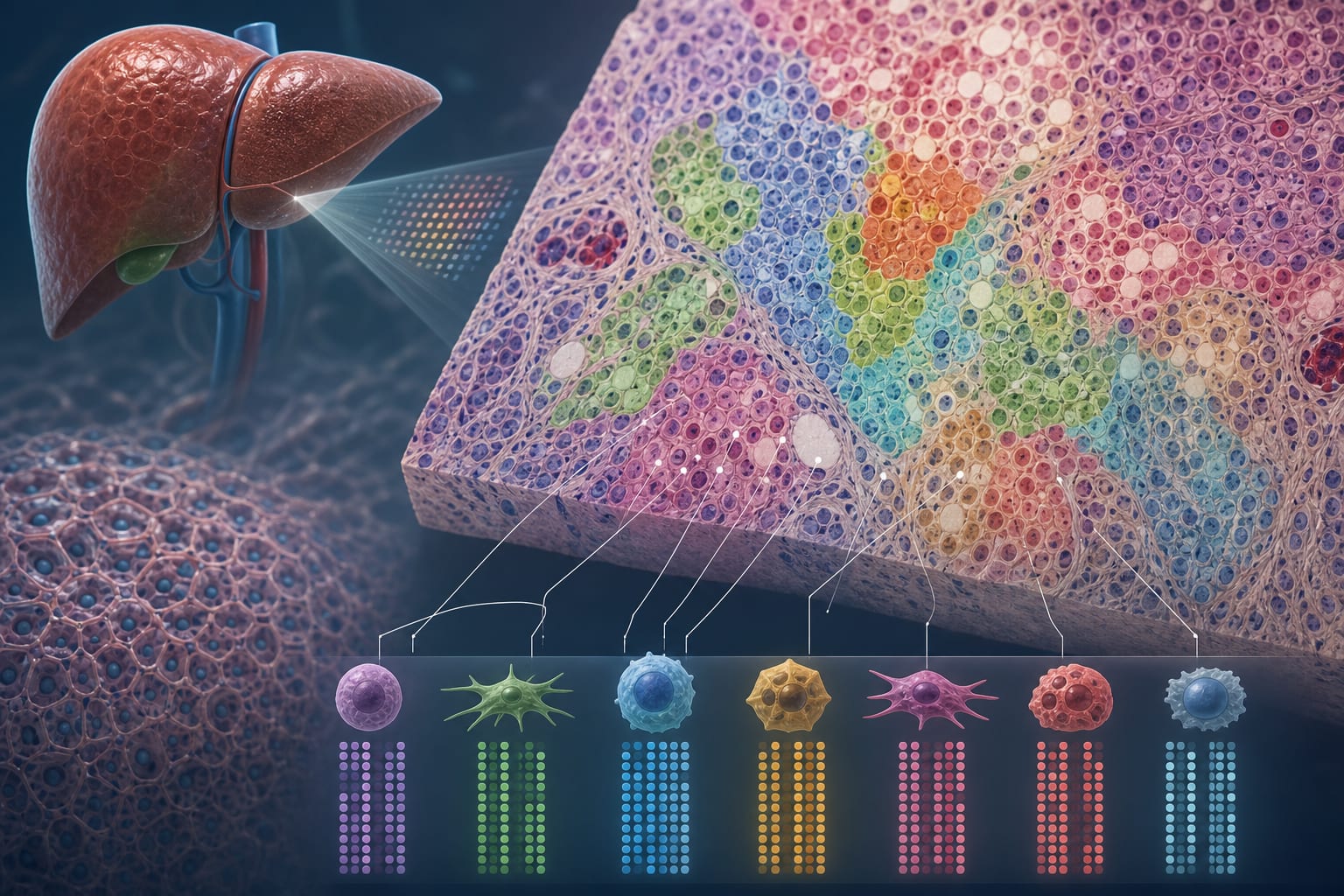
Advancements in Spatial Single-Cell Omics: Enhanced Understanding of Liver Disorders
-
By
-
Yuan Suo
-
Robert Thimme
-
Bertram Bengsch
-
June 1, 2026
Clinical Report: Advancements in Spatial Single-Cell Omics in Liver Disorders
Overview
This review highlights advancements in spatial omics technologies that enhance understanding of liver disorders. It emphasizes the significance of spatially defined cellular interactions in reshaping pathophysiological concepts of liver diseases.
Background
The liver's microarchitecture is crucial for its functions, and alterations in this organization are often seen in liver diseases. Traditional histopathologic methods for diagnosing liver conditions may not capture the spatial complexities of cellular interactions. Recent advancements in spatial omics technologies provide new insights into liver physiology and pathology, potentially improving diagnostic and therapeutic strategies.
Data Highlights
No specific numerical data provided in the article.
Key Findings
- Spatial omics technologies have revolutionized the understanding of liver microarchitecture and its role in liver diseases.
- Integration of single-cell RNA sequencing with spatial profiling has revealed zonal functional differences in hepatocytes.
- Spatial transcriptomics and proteomics have been recognized for their transformative impact on tissue organization understanding.
- Spatial features can enhance patient stratification and inform personalized medicine approaches.
- Current spatial omics methods face challenges but hold high translational potential for drug target development.
Clinical Implications
The integration of spatial omics into clinical practice could lead to improved diagnostic accuracy and more effective personalized treatment strategies for liver diseases. Understanding spatial interactions within the liver microenvironment may also facilitate the identification of novel therapeutic targets.
Conclusion
Advancements in spatial single-cell omics are poised to significantly enhance the understanding of liver disorders, paving the way for improved diagnostic and therapeutic approaches. Continued research in this area is essential for translating these technologies into clinical practice.
Related Resources & Content
- npj Digital Medicine, 2026 -- Combining Multi-Omics Approaches with Machine Learning to Unravel Cellular Diversity and Fibrotic Regulatory Pathways in the Transition from MASLD to MASH
- Frontiers in Medicine, 2026 -- Integrating single-cell RNA-seq and machine learning to dissect polyamine metabolism in metabolic dysfunction-associated steatotic liver disease
- Archives of Toxicology, 2016 -- Activity of Gene Networks in Cultured Primary Hepatocytes Closely Resembles That of Diseased Liver Tissue in Mammals
- Archives of Toxicology, 2014 -- Methods for Staining Bile Canalicular and Sinusoidal Networks in Human, Mouse, and Pig Livers: Three-Dimensional Reconstruction and Tissue Microarchitecture Quantification through Image Processing and Analysis
- EASL–EASD–EASO Clinical Practice Guidelines on the management of metabolic dysfunction-associated steatotic liver disease (MASLD): Executive Summary - PMC
- A Phase 3 Trial of Resmetirom in NASH with Liver Fibrosis - PubMed
- A spatial atlas of the healthy human liver from live donors | Nature
- EASL–EASD–EASO Clinical Practice Guidelines on the management of metabolic dysfunction-associated steatotic liver disease (MASLD): Executive Summary - PMC
- A Phase 3 Trial of Resmetirom in NASH with Liver Fibrosis - PubMed
- A spatial atlas of the healthy human liver from live donors | Nature
Based on findings from:
Spatial single-cell omics: new insights into liver diseases
Yuan Suo, Robert Thimme, Bertram Bengsch. Gut, 2026.
https://gut.bmj.com/content/75/6/1248
This content is an AI-generated, fully rewritten summary based on a published scholarly article. It does not reproduce the original text and is not a substitute for the original publication. Readers are encouraged to consult the source for full context, data, and methodology.