Extravertebral temperature exposure during spinal radiofrequency ablation: an experimental surrogate assessment of neural injury risk - Report - MDSpire

Extravertebral temperature exposure during spinal radiofrequency ablation: an experimental surrogate assessment of neural injury risk

  • By

  • Annabelle Weigert

  • Ralf-Thorsten Hoffmann

  • Andreas Büttner

  • Richard Zaccaria

  • Veronika Wegener

  • Boris Michael Holzapfel

  • Bernd Wegener

  • June 12, 2026

  • 0 min

Share

Clinical Report: Assessment of Extravertebral Temperature Impact on Neural Injury Risk

Overview

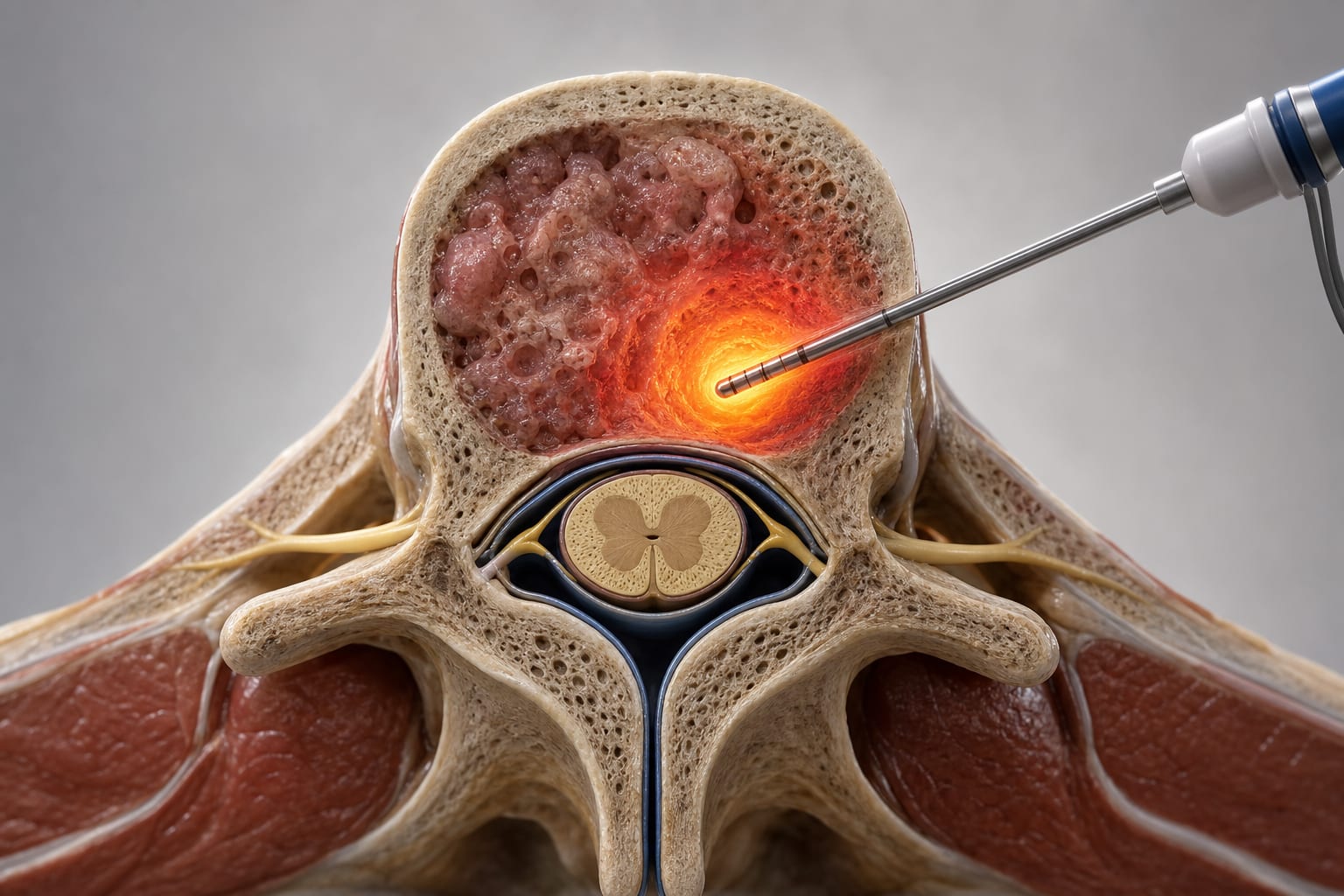
This study investigates the extravertebral temperature exposure during spinal radiofrequency ablation (RFA) to assess potential neural injury risks. The findings indicate that understanding temperature distribution is crucial for ensuring neural safety during RFA procedures.

Background

Vertebral metastases are common in cancer patients, often leading to significant pain and structural instability. Minimally invasive procedures like RFA are increasingly used for pain management, but there is limited data on the thermal effects on adjacent neural structures during these interventions. Understanding the thermal dynamics is essential for improving patient safety and treatment outcomes.

Data Highlights

No numerical data or trial results were provided in the source material.

Key Findings

  • Extravertebral temperature exposure during spinal RFA has not been sufficiently characterized.
  • Thermal ablation techniques are gaining importance for palliative treatment of tumors.
  • Unintended heat propagation to adjacent neural structures is a significant concern in spinal RFA.
  • Minimally invasive procedures like vertebroplasty and RFA are critical for pain control in metastatic disease.
  • Systematic experimental data on temperature exposure during RFA is limited.

Clinical Implications

Clinicians should be aware of the potential risks of thermal injury to neural structures during spinal RFA. Continuous monitoring of extravertebral temperatures may be necessary to mitigate these risks during procedures.

Conclusion

The study highlights the need for further research on temperature management during spinal RFA to enhance patient safety and treatment efficacy.

Related Resources & Content

  1. Various Authors, Various Sources, Year -- Assessment of Extravertebral Temperature Impact on Neural Injury Risk During Spinal Radiofrequency Ablation
  2. Pain Medicine — Evaluation of a novel nerve ablation technique to relieve lower back pain: a cadaveric feasibility pilot study
  3. Pain Medicine — Evaluation of internally cooled radiofrequency ablation targeting multiple shoulder nerves for chronic shoulder pain relief and function restoration: a prospective study
  4. Utilizing Functional Magnetic Resonance Imaging (fMRI) to Enhance Planning of Laser Interstitial Thermal Therapy (LITT) Near Critical Brain Areas
  5. Neuromonitoring-Assisted Radiofrequency Thermocoagulation Under General Anesthesia for Managing Refractory Trigeminal Neuralgia
  6. Overview | Radiofrequency ablation for palliation of painful spinal metastases | Guidance | NICE
  7. Radiofrequency Ablation Provides Rapid and Durable Pain Relief for the Palliative Treatment of Lytic Bone Metastases Independent of Radiation Therapy: Final Results from the OsteoCool Tumor Ablation Post-Market Study
  8. CIRSE Standards of Practice on Thermal Ablation of Bone Tumours

Original Source(s)

Related Content