Spontaneous coronary artery dissection as a threshold disorder of coronary wall integrity - Report - MDSpire

Spontaneous coronary artery dissection as a threshold disorder of coronary wall integrity

  • By

  • Zhongwei Liu

  • Jun Wang

  • July 6, 2026

  • 0 min

Share

Clinical Report: Spontaneous Coronary Artery Dissection and Wall Integrity

Overview

Spontaneous coronary artery dissection (SCAD) is increasingly recognized as a significant cause of non-atherosclerotic acute myocardial infarction, particularly in young and middle-aged women.

Background

SCAD is a critical clinical entity that presents unique diagnostic and management challenges, particularly in populations with few conventional atherosclerotic risk factors. The condition is notably prevalent among women and during pregnancy.

Data Highlights

No numerical or trial data provided in the source material.

Key Findings

  • SCAD is primarily observed in young and middle-aged women, often without traditional cardiovascular risk factors.
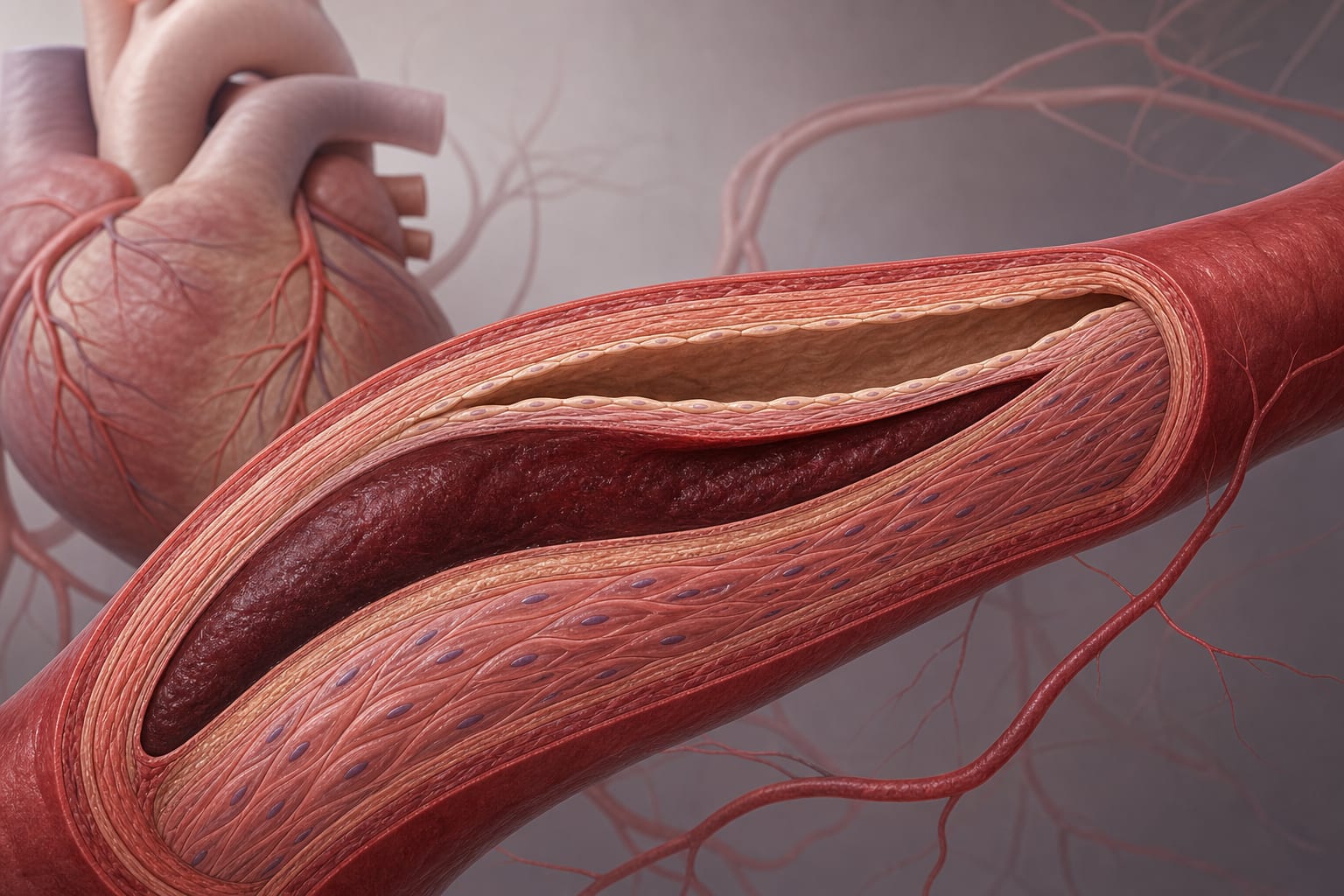
  • The final pathological event in SCAD is intramural hematoma formation leading to true-lumen compression.
  • Factors influencing the threshold for SCAD include inherited susceptibility, extracellular matrix architecture, and hemodynamic stress.
  • SCAD is distinct from plaque rupture and is not solely a Mendelian connective tissue disorder.
  • Current management strategies for SCAD require careful consideration of antithrombotic therapy, especially in pregnancy-associated cases.

Clinical Implications

Healthcare professionals should be aware of the unique characteristics of SCAD, particularly in young women and during pregnancy.

Conclusion

Understanding SCAD as a threshold disorder of coronary wall integrity may enhance clinical recognition.
Related Resources & Content

  1. JAMA Cardiology, 2025 -- Pregnancy-Associated Spontaneous Coronary Artery Dissection: A Report of the iSCAD Registry
  2. Frontiers in Cardiovascular Medicine, 2026 -- Case Report: A case of acute anterior wall myocardial infarction caused by stent fracture in the left anterior descending artery
  3. Frontiers in Cardiovascular Medicine, 2026 -- Spontaneous Coronary Artery Dissection in an Underrepresented Region: Insights from the Serbian (RS) SCAD Registry
  4. ACC, AHA Issue New Acute Coronary Syndromes Guideline - American College of Cardiology, 2025
  5. Antiplatelet therapy following conservatively managed spontaneous coronary artery dissection - PubMed, 2025
  6. Frontiers in Cardiovascular Medicine — Case Report: Spontaneous coronary artery dissection presenting as MINOCA in uncontrolled Graves’ disease
  7. 2025 ESC Guidelines for the management of cardiovascular disease and pregnancy
  8. ACC, AHA Issue New Acute Coronary Syndromes Guideline - American College of Cardiology
  9. Antiplatelet therapy following conservatively managed spontaneous coronary artery dissection - PubMed
  10. 26-A-17927-ACC DUAL VERSUS SINGLE ANTIPLATELET THERAPY IN CONSERVATIVELY MANAGED SPONTANEOUS CORONARY ARTERY DISSECTION: INSIGHTS FROM A LARGE DATABASE | JACC
  11. Study Details | NCT04850417 | Randomized Study of Beta-Blockers and Antiplatelets in Patients With Spontaneous Coronary Artery Dissection | ClinicalTrials.gov
  12. Optical Coherence Tomography for Spontaneous Coronary Artery Dissection Assessment: The Flush-Free OCT Technique | JACC: Case Reports
  13. A single-session CT angiography protocol for extracoronary vascular abnormality screening in spontaneous coronary artery dissection (SCAD) - PubMed

Original Source(s)

Related Content