Evaluation of Type I endoleak after endovascular aneurysm repair for abdominal aortic aneurysm using component quantification of energy loss: a preliminary feasibility study - Report - MDSpire
Coming Soon: Introducing MDSpire News. Learn more
Conexiant’s news site is now MDSpire News. Learn more

Assessment of Type I Endoleak Following Endovascular Aneurysm Repair for Abdominal Aortic Aneurysm through Energy Loss Component Analysis: An Initial Feasibility Investigation

  • By

  • Ran Tao

  • Qiming Liu

  • Weihao Guo

  • Lingshang Kong

  • Wenbin Wang

  • Xudong Jiang

  • Peng Wu

  • Yeben Qian

  • August 21, 2026

Share

Assessment of Type I Endoleak Following Endovascular Aneurysm Repair

Overview

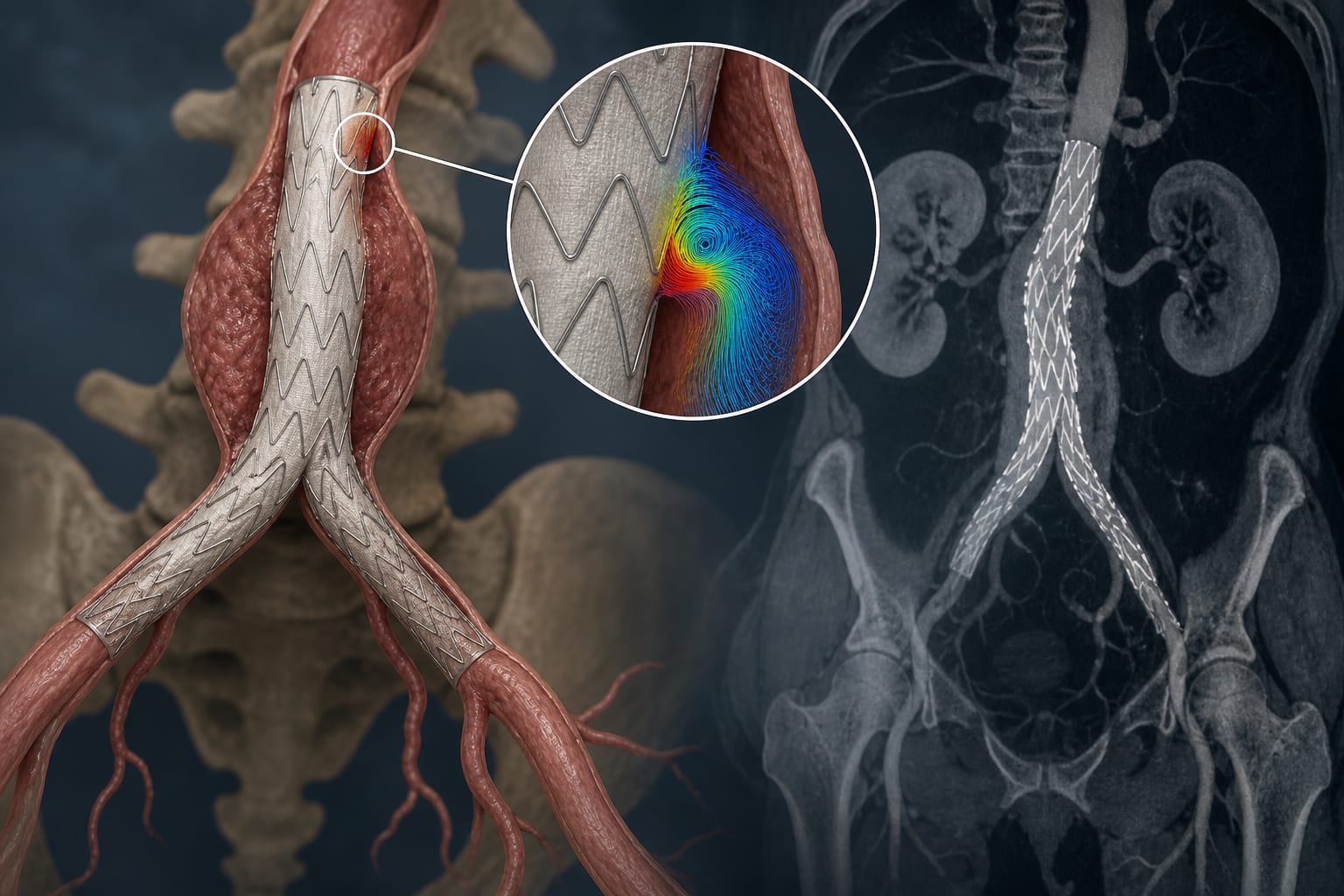
This study investigates the association of energy loss with Type I endoleak in patients post-EVAR using hemodynamic simulations.

Background

Endovascular aneurysm repair (EVAR) is a widely used treatment for abdominal aortic aneurysms (AAA), but complications such as endoleak can lead to serious long-term outcomes.

Data Highlights

ParameterEndoleak GroupNo Endoleak Group
Turbulence EL (main stents)516 ± 183*10−6 WN/A
Turbulence EL (left iliac branch)828 ± 195*10−6 WN/A
Turbulence EL (right iliac branch)609 ± 193*10−6 WN/A
Mean flow EL (main stents)363 ± 125*10−6 WN/A
Mean flow EL (left iliac branch)631 ± 138*10−6 WN/A
Mean flow EL (right iliac branch)352 ± 162*10−6 WN/A

Key Findings

  • Endoleaks localized at stent-graft junctions showed elevated turbulence energy loss.
  • Turbulence energy loss was higher in the endoleak group compared to the no endoleak group.
  • Mean flow energy loss exhibited significant differences between the two groups.
  • Time-averaged wall shear stress did not differ significantly between groups.
  • Energy loss component quantification may provide insights for assessing surgical prognosis.

Clinical Implications

The findings suggest that measuring energy loss components could enhance the assessment of Type I endoleak post-EVAR. Clinicians may consider incorporating these hemodynamic parameters into their evaluation protocols.

Conclusion

This study demonstrates the feasibility of using energy loss analysis to evaluate Type I endoleak following EVAR.

Related Resources & Content

  1. Journal of Endovascular Therapy, 2024 -- Proximal Seal After Endovascular Aneurysm Repair: Why Sealing Length Dynamics and Type 2 Endoleak Matter
  2. European Radiology, 2025 -- A systematic review of the effectiveness of dual-energy computed tomography in identifying endoleaks following endovascular aneurysm repair
  3. Percutaneous Micro-Robotic Approach for Targeting Type II Endoleaks in the Angio-Suite, 2024
  4. European Radiology, 2023 -- Radiomic Analysis of Unenhanced CT Scans for Identifying Endoleaks Following Endovascular Aneurysm Repair of Abdominal Aortic Aneurysms
  5. 2024 ESC Guidelines for the management of peripheral arterial and aortic diseases | European Heart Journal | Oxford Academic
  6. Meta-analysis of individual-patient data from EVAR-1, DREAM, OVER and ACE trials comparing outcomes of endovascular or open repair for abdominal aortic aneurysm over 5 years | BJS | Oxford Academic
  7. 2024 ESC Guidelines for the management of peripheral arterial and aortic diseases | European Heart Journal | Oxford Academic
  8. Meta-analysis of individual-patient data from EVAR-1, DREAM, OVER and ACE trials comparing outcomes of endovascular or open repair for abdominal aortic aneurysm over 5 years | BJS | Oxford Academic
  9. Machine Learning-Based Detection of Endoleak Following Endovascular Aneurysm Repair (EVAR): A Systematic Review and Meta-analysis - ScienceDirect

Original Source(s)

Related Content