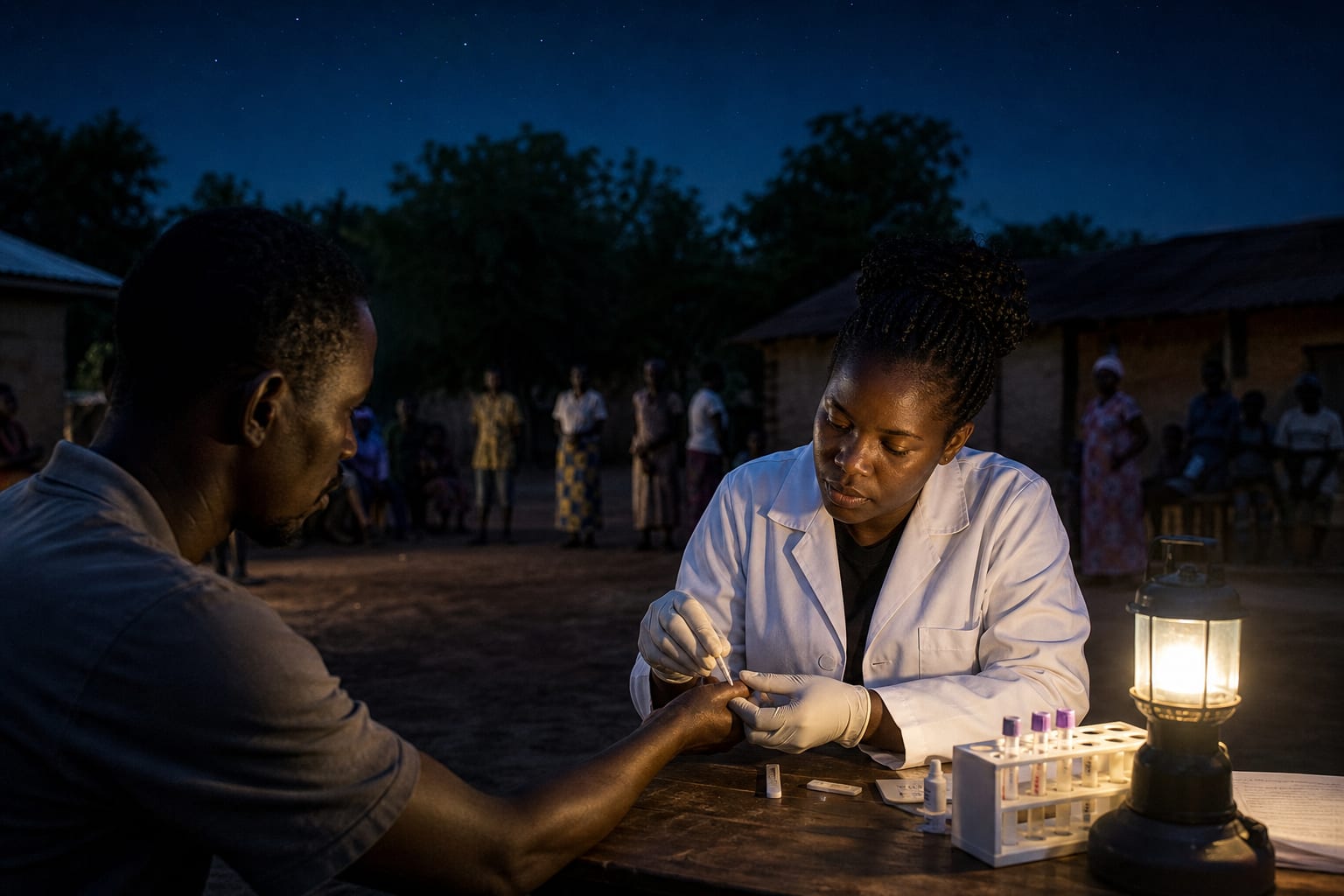
Midnight Patient Enrollment for a Filariasis Research Study in Tanzania
-
By
-
Inge Kroidl
-
September 7, 2026
Midnight Patient Enrollment for a Filariasis Research Study in Tanzania
Background
Lymphatic Filariasis, caused by Wuchereria bancrofti, is a neglected tropical disease that poses significant public health challenges in endemic regions. Effective diagnosis and treatment are crucial for controlling the disease. The TAKeOFF project aims to enhance research efforts in this area through collaboration across multiple countries.
Data Highlights
No numerical data available in the source material.
Key Findings
- Field research and blood collection for filariasis diagnosis occur at night when microfilariae concentrations peak.
- Participants are recruited from 9 pm to 2 am at remote health facilities, often over two hours from the main research site.
- Recruitment continues during power outages, utilizing mobile-phone light for questionnaires and procedures.
- Battery-powered ultrasound is used to visualize adult filarial worms, although battery life limits extended nighttime work.
- The TAKeOFF project collaborates with national health programs to improve diagnosis and treatment for filarial infections.
Clinical Implications
The study's approach to nighttime enrollment may serve as a model for future research in remote areas where traditional daytime recruitment is impractical. Understanding the dynamics of microfilariae concentration can enhance diagnostic accuracy and treatment strategies.
Conclusion
The innovative strategies employed in this study highlight the importance of adapting research methodologies to local conditions in order to effectively address neglected tropical diseases.
Related Resources & Content
- Kroidl I., Institute of Infectious Diseases and Tropical Medicine, 2026 -- Midnight Patient Enrollment for a Filariasis Research Study in Tanzania
- Drug Safety — Safety Comparison of Triple Therapy (IDA) and Dual Therapy (DA) in Mass Drug Administration for Lymphatic Filariasis Elimination in Kenya: A Cohort Event Monitoring Analysis
- The Journal of Infectious Diseases — Emergence of K13 Mutations Indicating Partial Artemisinin Resistance in Zanzibar and Tanzania: Evidence of Regional Dissemination and African Origins, 2023
- The Journal of Infectious Diseases — Effectiveness of Praziquantel in Treating Asymptomatic Plasmodium falciparum Infections Among Gabonese Adults: Results from a Double-Blind, Placebo-Controlled Randomized Study
- Open Forum Infectious Diseases — Investigating Malaria Epidemiology in Zanzibar Using Molecular and Serological Techniques on Samples Gathered During Reactive Case Detection
- Global programme to eliminate lymphatic filariasis: progress report, 2024
- A Trial of a Triple-Drug Treatment for Lymphatic Filariasis
- Tanzania (Mainland) Neglected Tropical Diseases Master Plan (2021 - 2026)
Based on findings from:
Patient recruitment at midnight for a filariasis study in Tanzania
Inge Kroidl. Infection, 2026.
https://link.springer.com/article/10.1007/s15010-026-02958-w
This content is an AI-generated, fully rewritten summary based on a published scholarly article. It does not reproduce the original text and is not a substitute for the original publication. Readers are encouraged to consult the source for full context, data, and methodology.