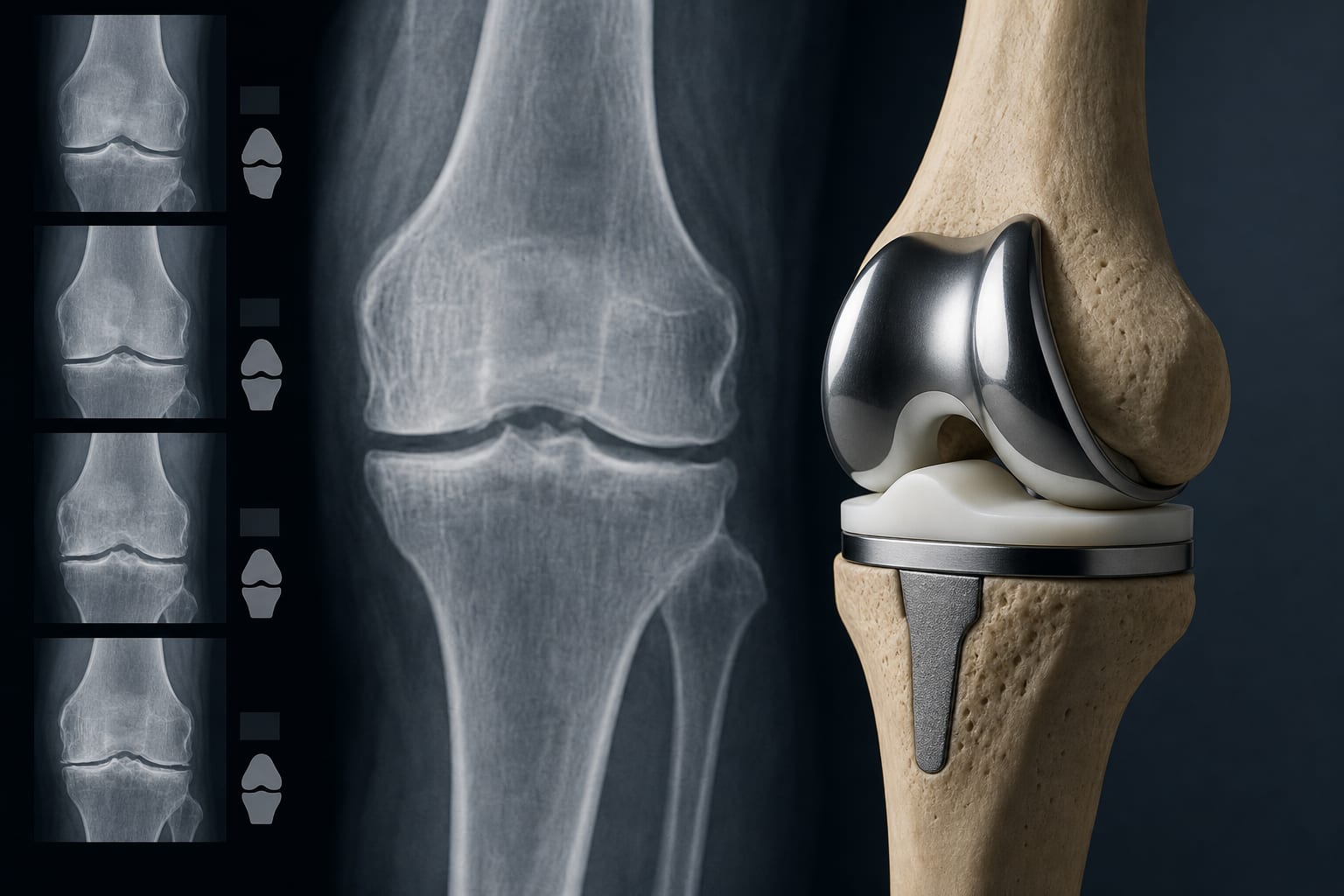
Preoperative lower radiographic osteoarthritis severity in primary total knee arthroplasty increases revision risk by tenfold compared to severe osteoarthritis - Report - MDSpire

Increased Risk of Revision Surgery Associated with Preoperative Radiographic Severity of Osteoarthritis in Primary Total Knee Arthroplasty

  • By

  • Lenka Stroobant

  • Hannes Vermue

  • Tamara Droogsma

  • Stefaan Van Onsem

  • Nele Arnout

  • Gijs G. van Hellemondt

  • Jan Victor

  • Petra J. C. Heesterbeek

  • July 17, 2026

Share

Clinical Report: Increased Risk of Revision Surgery Associated with Preoperative Radiographic Severity of Osteoarthritis in Primary Total Knee Arthroplasty

Overview

This study investigates the relationship between preoperative radiographic severity of osteoarthritis (OA) and the risk of revision surgery following primary total knee arthroplasty (TKA).

Background

Total knee arthroplasty (TKA) is a common procedure for advanced OA, yet a significant proportion of patients remain dissatisfied postoperatively. The rising incidence of revision TKA (rTKA) poses challenges due to less favorable outcomes and increased healthcare costs. Understanding the predictors of rTKA is crucial for improving patient care and resource allocation.

Data Highlights

No numerical data provided in the source material.

Key Findings

  • Preoperative severity of OA is a critical determinant of outcomes after TKA.
  • Approximately 10% of TKA patients remain dissatisfied postoperatively.
  • Revision TKA rates are projected to increase significantly in the coming decades.
  • Identifying risk factors for rTKA can help mitigate the occurrence of revision surgeries.

Clinical Implications

Clinicians should consider the radiographic severity of OA when evaluating candidates for TKA.

Conclusion

The study highlights the importance of assessing preoperative OA severity to predict the risk of revision surgery following TKA.

Related Resources & Content

  1. Assessment of a Radiological Grading System for Early Identification of Total Knee Arthroplasties Prone to Revision Surgery, 2024
  2. Short-term outcomes of total knee arthroplasty show limited functional improvement and increased dissatisfaction in patients with mild radiographic arthritis, 2022
  3. Evaluating the Risks of Perioperative Complications Following Aseptic Knee Revision Surgery, 2024
  4. 2023 American College of Rheumatology and American Association of Hip and Knee Surgeons Clinical Practice Guideline for the Optimal Timing of Elective Hip or Knee Arthroplasty, 2023
  5. Archives of Orthopaedic and Trauma Surgery — Retropatellar resurfacing in primary total knee arthroplasty does not improve clinical outcomes but increases revision rates
  6. AJRR 2025 Annual Report
  7. 2023 American College of Rheumatology and American Association of Hip and Knee Surgeons Clinical Practice Guideline for the Optimal Timing of Elective Hip or Knee Arthroplasty for Patients With Symptomatic Moderate-to-Severe Osteoarthritis or Advanced Symptomatic Osteonecrosis With Secondary Arthritis for Whom Nonoperative Therapy Is Ineffective
  8. ACR Appropriateness Criteria® Chronic Knee Pain: Update 2026 - PubMed
  9. United States Trends in Utilization and One-Year Revision Risk of Cementless Total Knee Arthroplasty: An Analysis of American Joint Replacement Registry Data - PubMed
  10. Meniscectomy before total knee arthroplasty increases the risk of all-cause revision and revision for infection: A national database analysis - ScienceDirect
  11. Incidence, Timing, and Implications of Postoperative Manipulation Under Anesthesia (MUA) Following Cemented Versus Cementless Total Knee Arthroplasty (TKA) - PubMed
  12. Total Knee Arthroplasty in Post-Traumatic Knee Osteoarthritis Shows Higher Failure Rates Depending on Implant Constraint: An Evaluation of the German Arthroplasty Register - PubMed
  13. Preoperative age, BMI and KL grade predict long-term functional outcome of knee arthroplasty better than CPAK-classification - PubMed

Original Source(s)

Related Content