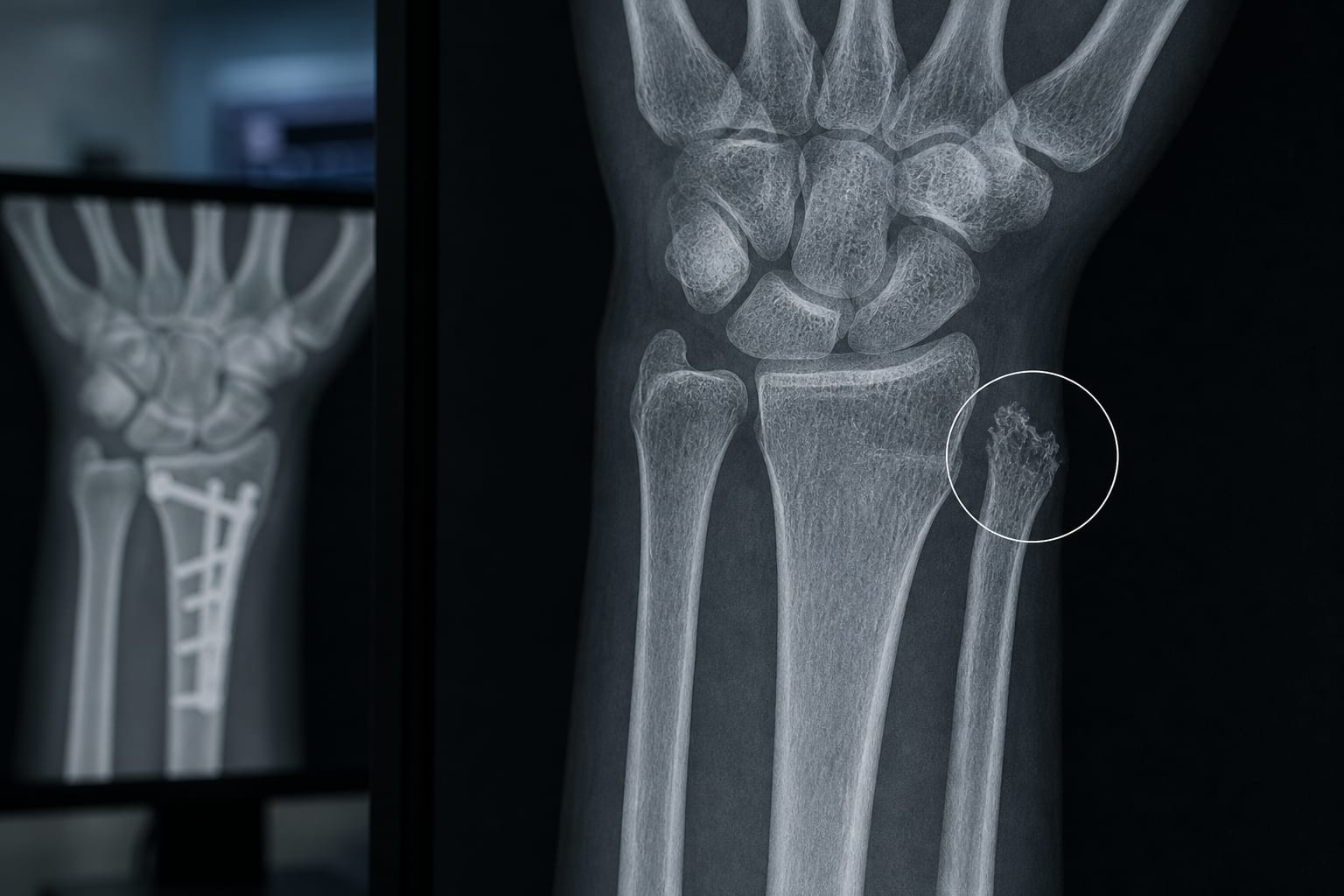
Ulnar Styloid Osteolysis: A Clinically Meaningful Finding Beyond Imaging?
-
By
-
Jan-Peter Grunz
-
Malek Othmani
-
Andreas Steven Kunz
-
November 9, 2026
Clinical Report: Ulnar Styloid Osteolysis After Distal Radius Fracture
Overview
A retrospective study of 143 patients with distal radius fractures found ulnar styloid osteolysis in 16.8% of cases, usually during the first months after injury. Osteolysis was associated with fracture-severity features and active smoking, but its biological basis and clinical consequences remain uncertain.
Background
Distal radius fractures are common injuries in musculoskeletal imaging and orthopedic practice. Ulnar styloid osteolysis is delayed cortical resorption without a visible ulnar fracture; first reported in 1969, it has received little subsequent investigation. The ulnar styloid provides an attachment for the triangular fibrocartilage complex, which contributes to distal radioulnar joint stability. The source article notes that instability is associated with poorer outcomes after distal radius fractures, while the relationship between osteolysis and wrist function has not been established.
Data Highlights
| Measure | Finding |
|---|---|
| Study design and population | Retrospective analysis of 143 individuals with distal radius fractures |
| Ulnar styloid osteolysis frequency | 16.8% (approximately one-sixth of cases) |
| Timing | Most lesions became apparent during the initial months after injury |
| Associated radiographic features | Comminution, dorsal angulation, diastasis, and impaction |
| Other associated factor | Active smoking |
Key Findings
- Freire and colleagues reported ulnar styloid osteolysis in 16.8% of 143 patients with distal radius fractures and no visible ulnar fracture.
- Most lesions were identified during the initial months following injury.
- Osteolysis was associated with comminution, dorsal angulation, diastasis, and impaction on radiographs.
- Active smoking was also associated with osteolysis in the retrospective analysis.
- The study relied almost entirely on follow-up radiographs, leaving uncertain whether the defects represent cortical bone loss, insertional remodeling, occult microfractures, or a combination.
- The source article identifies the relationship of osteolysis to TFCC injury, DRUJ biomechanics, instability, and clinical outcomes as unresolved.
Clinical Implications
The source article notes that recognizing the post-traumatic context may help avoid misinterpreting these delayed radiographic abnormalities as inflammatory or erosive arthropathies. It does not establish osteolysis as a marker of DRUJ dysfunction or demonstrate clinical consequences; the authors identify CT and MRI characterization as priorities for future research.
Conclusion
Ulnar styloid osteolysis is a relatively frequent post-traumatic imaging finding in the reported cohort, but its structural basis and clinical significance remain undetermined. Further imaging and clinical investigation is needed to clarify its relationship to wrist biomechanics and outcomes.
Related Resources & Content
- Freire et al., European Radiology, 2026 — Frequency and Associated Factors of Ulnar Styloid Osteolysis After Distal Radius Fracture Without an Ulnar Fracture
- AAOS/ASSH, 2020 — Clinical Practice Guideline on the Management of Distal Radius Fractures
- ESTES, 2026 — ESTES recommendations regarding distal radius fractures
- Langenbecks Archives of Surgery — Efficacy of Altered Ulnar Metaphyseal Wedge Osteotomy for Ulnar Impaction Syndrome: A Comparative Clinical Analysis
- Frontiers in Medicine — Ulnar styloid abduction angle: a novel radiological predictor of Palmer Type IB tears of the triangular fibrocartilage complex
- Archives of Orthopaedic and Trauma Surgery (Springer) — Retrospective Assessment of the Ulna Osteotomy Locking Plate II in Patients Diagnosed with Ulnocarpal Impaction Syndrome
- Frequency and Associated Factors of Ulnar Styloid Osteolysis After Distal Radius Fracture Without an Ulnar Fracture
- Clinical Practice Guideline on the Management of Distal Radius Fractures
- ESTES recommendations regarding distal radius fractures
- Operative versus non-operative treatment of ulnar styloid process base fractures: a systematic review and meta-analysis
- Factors associated with variation in treatment of the distal radioulnar joint after plate fixation of distal radial fractures
Based on findings from:
Ulnar styloid osteolysis: More than a radiographic curiosity?
Jan-Peter Grunz, Malek Othmani, Andreas Steven Kunz. European Radiology, 2026.
https://link.springer.com/article/10.1007/s00330-026-12819-7
This content is an AI-generated, fully rewritten summary based on a published scholarly article. It does not reproduce the original text and is not a substitute for the original publication. Readers are encouraged to consult the source for full context, data, and methodology.