Inhibitory impact of A1 and A2 cow’s milk on human peripheral blood mononuclear cells identifies TOM1 as a candidate anti-inflammatory mediator - Report - MDSpire

Inhibitory impact of A1 and A2 cow’s milk on human peripheral blood mononuclear cells identifies TOM1 as a candidate anti-inflammatory mediator

  • By

  • Lili M. Flad

  • Tanja Weißer

  • Jonas Liedl

  • Felix Gard

  • Agnese Petrera

  • Christine von Toerne

  • Stefanie M. Hauck

  • Cornelia A. Deeg

  • Kristina J. H. Kleinwort

  • June 10, 2026

  • 0 min

Share

Effects of A1 and A2 Cow's Milk on Human Peripheral Blood Mononuclear Cells

Overview

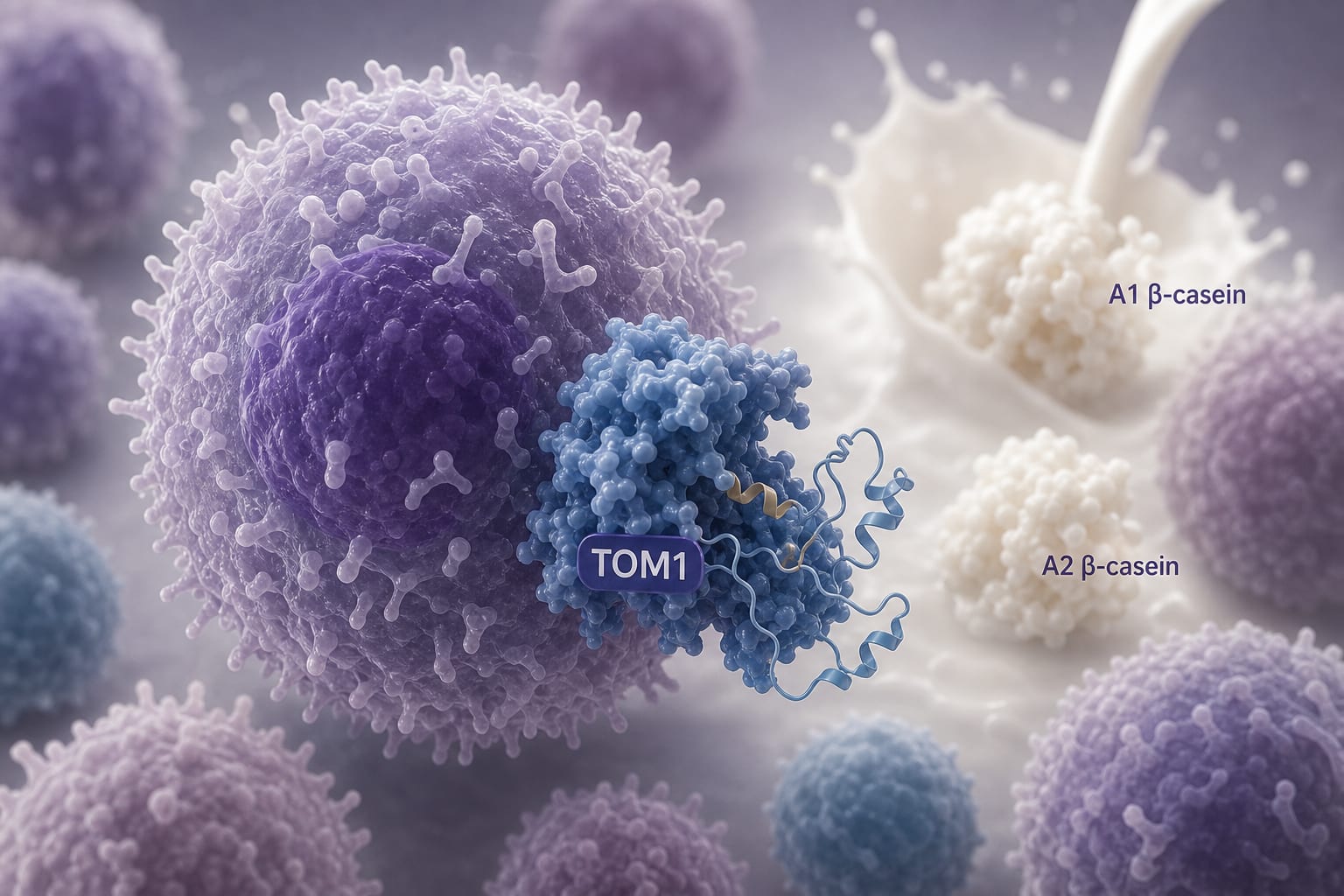
This study investigates the effects of A1 and A2 cow's milk on human peripheral blood mononuclear cells (PBMC). High molecular weight fractions of both milk types were found to inhibit PBMC proliferation, with TOM1 significantly increased in the supernatant proteomes.

Background

Cow's milk has been a subject of debate regarding its impact on immune response, particularly the differences between A1 and A2 β-casein variants. This study aims to elucidate the mechanisms behind the inhibitory effects of A1 and A2 milk on PBMC proliferation.

Data Highlights

FractionEffect on PBMC
High Molecular Weight FractionsInhibitory
TOM1Inhibitory

Key Findings

  • Both A1 and A2 milk inhibit Concanavalin A-induced PBMC proliferation.
  • High molecular weight fractions of milk were identified as the inhibitory components.
  • TOM1 was significantly increased in the supernatant proteomes after co-incubation with HWFs.
  • TOM1 demonstrated an inhibitory effect on stimulated PBMC.
  • Olink analysis indicated TOM1's role in regulating immune response via Interleukin-1β-associated signaling.

Clinical Implications

The identification of TOM1 as an anti-inflammatory mediator suggests potential pathways for dietary interventions in immune-related conditions. Further research may clarify the role of A1 and A2 milk in immune modulation and inform clinical guidelines.

Conclusion

This study highlights the immunomodulatory effects of A1 and A2 cow's milk, with TOM1 emerging as a key factor in the regulation of immune responses.

Related Resources & Content

  1. Archives of Toxicology, 2018 -- Alternariol, a mycotoxin, inhibits inflammation induced by lipopolysaccharides in THP-1 derived macrophages through modulation of the NF-κB signaling pathway
  2. Open Forum Infectious Diseases -- Monocyte Activation in Individuals with HIV and Concurrent Tuberculosis: Insights from the ACTG A5279/BRIEF TB Study on the Impact of Preventive Therapy
  3. Intensive Care Medicine -- Variations in Cytokine and Chemokine Expression Induced by Lipopolysaccharides and Lipoteichoic Acid
  4. World Allergy Organization (WAO) Diagnosis and Rationale for Action against Cow's Milk Allergy (DRACMA) guidelines update - XVI - Nutritional management of cow's milk allergy
  5. The Journal of Clinical Endocrinology & Metabolism — Saturation Effects on Branched-Chain Amino Acid Metabolism Following Increased Milk Protein Consumption in Healthy Adults
  6. The Effect of A2 Milk on Gastrointestinal Symptoms in Comparison to A1/A2 Milk: A Single-center, Randomized, Double-blind, Cross-over Study
  7. World Allergy Organization (WAO) Diagnosis and Rationale for Action against Cow's Milk Allergy (DRACMA) guidelines update - XVI - Nutritional management of cow's milk allergy - PubMed
  8. Assessment of heat stress response of peripheral blood mononuclear cells from dairy cows stress-phenotyped using bacterial lipopolysaccharide endotoxin - PubMed

Original Source(s)

Related Content