Diagnostic value of combined flow cytometry-based detection of peripheral blood lymphocyte subsets and cytokines for pediatric infectious mononucleosis - Report - MDSpire
Advertisement
Diagnostic value of combined flow cytometry-based detection of peripheral blood lymphocyte subsets and cytokines for pediatric infectious mononucleosis
Clinical Report: Evaluating the Diagnostic Utility of Combined Flow Cytometry
Overview
This study evaluates the diagnostic performance of peripheral blood lymphocyte subsets and cytokine profiles in pediatric infectious mononucleosis (IM) caused by Epstein–Barr virus (EBV).
Background
Pediatric infectious mononucleosis, primarily caused by EBV, presents diagnostic challenges due to overlapping symptoms with other febrile illnesses. Accurate early diagnosis is crucial for effective management, as current diagnostic methods have limitations, particularly in atypical cases. This study explores the potential of flow cytometry and cytokine profiling as adjunct diagnostic tools.
Data Highlights
Parameter
IM Group (n=61)
HC Group (n=32)
P-value
White Blood Cell Count
Elevated
Normal
< 0.05
Absolute Lymphocyte Count
Elevated
Normal
< 0.05
Platelet Count
Elevated
Normal
< 0.05
ALT
Elevated
Normal
< 0.05
AST
Elevated
Normal
< 0.05
LDH
Elevated
Normal
< 0.05
Key Findings
IM group showed significantly elevated white blood cell counts, lymphocyte counts, and hepatic transaminases compared to healthy controls (P < 0.05).
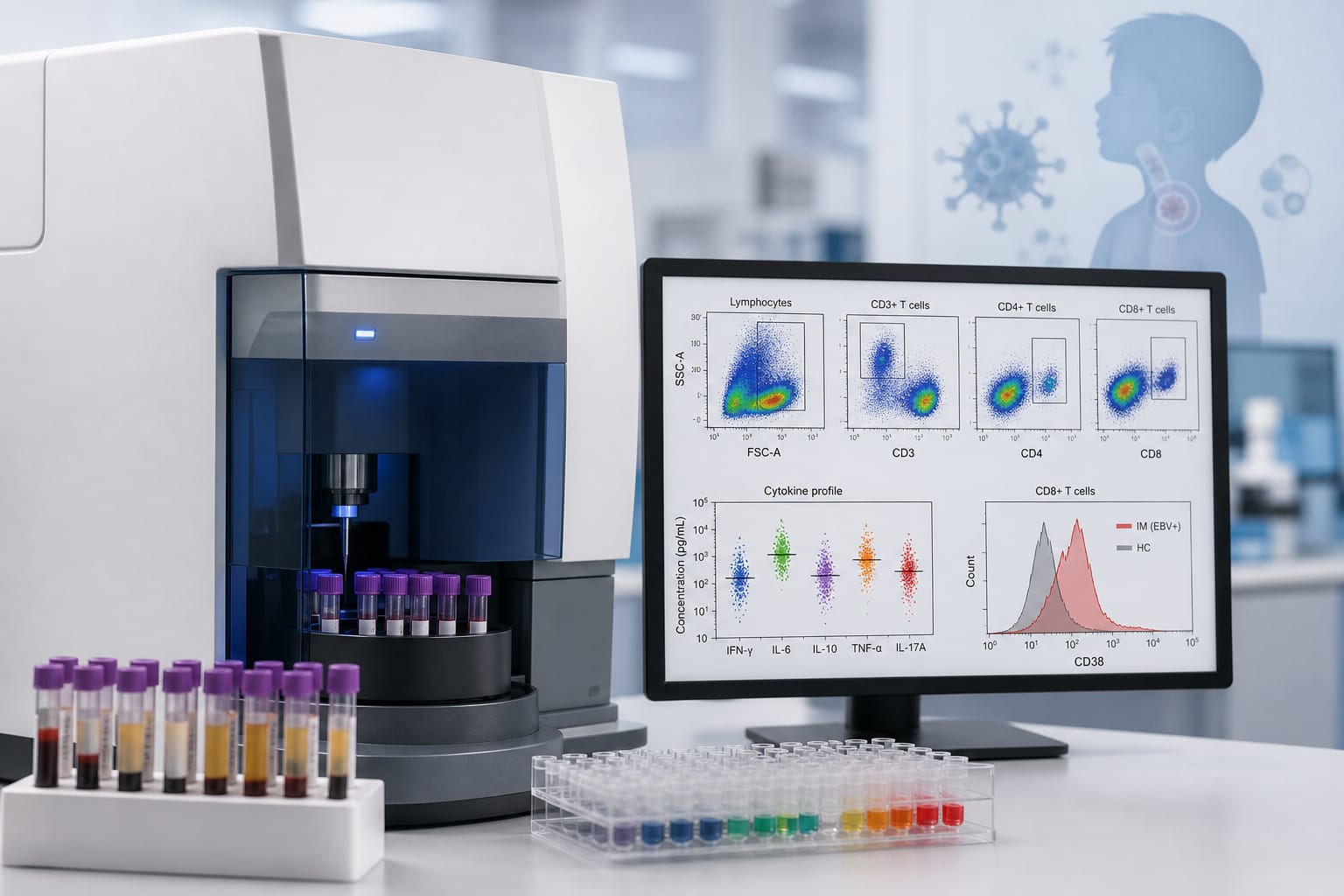
Absolute counts of total lymphocytes, CD3⁺ T cells, and CD8⁺ T cells were significantly higher in the IM group (P < 0.05).
Significant elevation of pro-inflammatory cytokines (IL-6, IL-10, TNF-α, IFN-γ) was observed in the IM group (P < 0.05).
Combined lymphocyte subset analysis yielded an AUC of 0.995, while combined cytokine assessment achieved an AUC of 0.980.
Single biomarkers showed inferior diagnostic performance compared to combined assessments.
Clinical Implications
The study suggests that combined flow cytometric analysis of lymphocyte subsets and cytokine profiles may improve diagnostic accuracy for pediatric infectious mononucleosis. This approach could aid clinicians in differentiating IM from other febrile illnesses more effectively.
Conclusion
The findings indicate that pediatric infectious mononucleosis is associated with significant immune activation.