Variants in UGT1A1 and SLCO1B1 increase the risk of neonatal hyperbilirubinemia: a case-control study in subtropical China - Report - MDSpire

Variants in UGT1A1 and SLCO1B1 increase the risk of neonatal hyperbilirubinemia: a case-control study in subtropical China

  • By

  • Wen-Fang Wang

  • Li-Sen Shi

  • Zeng-Wen Xing

  • Yan-Mei Han

  • Wei-Qiang Liu

  • June 24, 2026

  • 0 min

Share

Genetic Variants in UGT1A1 and SLCO1B1 Elevate Neonatal Hyperbilirubinemia Risk

Overview

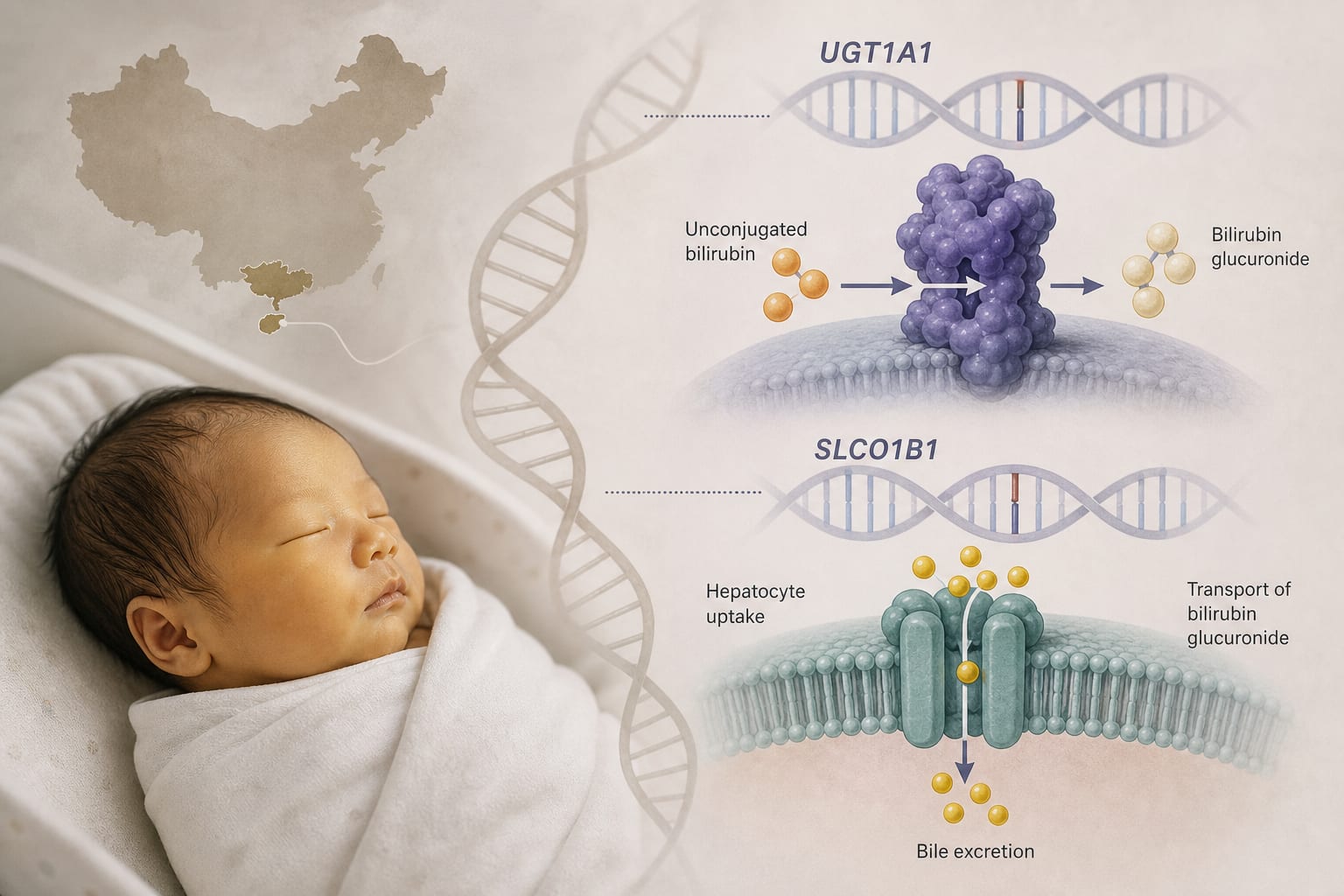
This study identifies associations between genetic variants in UGT1A1 and SLCO1B1 genes and the risk of neonatal hyperbilirubinemia in a subtropical Chinese population.

Background

Neonatal hyperbilirubinemia is a common condition that can lead to severe complications if untreated. This study focuses on the Haikou population in subtropical China, where genetic susceptibility may play a role in disease manifestation.

Data Highlights

Genetic VariantCase Group FrequencyControl Group FrequencyP-value
UGT1A1 rs414832322.14%11.79%< 0.05
SLCO1B1 rs414905619.05%10.26%< 0.05
SLCO1B1 rs414901521.43%11.79%< 0.05

Key Findings

  • The prevalence of preterm births was higher in the hyperbilirubinemia group (16.9%) compared to controls (9.5%) with a P-value of 0.04.
  • UGT1A1 rs4148323 GA genotype was associated with an increased risk of hyperbilirubinemia (OR = 2.370).
  • SLCO1B1 rs4149056 TC genotype was linked to a significant risk increase (OR = 1.594).
  • Carriers of multiple risk alleles (3-4) exhibited a markedly elevated risk of hyperbilirubinemia (adjusted OR = 3.412).
  • Combined genotype analysis showed higher total bilirubin levels in carriers of concurrent genetic variants.

Clinical Implications

The identification of UGT1A1 and SLCO1B1 variants as genetic biomarkers for neonatal hyperbilirubinemia may assist in understanding risk factors associated with this condition.

Conclusion

The study highlights the role of specific genetic variants in the risk of neonatal hyperbilirubinemia.

Related Resources & Content

  1. Pediatric Cardiology, 2020 -- Investigation of Maternal MTHFR Gene SNPs and Homocysteine Levels in Relation to Congenital Heart Defects
  2. The Journal of Clinical Endocrinology & Metabolism, 2025 -- Genetic and Clinical Characteristics of Pediatric Monogenic Diabetes Subtypes: In-Depth Analysis of 138 Cases
  3. Bone Marrow Transplantation, 2024 -- 50th Annual Conference of the European Society for Blood and Marrow Transplantation: Pharmacist Committee – Poster Presentations (P762-P770)
  4. Clinical Rheumatology, 2015 -- Link Between the T Allele of rs2431697 at 5q33.3 and Systemic Lupus Erythematosus: A Case-Control Investigation and Meta-Analysis
  5. Société canadienne de pédiatrie -- Directives de détection et de prise en charge de l’hyperbilirubinémie chez les nouveau-nés à terme et peu prématurés
  6. Pediatric Research, 2025 -- Time to clarify the role of extrahepatic intestinal UGT1A1 in human neonatal bilirubin metabolism
  7. Canadian Paediatric Society Position Statement on Hyperbilirubinemia
  8. Pediatric Research Editorial on UGT1A Region and Neonatal Jaundice
  9. Home phototherapy for neonatal hyperbilirubinemia: a mixed methods systematic review and meta-analysis | Pediatric Research

Original Source(s)

Related Content