Development and validation of an intra-tumoral and peri-tumoral radiomics model based on dynamic contrast-enhanced ultrasound for predicting lymph node metastasis in type 2 diabetic patients with thyroid cancer - Report - MDSpire
Advertisement
Development and validation of an intra-tumoral and peri-tumoral radiomics model based on dynamic contrast-enhanced ultrasound for predicting lymph node metastasis in type 2 diabetic patients with thyroid cancer
Clinical Report: Radiomics Models for Predicting Lymph Node Metastasis in Thyroid Cancer
Overview
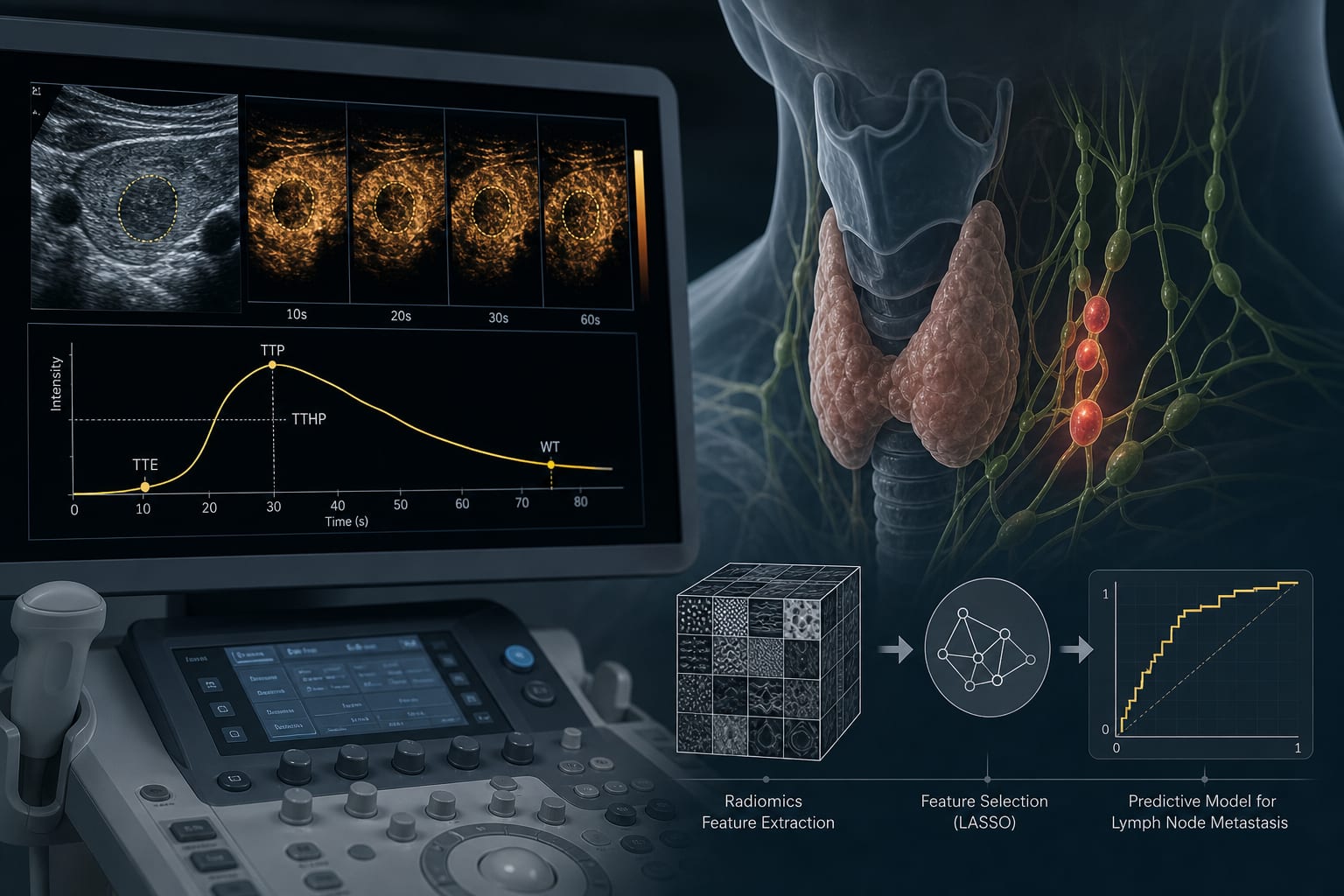
This study developed and validated radiomics models using dynamic contrast-enhanced ultrasound (CEUS) to predict lymph node metastasis (LNM) in thyroid cancer patients with type 2 diabetes. The models demonstrated high accuracy across multiple cohorts.
Background
Thyroid cancer is the most common endocrine malignancy, with lymph node metastasis occurring in 20% to 50% of cases. Type 2 diabetes is increasingly recognized as a risk factor for thyroid cancer. Accurate preoperative assessment of LNM is crucial for guiding surgical strategies in this patient population.
Data Highlights
Cohort
AUC
95% CI
Training
0.930
0.876–0.964
External Validation 1
0.907
0.796–0.968
External Validation 2
0.865
0.739–0.941
Key Findings
The 2 mm peri-tumoral region outperformed the 1 mm region in predicting LNM.
The combined radiomics model achieved AUCs of 0.930, 0.907, and 0.865 across cohorts.
Calibration curves indicated good agreement between predicted and actual outcomes.
Diabetes may increase susceptibility to LNM in thyroid cancer patients.
Clinical Implications
The CEUS-based radiomics models provide a tool for preoperative prediction of LNM in thyroid cancer patients with type 2 diabetes.
Conclusion
The study highlights the effectiveness of CEUS-based radiomics models in predicting lymph node metastasis in a specific patient population.