Systemic immune-inflammation Index is an independent risk factor for Major adverse cardiovascular events in patients with coronary artery ectasia - Report - MDSpire

Systemic immune-inflammation Index is an independent risk factor for Major adverse cardiovascular events in patients with coronary artery ectasia

  • By

  • Deguang Wang

  • Jingxian Xing

  • Zhaoqing Xie

  • Yunlong Zhang

  • Yunjie Wu

  • Tao Geng

  • July 9, 2026

  • 0 min

Share

Clinical Report: The Systemic Immune-Inflammation Index as a Distinct Predictor of Major Adverse Cardiovascular Events in Individuals with Coronary Artery Ectasia

Overview

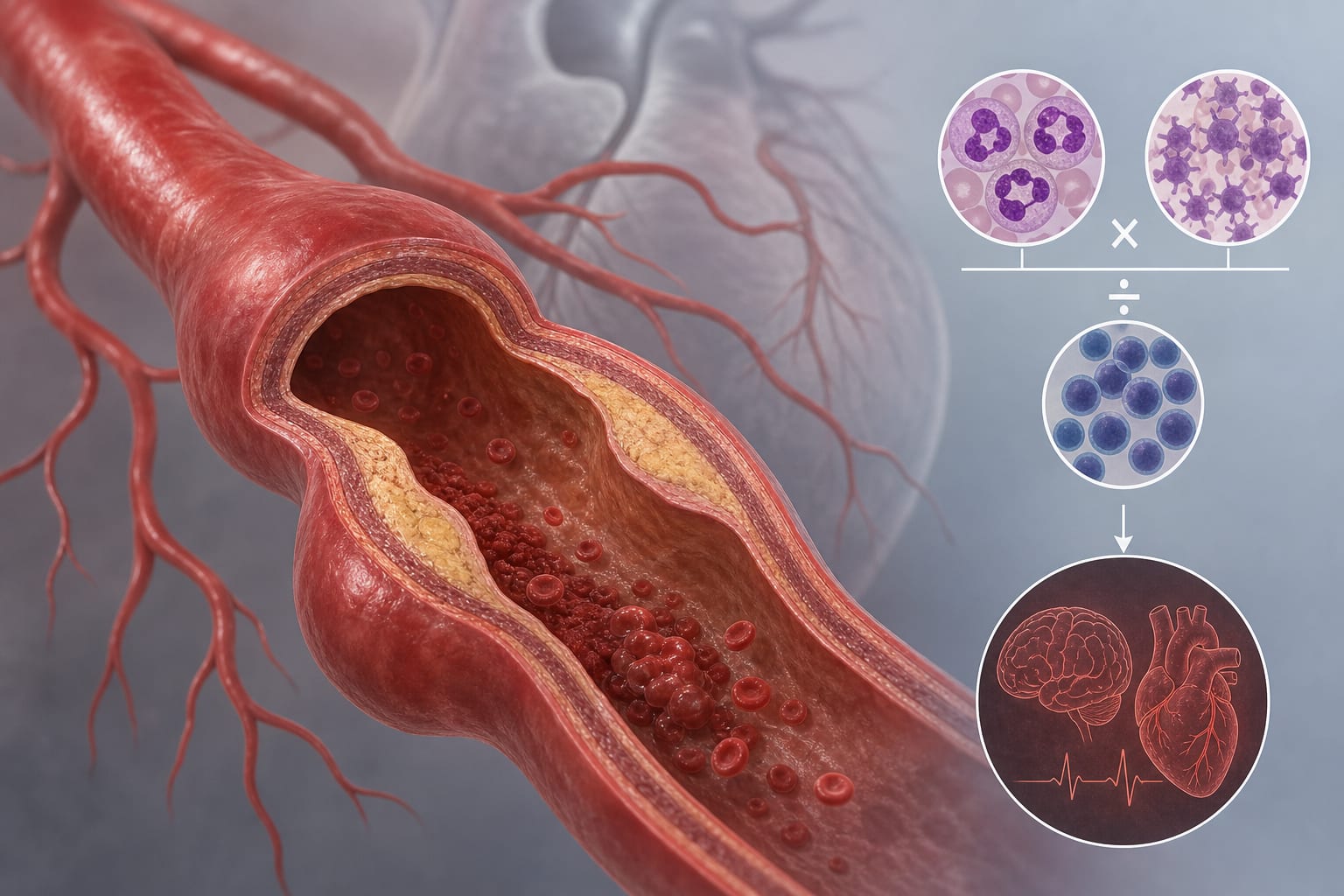
This study evaluates the systemic immune-inflammation index (SII) as an independent predictor of major adverse cardiovascular events (MACE) in patients with coronary artery ectasia (CAE). Findings indicate that elevated SII levels correlate with increased risk of MACE.

Background

Coronary artery ectasia (CAE) is a condition characterized by the dilation of coronary arteries, which can lead to significant cardiovascular events despite the absence of obstructive coronary disease. The systemic immune-inflammation index (SII) may provide insights into the inflammatory status and risk of adverse events in this population.

Data Highlights

ParameterValue
MACE occurrence during follow-up18%
AUC for SII predicting MACE0.81
Optimal SII cut-off value645
Adjusted HR for high vs. low SII2.48
C-statistic increase with SII addition0.72 to 0.83

Key Findings

  • 18% of patients with CAE experienced major adverse cardiovascular events (MACE) during follow-up.
  • Baseline SII levels were significantly higher in patients who developed MACE.
  • ROC analysis showed SII had good discriminatory ability for predicting MACE (AUC 0.81).
  • Kaplan–Meier analysis indicated lower event-free survival in patients with high SII levels.
  • Multivariate Cox regression confirmed SII as an independent predictor of MACE.
  • Incorporating SII into clinical models improved prognostic accuracy significantly.

Clinical Implications

The systemic immune-inflammation index (SII) may serve as a valuable biomarker for risk stratification in patients with coronary artery ectasia.

Conclusion

Elevated SII is an independent predictor of MACE in patients with CAE, enhancing the accuracy of risk assessments.

Related Resources & Content

  1. Frontiers in Neurology, 2026 -- Systemic immune-inflammation index predicts post-thrombectomy outcomes and reveals a mediating role in the association between neurocardiac stress and prognosis: a multicenter study
  2. Clinical Research in Cardiology, 2023 -- A Bio-Psycho-Social Approach Utilizing Machine Learning to Forecast Non-Obstructive and Obstructive Coronary Artery Disease
  3. Frontiers in Endocrinology, 2026 -- Association between systemic inflammation response index and risk of major adverse cardiovascular events in adults with and without metabolic syndrome: a prospective cohort study in Shanghai, Pudong
  4. 2025 Guideline for Acute Coronary Syndromes - Professional Heart Daily | American Heart Association
  5. Unravelling the link between inflammatory biomarkers and coronary artery ectasia severity: a systematic review and meta-analysis | Cardiology | Karger Publishers
  6. Frontiers in Immunology — Pan-immune-inflammation value for risk stratification of adverse cardiovascular outcomes in acute coronary syndrome undergoing percutaneous coronary intervention: a systematic review and meta-analysis
  7. 2025 Guideline for Acute Coronary Syndromes - Professional Heart Daily | American Heart Association
  8. Unravelling the link between inflammatory biomarkers and coronary artery ectasia severity: a systematic review and meta-analysis | Cardiology | Karger Publishers
  9. The association between systemic immune-inflammation index and cardiovascular diseases: An in-depth umbrella review of meta-analyses with GRADE assessment - ScienceDirect

Original Source(s)

Related Content