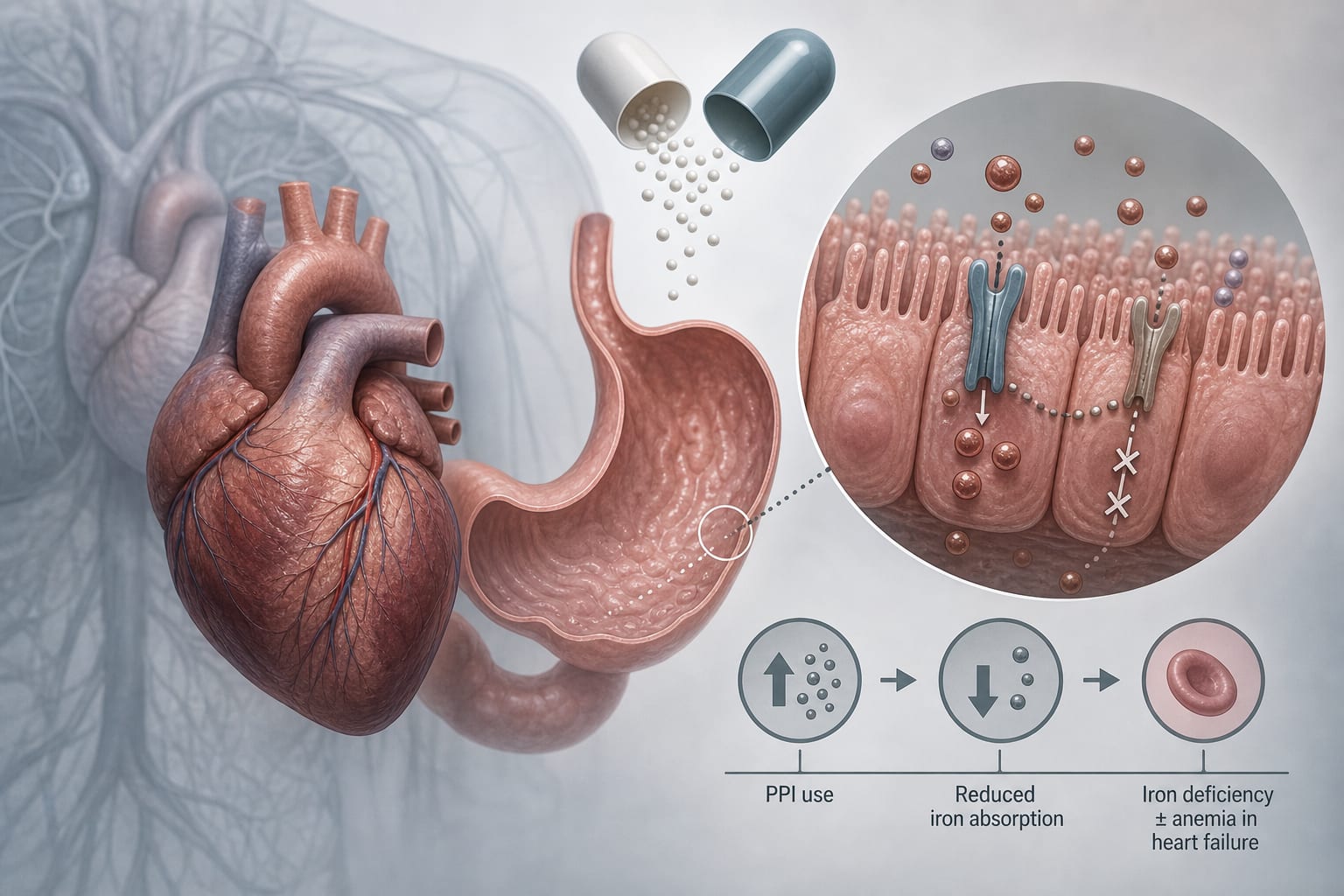
The Role of Proton-Pump Inhibitors as a Modifiable Contributor to Iron Deficiency in Heart Failure Patients
-
By
-
MATS KUTSCHER
-
HAYE H. VAN DER WAL
-
ADRIAAN A. VOORS
-
PETER VAN DER MEER
-
NIELS GROTE BEVERBORG
-
May 13, 2026
Clinical Report: The Role of Proton-Pump Inhibitors as a Modifiable Contributor to Iron Deficiency in Heart Failure Patients
Overview
This post hoc BIOSTAT-CHF analysis examined associations between proton-pump inhibitor (PPI) use and iron deficiency (ID) in 4056 patients with heart failure (HF). PPI users had worse iron status than nonusers, and PPI use remained independently associated with ID after multivariable adjustment.
Background
ID is highly prevalent in HF and is associated with morbidity and worse prognosis, even without anemia. Its etiology is multifactorial and includes fixed and potentially modifiable factors. Because PPI use has been associated with ID in other populations and is common in HF, this study evaluated associations according to PPI use, subtype, and acid-suppressive dose.
Data Highlights
Characteristic | PPI Users (n=1534) | Non-PPI Users (n=2522) |
|---|---|---|
Age (years) | 73 ± 11 | 70 ± 12 |
Diabetes | 35% | 31% |
Chronic Obstructive Pulmonary Disease | 21% | 16% |
Renal Disease | 40% | 32% |
Transferrin Saturation | 16% | 19% |
Serum Iron (µmol/L) | 9 | 10 |
Hemoglobin (g/dL) | 12.88 ± 1.94 | 13.41 ± 1.87 |
Key Findings
PPI use was reported by 1534 patients (38%); users were older and had more comorbidities.
PPI users had lower transferrin saturation, serum iron, hemoglobin, and albumin levels.
PPI use remained independently associated with ID after full adjustment (OR, 1.29; 95% CI, 1.08–1.54; P = .006).
Each 10-mg increase in omeprazole-equivalent dose was associated with greater odds of ID (OR, 1.09; 95% CI, 1.03–1.16; P = .005).
Individual PPI subtypes were not independently associated with ID after adjustment for acid-suppressive potency.
Clinical Implications
The dose-response relationship suggests that the association may be related primarily to the potency of acid inhibition rather than to individual PPI-specific effects. The authors recommend considering more frequent iron-status monitoring in patients with HF receiving PPIs and critically evaluating the indication for continued PPI therapy. Because the study was observational, it cannot establish that PPI use causes ID.
Conclusion
In patients with HF, PPI use was independently associated with ID in a dose-dependent manner. These findings identify PPI exposure as a potentially modifiable contributor to impaired iron status, but causal inference is limited by the observational design and possible residual confounding.
Related Resources & Content
Kutscher M, van der Wal HH, Voors AA, et al. Journal of Cardiac Failure. 2026 — Proton-Pump Inhibitor Use as a Modifiable Etiological Factor for Iron Deficiency in Heart Failure
Alnuwaysir RIS, Hoes MF, van Veldhuisen DJ, et al. Journal of Clinical Medicine. 2021 — Iron deficiency in heart failure: mechanisms and pathophysiology
van der Wal HH, Grote Beverborg N, Dickstein K, et al. European Heart Journal. 2019 — Iron deficiency in worsening heart failure is associated with reduced estimated protein intake, fluid retention, inflammation, and antiplatelet use
McDonagh TA, Metra M, Adamo M, et al. European Heart Journal. 2021 — Corrigendum to: 2021 ESC Guidelines for the diagnosis and treatment of acute and chronic heart failure: developed by the Task Force for the diagnosis and treatment of acute and chronic heart failure of the European Society of Cardiology, with the special contribution of the Heart Failure Association of the ESC
Douwes RM, Gomes-Neto AW, Eisenga MF, et al. Journal of Clinical Medicine. 2019 — Chronic use of proton-pump inhibitors and iron status in renal transplant recipients
Tran-Duy A, Connell NJ, Vanmolkot FH, et al. Journal of Internal Medicine. 2019 — Use of proton pump inhibitors and risk of iron deficiency: a population-based case-control study
Voors AA, Anker SD, Cleland JG, et al. European Journal of Heart Failure. 2016 — A systems BIOlogy Study to TAilored Treatment in Chronic Heart Failure: rationale, design, and baseline characteristics of BIOSTAT-CHF
Kirchheiner J, Glatt S, Fuhr U, et al. European Journal of Clinical Pharmacology. 2009 — Relative potency of proton-pump inhibitors: comparison of effects on intragastric pH
Hamano H, Niimura T, Horinouchi Y, et al. Toxicology Letters. 2020 — Proton pump inhibitors block iron absorption through direct regulation of hepcidin via the aryl hydrocarbon receptor-mediated pathway
Based on findings from:
Proton-Pump Inhibitor Use as a Modifiable Etiological Factor for Iron Deficiency in Heart Failure
MATS KUTSCHER, HAYE H. VAN DER WAL, ADRIAAN A. VOORS, PETER VAN DER MEER, NIELS GROTE BEVERBORG. Journal Of Cardiac Failure, 2026.
https://onlinejcf.com/article/s1071-9164(26)00230-7/fulltext
This content is an AI-generated, fully rewritten summary based on a published scholarly article. It does not reproduce the original text and is not a substitute for the original publication. Readers are encouraged to consult the source for full context, data, and methodology.