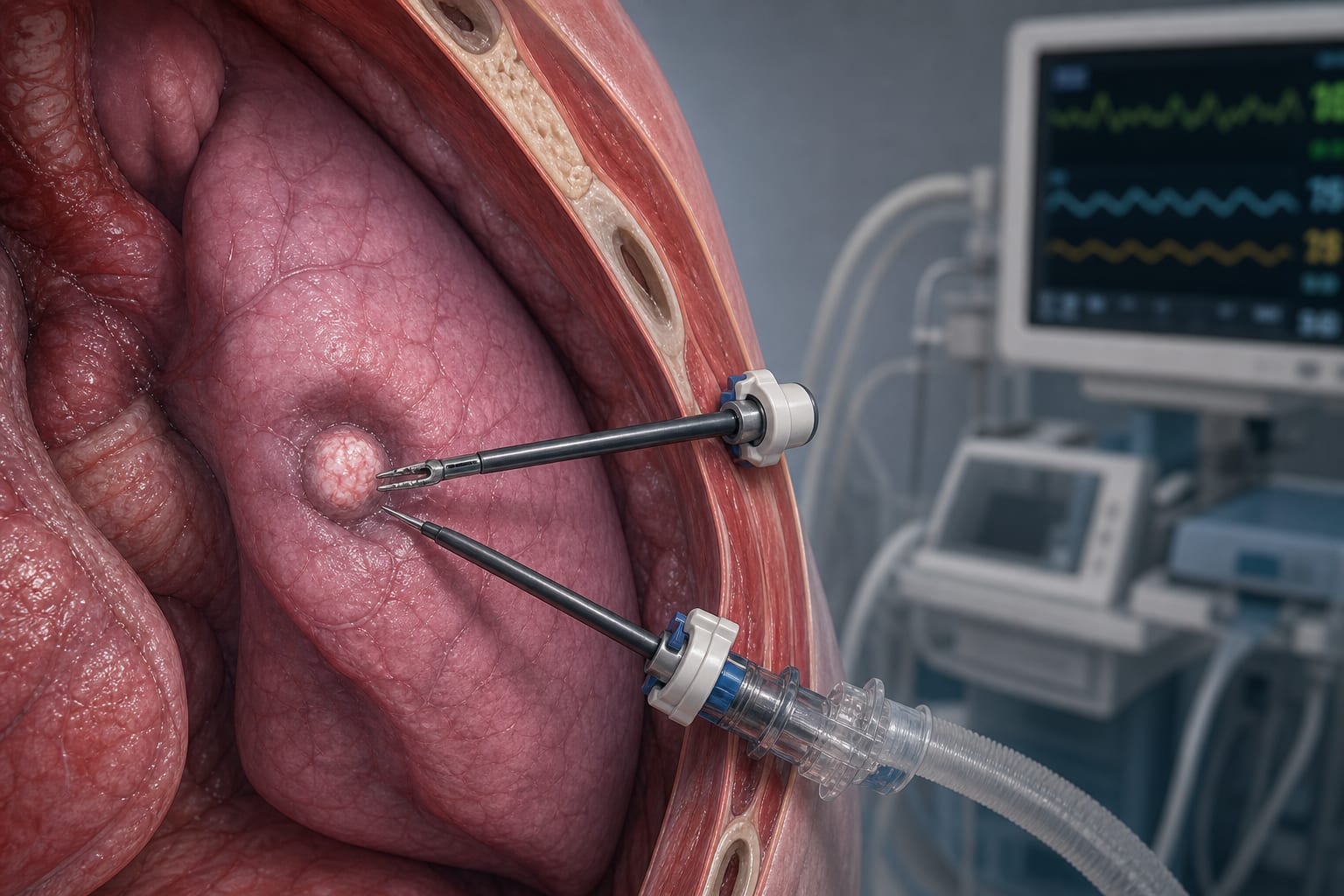
Progress in Tubeless Thoracic Surgery for Pulmonary Nodules: Present Insights and Future Obstacles
-
By
-
Hengyu Li
-
Lei Zhao
-
Hui Tian
-
May 25, 2026
Clinical Report: Progress in Tubeless Thoracic Surgery for Pulmonary Nodules
Overview
Revise to clarify the uncertainty regarding long-term oncological safety with specific references to studies or data.
Background
Lung cancer is the leading cause of cancer-related deaths globally, with early detection of pulmonary nodules critical for improving outcomes. Traditional surgical methods, while effective, often result in significant postoperative complications and prolonged recovery. Tubeless thoracic surgery offers a minimally invasive alternative that may enhance recovery and reduce hospital stays.
Data Highlights
Revise to reflect that while no formal data was presented, anecdotal evidence or qualitative findings should be mentioned.Key Findings
- Tubeless surgery may reduce laryngeal edema, postoperative nausea, and pain.
- Hospital stays are potentially shorter with tubeless techniques.
- Risks include intraoperative hypercapnia and possible conversion to intubation.
- Long-term oncological safety of tubeless approaches is not yet confirmed.
- Future integration of technologies like electromagnetic navigation and AI is anticipated to enhance outcomes.
Clinical Implications
Suggest specific criteria for patient selection to enhance clarity on who may benefit from tubeless surgery.
Conclusion
Reiterate the need for specific future research directions or types of studies needed to confirm safety and efficacy.
Related Resources & Content
- Society of Thoracic Surgeons, ScienceDirect, 2025 -- Expert Consensus Document on Interventions for Screen-Detected Lung Nodules
- BMC Anesthesiology, Springer Nature, 2025 -- Comparison of non-intubated and intubated video-assisted thoracoscopic surgery for perioperative complications
- The Cardiothoracic Surgeon, Springer Nature, 2026 -- Tube or tubeless? Non-intubated VATS as a contemporary strategy in thoracic surgery
- Surgical Endoscopy — Evaluating Safety and Influential Factors in Diagnostic Outcomes of Modified Virtual Bronchoscopy for Accessing Pulmonary Nodules
- Updates in Surgery — Enhancing Sensory Awareness: Utilizing Intraoperative Lung Ultrasound for Accurate Localization of Pulmonary Nodules in Robotic Thoracic Surgery
- Updates in Surgery — Benefits of Utilizing Preoperative 3D Reconstruction Compared to 2D-CT in Thoracoscopic Segmentectomy
- Frontiers in Pediatrics — Robotic-Assisted Thoracic Surgery in Children with Congenital Lung Disease: Advancements, Challenges, and Future Directions
- Evaluating Safety and Influential Factors in Diagnostic Outcomes of Modified Virtual Bronchoscopy for Accessing Pulmonary Nodules
- Enhancing Sensory Awareness: Utilizing Intraoperative Lung Ultrasound for Accurate Localization of Pulmonary Nodules in Robotic Thoracic Surgery
- Benefits of Utilizing Preoperative 3D Reconstruction Compared to 2D-CT in Thoracoscopic Segmentectomy
- The Society of Thoracic Surgeons (2025) Expert Consensus Document on Interventions for Screen-Detected Lung Nodules - ScienceDirect
- Comparison of non-intubated and intubated video-assisted thoracoscopic surgery for perioperative complications—a systematic review and meta-analysis | BMC Anesthesiology | Springer Nature Link
- Tube or tubeless? Non-intubated VATS as a contemporary strategy in thoracic surgery | The Cardiothoracic Surgeon | Springer Nature Link
- Optimal Suction Strategy After Pulmonary Resection Using a Digital Drainage System With a Single Blake Drain: A Randomized Study - Conor M. Maxwell, Benny Weksler, Kevin Shahbahrami, Brent Williams, Kurt DeHaven, Pam Kuchta, Kara Specht, Hiran C. Fernando, 2025
- (PDF) A Novel Same Day Discharge Program After Pulmonary Wedge Resection: A Prospective Clinical Trial
- Segmentectomy versus lobectomy in non-small-cell lung cancer with pathologically invasive features: a post-hoc supplementary analysis of a multicenter, Phase 3 trial JCOG0802/WJOG4607L - PubMed
Based on findings from:
Research advances of tubeless thoracic surgery for pulmonary nodules: current status and future challenges
Hengyu Li, Lei Zhao, Hui Tian. Frontiers In Surgery, 2026.
https://www.frontiersin.org/journals/surgery/articles/10.3389/fsurg.2026.1834893/full
This content is an AI-generated, fully rewritten summary based on a published scholarly article. It does not reproduce the original text and is not a substitute for the original publication. Readers are encouraged to consult the source for full context, data, and methodology.