A novel H2A-A127 variant is associated with human cancer and enhances tumor-related phenotypes in Drosophila melanogaster models - Report - MDSpire

A novel H2A-A127 variant is associated with human cancer and enhances tumor-related phenotypes in Drosophila melanogaster models

  • By

  • Zeinab AlHajj Hassan

  • Hassan Dakik

  • Patricia Arreba-Tutusaus

  • Felice Frey

  • Sarah Mantash

  • Amanda Mitchell

  • Meaghan Boileau

  • Sagi Abelson

  • Malak Kleit

  • Zahraa Hayek

  • Jana Awada

  • Roy El Darzi

  • Kolja Eppert

  • Margret Shirinian

  • July 13, 2026

Share

Clinical Report: A new variant of H2A-A127 linked to human cancers

Overview

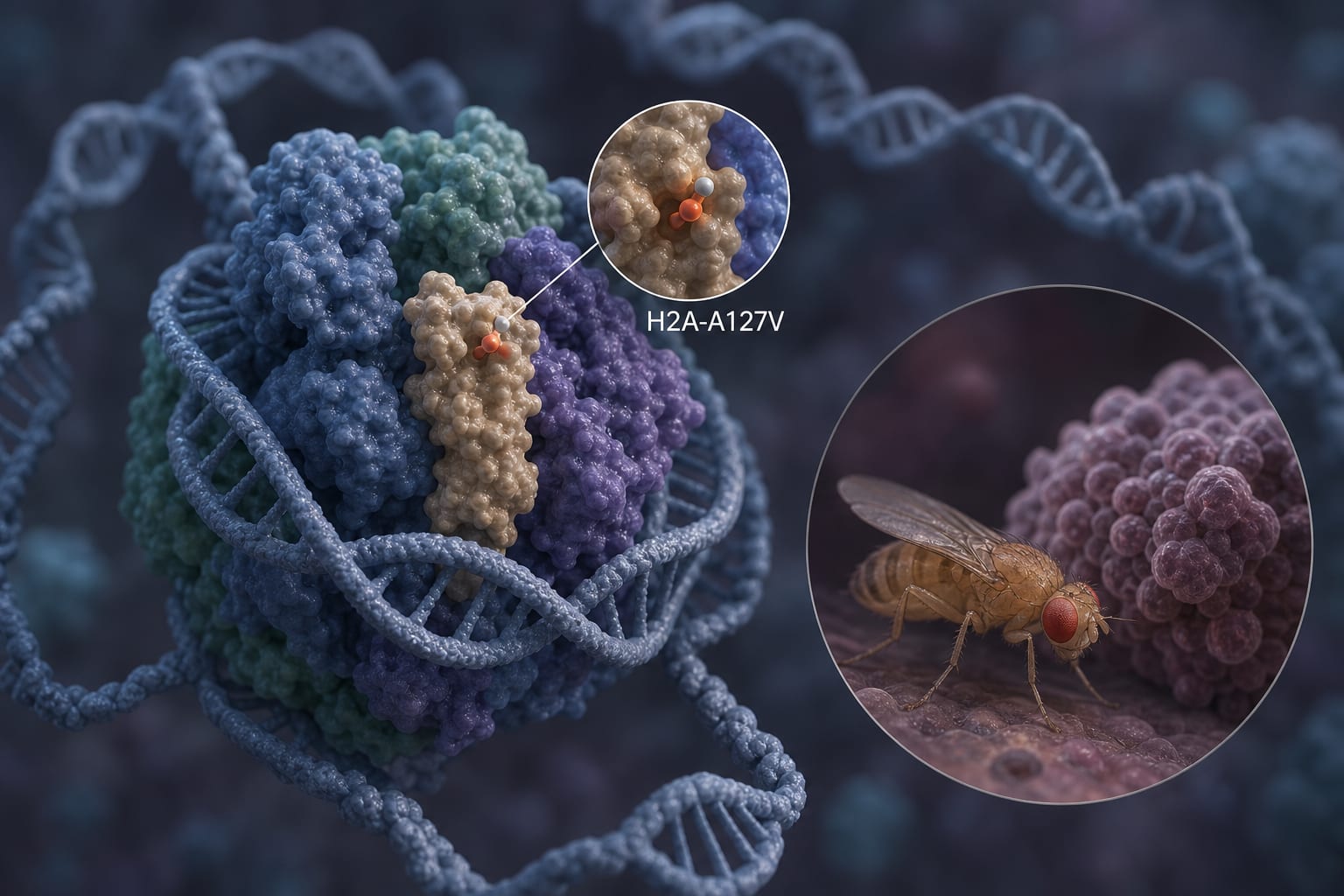
The study identifies a novel histone variant, H2A-A127V, associated with acute myeloid leukemia (AML) and solid tumors. Functional assays in Drosophila models demonstrate its role in promoting tumor characteristics and tissue overgrowth.

Background

Acute Myeloid Leukemia (AML) is characterized by genetic and epigenetic dysregulation, making the identification of mutations critical for understanding disease mechanisms. Histone mutations, particularly in histone H3, have been linked to cancer progression, yet mutations in histone H2A genes have been less explored. This study highlights the importance of considering duplicated histone genes in mutation analyses to enhance our understanding of oncogenesis.

Data Highlights

The H2A-A127V variant was identified in AML and solid tumors, with a prevalence of 1.44% in the 1000 Genomes Project.

Key Findings

  • A recurrent Alanine to Valine substitution at position 127 (H2A-A127V) was identified in AML and solid tumors.
  • H2A-A127V promotes eye tumor phenotypes in Drosophila melanogaster models.
  • Downregulation of E(z) in the presence of H2A-A127V enhances ectopic growth.
  • Histone genes H2AC18 and H2AC19, which share identical sequences, have been largely overlooked in mutation analyses.

Clinical Implications

The identification of the H2A-A127V variant suggests a need for more comprehensive genetic profiling in AML and other cancers.

Conclusion

This study uncovers a novel cancer-associated histone variant.
Related Resources & Content

  1. Doehner H. et al., Blood, 2022 -- Diagnosis and management of AML in adults: 2022 recommendations from an international expert panel on behalf of the ELN
  2. Frontiers in Immunology — HNRNPA2B1 as an emerging coordinator of RNA fate in cancer: m6A reading, RNA export, translation reprogramming, and immune–metabolic adaptation
  3. Frontiers in Medicine — Locus-specific HERV expression identifies an aggressive, NK-depleted, checkpoint-refractory acral melanoma phenotype
  4. The Journal of Infectious Diseases — Avian Influenza Virus A(H5N1) Genotype D1.1 Is Better Adapted to Human Nasal and Airway Organoids Than Genotype B3.13
  5. Gastric Cancer — Genomic Characteristics of a Mouse Model for Diffuse-Type Gastric Adenocarcinoma
  6. NCCN Guidelines® Insights: Acute Myeloid Leukemia, Version 3.2026
  7. Azacitidine and Venetoclax in Previously Untreated Acute Myeloid Leukemia
  8. bloodBLD2022016867.pdf
  9. https://www.hematology.org/-/media/hematology/files/clinicians/guidelines/ash-guidelines-update-2025/aml-summary-of-changes-final.pdf
  10. Quizartinib in newly diagnosed patients with FLT3-ITD-positive AML who received maintenance therapy in QuANTUM-First - PubMed
  11. Gilteritinib or Chemotherapy for Relapsed or Refractory FLT3-Mutated AML | New England Journal of Medicine
  12. Ivosidenib and Azacitidine in IDH1-Mutated Acute Myeloid Leukemia | New England Journal of Medicine
  13. Efficacy of hypomethylating agents in combination with venetoclax in relapsed/refractory acute myeloid leukemia: A systematic review and meta-analysis - PubMed
  14. FDA approves revumenib for relapsed or refractory acute leukemia with a KMT2A translocation | FDA
  15. Revumenib: First Approval - PubMed
  16. The role of ASXL1, SRSF2, and EZH2 mutations in chromatin dysregulation of myelodysplastic neoplasia and acute myeloid leukemia | Leukemia

Original Source(s)

Related Content