The TREM2 paradox in fibrosis: a unified mechanism for opposite outcomes across organs - Report - MDSpire

The TREM2 paradox in fibrosis: a unified mechanism for opposite outcomes across organs

  • By

  • Xiuping Liang

  • Yanhong Li

  • Ziyi Tang

  • Guan Wang

  • Yi Liu

  • June 16, 2026

  • 0 min

Share

Clinical Report: The Dual Role of TREM2 in Fibrosis

Overview

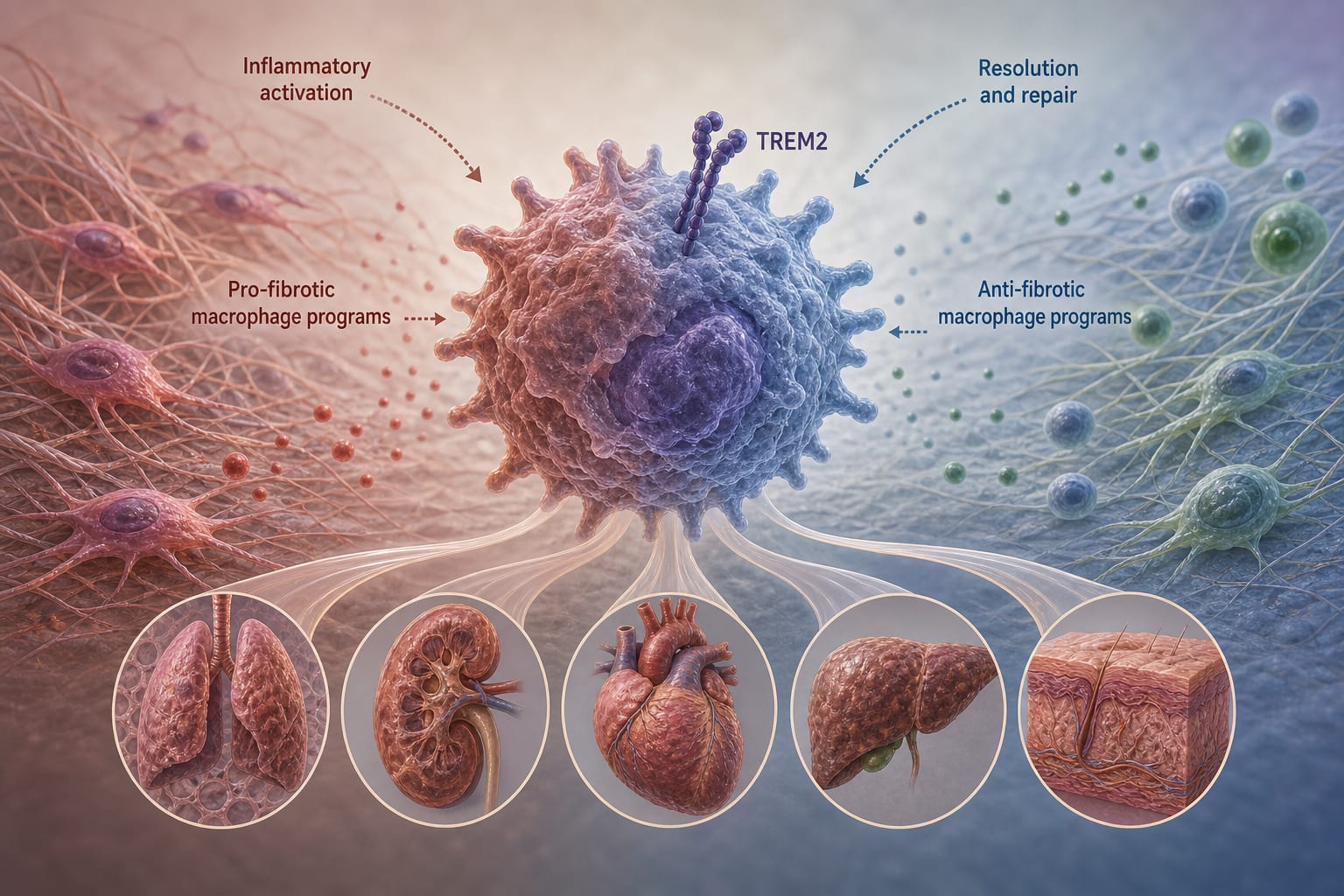
This review explores the dual role of TREM2 in organ fibrosis, highlighting its influence on macrophage polarization and tissue repair mechanisms. It emphasizes the organ-specific effects of TREM2, which can either promote or inhibit fibrosis depending on the context, as supported by various studies.

Background

Organ fibrosis is a significant consequence of chronic diseases, resulting from the interplay between inflammation and tissue repair. Understanding the mechanisms governing fibrosis is crucial for developing targeted therapies. TREM2, a receptor on myeloid cells, plays a pivotal role in regulating these processes, as evidenced by its contradictory roles across different organs.

Data Highlights

No numerical data or trial data presented in the article.

Key Findings

  • TREM2 is primarily expressed on macrophages and regulates inflammation and fibrosis, as shown in multiple studies.
  • In liver fibrosis, TREM2 enhances collagen degradation and inhibits hepatic stellate cell activation, according to specific research.
  • In pulmonary fibrosis, TREM2 expression correlates positively with fibrosis severity, based on recent findings.
  • TREM2's role in fibrosis is influenced by its ability to modulate macrophage polarization and immunometabolic reprogramming, as indicated in the literature.
  • Soluble TREM2 (sTREM2) has potential as a dynamic biomarker in fibrotic diseases, supported by current research.

Clinical Implications

Understanding the organ-specific roles of TREM2 could inform the development of tailored interventions, as suggested by recent studies.

Conclusion

The dual role of TREM2 in fibrosis highlights the complexity of macrophage interactions in different organ contexts, necessitating further research to clarify its roles.
Related Resources & Content

  1. Frontiers in Immunology, 2026 -- Canonical and emerging regulatory mechanisms of tissue remodeling: shared principles across organs and therapeutic opportunities
  2. Acta Neuropathologica, 2023 -- Regional Variations in TREM2 Gene Expression Linked to Alzheimer’s Disease Neuropathology: Insights into Cortical and Subcortical Microglial Function
  3. Journal of Gastroenterology, 2026 -- Single-cell analysis reveals crosstalk between TREM1-positive myeloid cells and cancer-associated fibroblasts in colorectal cancer progression
  4. Basic Research in Cardiology — Loss of Fn14 Receptor Mitigates Right Ventricular Fibrosis and Impairment
  5. Idiopathic Pulmonary Fibrosis (an Update) and Progressive Pulmonary Fibrosis in Adults: An Official ATS/ERS/JRS/ALAT Clinical Practice Guideline
  6. Summary for Clinicians: Clinical Practice Guideline for the Treatment of Systemic Sclerosis-associated Interstitial Lung Disease: Evidence-based Recommendations
  7. Clinical Assessment and Management of Metabolic Dysfunction-Associated Steatotic Liver Disease
  8. KDIGO 2024 CLINICAL PRACTICE GUIDELINE
  9. A Phase 3, Randomized, Controlled Trial of Resmetirom in NASH with Liver Fibrosis - PubMed
  10. Summary for Clinicians: Clinical Practice Guideline for the Treatment of Systemic Sclerosis–associated Interstitial Lung Disease: Evidence-based Recommendations | Annals of the American Thoracic Society
  11. TREM2 promotes lung fibrosis via controlling alveolar macrophage survival and pro-fibrotic activity | Nature Communications
  12. TREM2-expressing macrophages in liver diseases - ScienceDirect
  13. Exosomes derived from TREM-2 knocked-out macrophages alleviated renal fibrosis via HSPa1b/AKT pathway - PubMed

Original Source(s)

Related Content