An exploratory multimodal imaging and clinicopathological strategy for suspected Kümmell’s disease in the absence of MRI - Report - MDSpire

An exploratory multimodal imaging and clinicopathological strategy for suspected Kümmell’s disease in the absence of MRI

  • By

  • Buqing Ma

  • Guanxiong Wang

  • Baokun Lin

  • Dongxu Yang

  • Yijing Fang

  • Yihao Zhu

  • Zibin Li

  • Chang Liu

  • Jie Ding

  • Jiayang Li

  • Haoyang Rao

  • Bin Mai

  • Zhen Zhang

  • Guoye Mo

  • Huizhi Guo

  • Danqing Guo

  • Yanhuai Ma

  • Yuewei Lin

  • Yongchao Tang

  • Kai Yuan

  • Shuncong Zhang

  • Haishan Li

  • Yongxian Li

  • July 9, 2026

  • 0 min

Share

Clinical Report: A Novel Multimodal Diagnostic Approach for Suspected Kümmell’s Disease

Background

Kümmell’s disease is a delayed complication of osteoporotic vertebral compression fractures, often leading to significant clinical symptoms. Accurate diagnosis is challenging, particularly in patients with contraindications for MRI, which is the gold standard for soft tissue imaging. This study addresses the need for alternative diagnostic pathways that integrate various imaging modalities.

Data Highlights

No numerical data or trial data was provided in the source material.

Key Findings

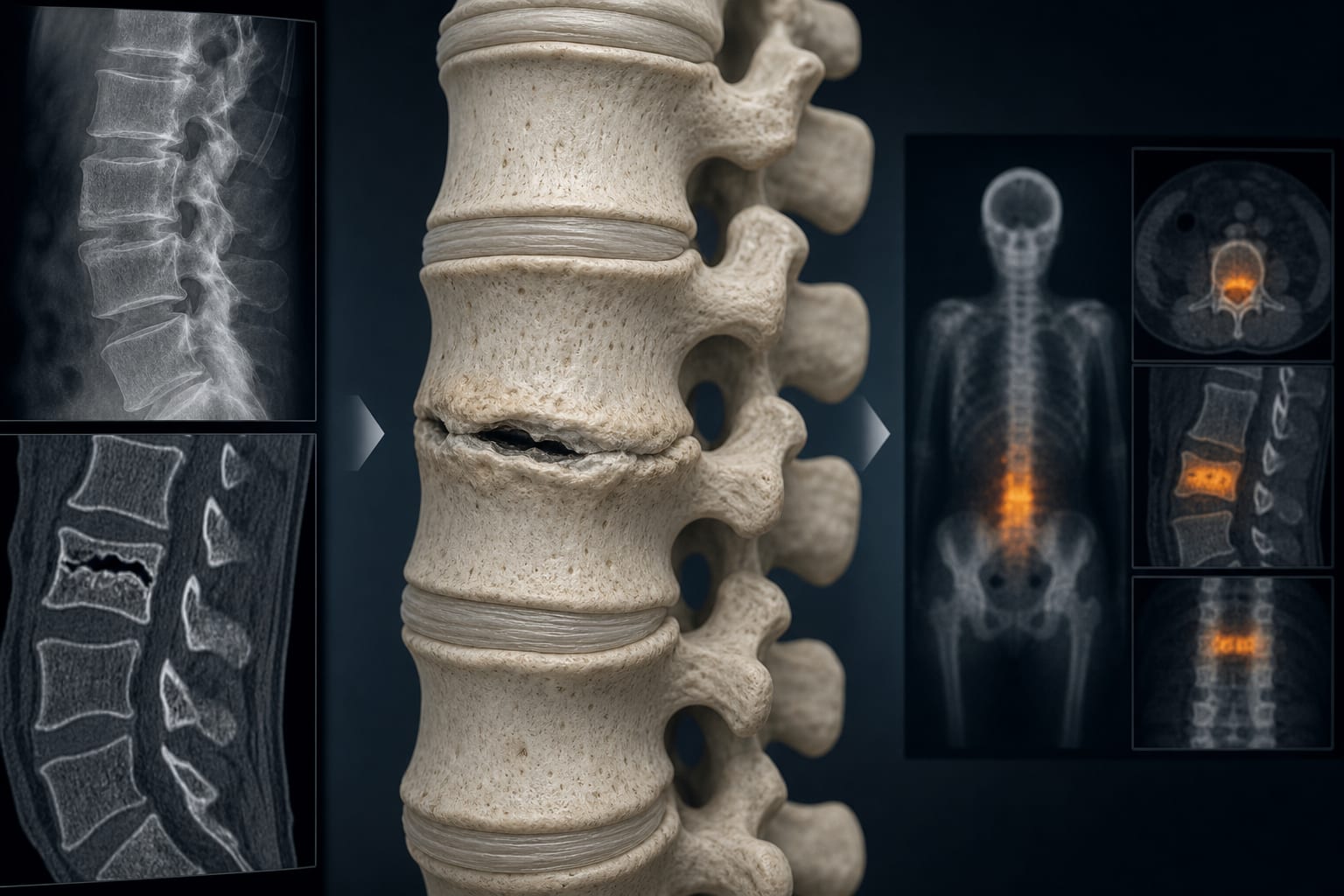
  • CT scans provided conclusive anatomical evidence of vertebral injury and instability.
  • Emission computed tomography (ECT) identified lesions with varying metabolic activity.
  • The combination of imaging modalities offered convergent evidence supportive of KD diagnosis.
  • Initial screening focused on older women with severe osteoporosis.
  • The proposed multimodal approach may address limitations of single-modality assessments.

Clinical Implications

The integration of CT and ECT imaging may enhance diagnostic accuracy for KD in patients unable to undergo MRI.

Conclusion

A multimodal diagnostic approach combining CT and ECT imaging presents a feasible alternative for diagnosing Kümmell’s disease in patients with MRI contraindications.

Related Resources & Content

  1. European Radiology, 2024 -- Evaluating the Role of 3D Real-IR Delayed Post-Gadolinium MRI Parameterization on Diagnostic Efficacy and Descriptor Selection in Ménière’s Disease
  2. Clinical Research in Cardiology, 2020 -- Evaluating the Diagnostic Utility of Cardiovascular Magnetic Resonance Versus Endomyocardial Biopsy in Cardiac Amyloidosis: A Multi-Center Analysis
  3. European Radiology, 2025 -- Enhancing Whole-Body MRI Techniques for Early Cancer Identification in Li-Fraumeni Syndrome: A Prospective Bicentric Investigation
  4. European Radiology, 2024 -- Evaluating Key MRI Features for the Diagnosis of Ménière’s Disease and the Importance of Vestibular Aqueduct Analysis
  5. ACR Appropriateness Criteria, 2026 -- Evaluating the Role of Imaging in Kümmell’s Disease
  6. ScienceDirect, 2025 -- Is fixation beneficial in Kümmell's disease? A metaanalysis of clinical and radiological outcomes
  7. PubMed, 2023 -- Fast kilovoltage peak-switching dual-energy computed tomography water-hydroxyapatite decomposition for detecting vertebral compression fracture-related bone marrow edema: a comparison with magnetic resonance imaging
  8. https://acsearch.acr.org/list/GenerateAppendixPDF?PanelName=Interventional+Radiology&TopicId=171
  9. Is fixation beneficial in Kümmell's disease? A metaanalysis of clinical and radiological outcomes - ScienceDirect
  10. Fast kilovoltage peak-switching dual-energy computed tomography water-hydroxyapatite decomposition for detecting vertebral compression fracture-related bone marrow edema: a comparison with magnetic resonance imaging - PubMed

Original Source(s)

Related Content