Smartphone-Based Monitoring of Quality of Life and Adverse Events After Neurosurgery: Prospective Cohort Study - Report - MDSpire
Coming Soon: Introducing MDSpire News. Learn more
Conexiant’s news site is now MDSpire News. Learn more

Mobile Device Monitoring of Patient Well-Being and Complications Following Neurosurgical Procedures: A Prospective Cohort Investigation

  • By

  • Alexis Paul Romain Terrapon

  • Erik Schulz

  • Athina Firtinidou

  • Silvio Heinig

  • Lorenzo Bertulli

  • Felix Corr

  • Meltem Gönel

  • Maria Nikolaeva

  • Thomas Petutschnigg

  • Sivani Sivanrupan

  • Jakob Heimer

  • Menno R Germans

  • Christian Zweifel

  • Andreas Raabe

  • Philippe Schucht

  • Luca Regli

  • Marian Christoph Neidert

  • Oliver Bozinov

  • Linda Bättig

  • Martin Nikolaus Stienen

  • September 9, 2026

Share

Mobile Device Monitoring of Patient Well-Being and Complications Following Neurosurgical Procedures

Overview

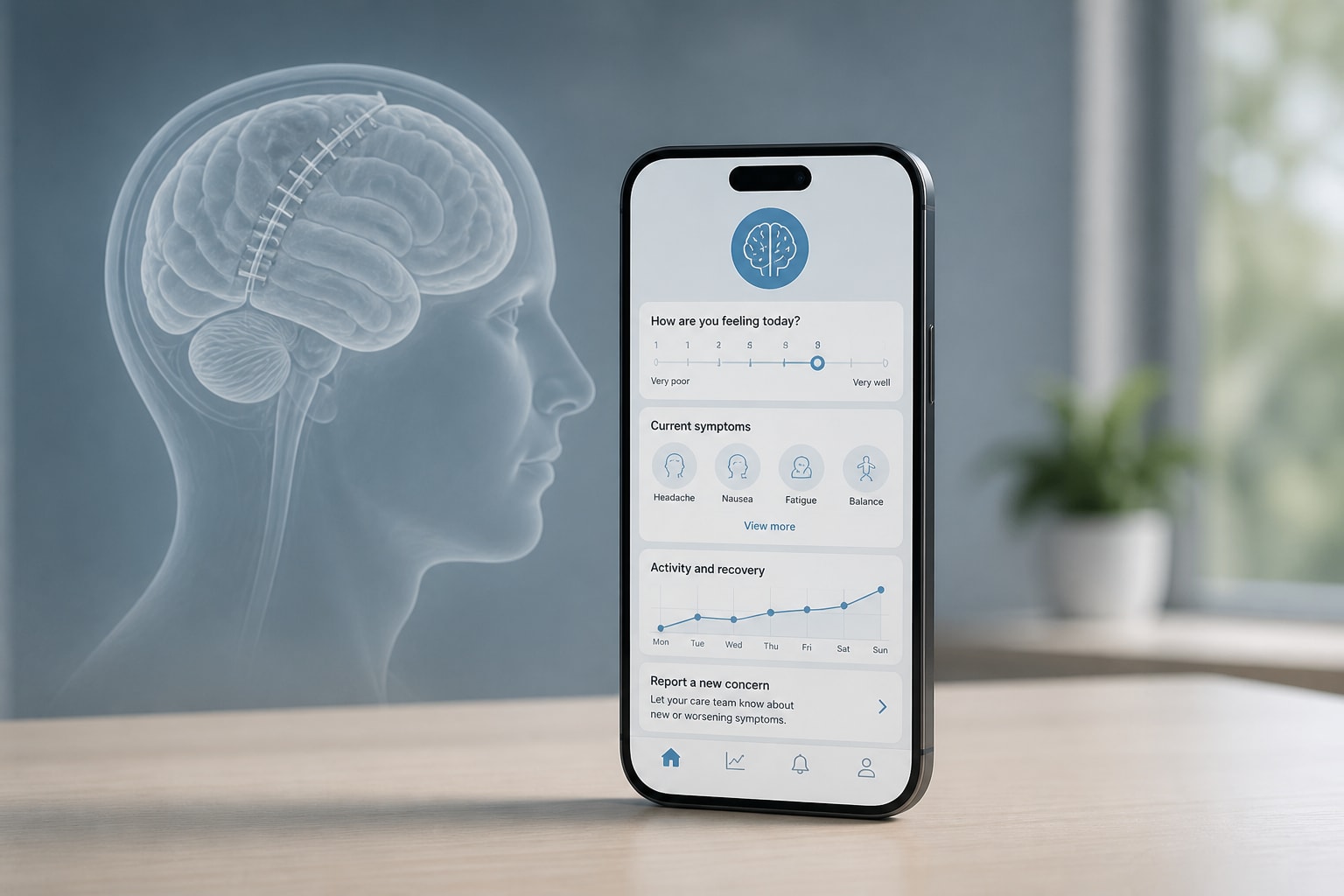
This study investigates the use of a smartphone application, OP Tracker, to monitor patient well-being and complications after neurosurgery.

Background

Understanding the impact of surgical procedures and adverse events on patient well-being is crucial for informed decision-making in neurosurgery. Traditional methods of outcome assessment are often limited and may overlook important patient-reported outcomes.

Data Highlights

No specific numerical data or trial results were provided in the source material.

Key Findings

  • The Therapy-Disability-Neurology (TDN) grade was introduced to better classify adverse events in neurosurgery.
  • Previous studies have shown that the TDN grade correlates with functional outcomes and hospital length of stay.
  • Mobile applications like OP Tracker can facilitate longitudinal assessment of patient well-being.
  • There is a lack of standardized grading systems that adequately capture patient experiences related to adverse events.
  • Smartphone adoption across demographics presents an opportunity for improved patient monitoring.

Clinical Implications

Clinicians may consider utilizing mobile monitoring tools in postoperative care.

Conclusion

The study presents the use of mobile applications in assessing patient well-being following neurosurgical procedures.

Related Resources & Content

  1. Terrapon AP, Zattra CM, Voglis S, et al., Neurosurgery, 2021 -- Adverse events in neurosurgery: the novel Therapy-Disability-Neurology grade
  2. Knight SR, Ng N, Tsanas A, et al., NPJ Digit Med, 2021 -- Mobile devices and wearable technology for measuring patient outcomes after surgery: a systematic review
  3. Evaluating the Effects of Postoperative Complications in Neurosurgery Through Longitudinal Assessments Using Smartphone Applications
  4. Obesity Surgery — Insights Gained from Remote Monitoring in an Outpatient Bariatric Surgery Program—Secondary Findings from a Patient Preference Clinical Trial
  5. Evaluating Three Years of Same-Day Discharge and Remote Patient Monitoring in Bariatric Surgery: Insights Beyond Healthdot
  6. Evaluation of the Feasibility and Acceptance of Telemonitoring Patient-Generated Health Data During Perioperative Care in Gastrointestinal Cancer Surgery: A Randomized Controlled Trial
  7. American Association of Neurological Surgeons and Congress of Neurological Surgeons Statement
  8. NINDS Common Data Elements
  9. International survey-based assessment of the reliability, validity, and interpretability of the TDN grade for neurosurgical adverse events | Scientific Reports
  10. Comparative effectiveness of remote perioperative telemonitoring in cancer surgery: a randomized trial | npj Digital Medicine
  11. Continuous Vital Sign Monitoring at the Surgical Ward for Improved Outcomes After Major Noncardiac Surgery: A Randomized Clinical Trial - PMC
  12. Discharge with a smartphone application for follow-up after day care surgery: a randomised controlled trial - ScienceDirect
  13. Study Details | NCT06352710 | Determining Postoperative Recovery and the Impact of Adverse Events in Neurosurgery Based on Self-reported, App-based Longitudinal Assessment | ClinicalTrials.gov
  14. Mobile applications in enhanced recovery after surgery: a systematic review of protocol adherence and outcomes - PMC
  15. A systematic review of the impacts of remote patient monitoring (RPM) interventions on safety, adherence, quality-of-life and cost-related outcomes | npj Digital Medicine
  16. Enhanced Recovery After Surgery for Craniotomies: A Systematic Review and Meta-analysis - PubMed

Original Source(s)

Related Content